
William G. Witt

August 19, 2015

Objections to My Essays on Women’s Ordination

Filed under: Theology,Women's Ordination — William Witt @ 6:39 am
ship

I am pleased to discover that someone actually takes the time to read my blog. An Anglican deacon named Christopher Little has taken the time to address my series of essays on women’s ordination. I am happy to have my views challenged. I believe that what I have written is defensible, but, if not, the sooner I am corrected, the better. Little begins by addressing my first essay, “Concerning the Ordination of Women: Preliminaries.”

I began that essay by noting the names of a number of contemporary orthodox theologians and biblical scholars who embrace women’s ordination: T. F. Torrance, Ben Witherington, N.T. Wright, Richard Hays, Michael Gorman, Robert Gagnon, and Alan Padgett.

Deacon Little comments:

Now, it’s of course fallacious to argue or even imply that because a number of noted “orthodox Christians” defend women’s ordination (“WO” going forward) that Witt therefore stands in good company. It may be the fact that each and every one of these ostensibly orthodox Christians happens to be heretical on this particular issue, and defenders of the traditional view believe that they are in fact so, their commendable orthodoxy on all the other issues not withstanding. Also fallacious is the argument that “the number of orthodox Christians endorsing WO is not a small or insignificant group.” Size doesn’t matter in this discussion. What matters is whether or not WO is an unbiblical and uncatholic innovation.

It is of course correct that the number of adherents to a position does not determine its truth. At the same time, the number of those who disagree with a position does not determine its falsity. The point here was not to “count noses.” When there is disagreement about an issue, it does mean something that there is sizable disagreement. It is possible that one side is simply stupid or deliberately deceptive, but charity would not assume that without giving a fair hearing to the opposition.

I deliberately listed the above names because they are some of the most significant and respected scholars in late twentieth century and early twentieth-first century orthodox theological and biblical scholarship. T.F. Torrance was one of the most significant systematic and historical theologians of the late twentieth century. If one wants to know something about trinitarian theology, then one had better know Torrance. Christology, incarnational theology and atonement? Ecumenical theology? Sacramental and liturgical theology? The relationship between theology and modern science? Torrance.

The other scholars I mentioned are all experts on NT scholarship. Hays, Wright and Gorman are recognized authorities on Paul. Witherington has written critical commentaries on every single book in the NT, and his doctoral dissertation (later published by Cambridge University Press) was likely the first ever study of every single passage referring to women in the NT. It is still considered an indispensable work in the field. Gagnon’s book on homosexuality and the Bible is considered the definitive work in the field. Given that so much of the discussion about women’s ordination rests on the interpretation of passages in Paul, it might have some significance that perhaps the majority of contemporary NT Paul scholars say that there is nothing in Paul’s theology that would forbid the ordination of women. It might be significant if the foremost expert on what Paul says about homosexuality also says that nothing in Paul forbids women’s ordination. If we have Wayne Grudem (pretty much alone) on the one side, and a significant number of the most respected Pauline scholars on the other, that alone is worth noticing.

Deacon Little writes:

What matters is whether or not WO is an unbiblical and uncatholic innovation.

And, of course, that is correct. However, it is also the case that the people I mentioned are in fact experts in the area of both biblical studies and (in Torrance’s case) evangelical, ecumenical, and catholic theology. It is, of course, possible that these intelligent  orthodox theologians and biblical scholars suddenly become either “dunces,” dishonest, or “heretics” when they discuss the issue of women’s ordination, but it would be presumptuous to make such an assumption without first hearing what they have to say.
(more…)

July 13, 2015

Called to be Servants: An Ordination Sermon

Filed under: Sermons — William Witt @ 3:29 am

Jeremiah 1:4-10
Psalm 119:1-8
Acts 6:1-7
Luke 12:35-40

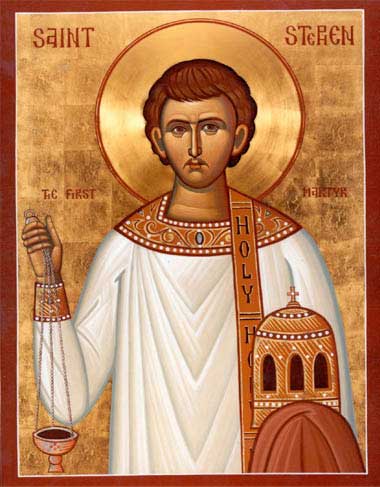
St. Stephen As a theology professor, I have many favorite moments. I love the first day of class in the fall when I meet new students for the first time and we go over the syllabus for the next semester. I love those moments in class when a lecture or discussion is going particularly well and I find myself thinking “This is why I love teaching.” I love lunches in the Commons Hall when I’m sitting together with students or faculty and we’re laughing together. I love that moment at the end of graduation when all of the faculty process out of St. Stephen’s Church wearing our academic regalia and we look back at the faces of the graduating seniors and the hundreds of parents and friends who have come to celebrate. But I think that this is my absolute favorite moment – when I attend the ordination of former students whom I have seen come to the seminary as new students, watched them become part of the Trinity community and progress in their coursework and spiritual formation over a period of years, and, finally, after graduation, the church recognizes their vocation when the bishop lays his hands on them and prays for them to “Receive the Holy Spirit” for the ministry to which they have been called. I want to thank Jared and Rebecca for inviting me to preach this sermon, and Bishop Duncan for allowing me to share in this service.

I first became acquainted with Rebecca and Jared on separate occasions. I became acquainted with Rebecca because of an email she sent out on “Campus News” asking if anyone could help her to locate some poison berries she needed. My wife Jennie knew where some were growing so she emailed back, and I assume Rebecca got her berries. Jared and I are both alive so the berries went for a harmless purpose. As many of you know, Rebecca knits and she needed the berries to make a dye for her yarn. My first real acquaintance with Jared began during a walk for coffee after lunch that I took with Professor Leander Harding, who invited Jared along. During that walk, we asked Jared about why he had come to seminary, and we found out during that talk that Jared saw his vocation as a shared vocation with his wife Rebecca. Some students come to seminary, and their spouses come along as well. Jared made clear that Rebecca and he had come together, and that they shared a common vision of ministry as something to do together. I got to know Jared and Rebecca over the next several years as they were students in my classes, and both were exceptionally good students. For the first couple of years they were here, both worshiped at Grace Edgeworth where Jennie and I attend, and I found out that they were not only good students but very good cantors. Jared and Rebecca struggled to have children, and we all rejoiced when first Naomi and now Martha were born. Jared and Rebecca formed friendships with students whom I got to know as friends as well, and some of them are here today. I can honestly say that I do not only think of Jared and Rebecca as my students, but as special friends whom I have come to love and respect. I am greatly honored to be able to preach at their ordination to the diaconate this morning.
(more…)

June 20, 2015

Yes, Virginia, There is Such a Thing as Fundamentalism or The Subject Matter of Christianity is the Subject Matter of Christianity

Filed under: Anglicanism,Ecumenism,Theology — William Witt @ 5:00 am

Melancholy Much of what I have written on my blog has been addressed against what is called either (depending on which side of the Reformation one hangs one’s hat) Liberal Protestantism or Catholic Modernism. (One of the advantages of being Anglican is that one can embrace either heresy. When Anglican Evangelicals go bad they become liberal Protestants. When Anglo-Catholics go bad, they become Modernists.) Within the parameters of the church, I consider liberalism to be the greatest heresy today because it denies the central subject matter of the Christian faith as taught in the Scriptures, and summarized in the ecumenical creeds: the doctrines of the Trinity, the incarnation of God in Christ, the atoning death and resurrection of Jesus Christ.

Numerous essays on my blog address this heresy in one way or another. Even the issue of same -sex sexual unions, which is the key issue of controversy dividing the Western churches these days, I regard as church dividing precisely because I see an inherent connection between affirming same-sex activity and denying key doctrines of Christian faith. It is not a coincidence that the leading advocates of SSUs have also been functional unitarians and/or panentheists. (I think of people like retired Bishop John Spong, the late Marcus Borg, and Sallie McFague. Despite a caginess that makes her hard to pin down, I think it clear that Episcopal Presiding Bishop Katherine Jefferts Schori is solidly in this camp.) There are, of course, exceptions, including some theologians whom I have admired and who have influenced me: Stanley Hauerwas and George Hunsinger, in particular. However, they really are exceptions. Precisely because Scripture is so clear on this issue and it is tied so closely to the doctrine of creation (and, I would add, even the doctrines of the Trinity and ecclesiology), where one stands on SSU’s predictably indicates where one stands on creedal issues.

Advocates of theological liberalism/modernism in the church regularly refer to those who disagree with them as “fundamentalists,” and I have been the recipient of this accusation myself. John Spong’s book Rescuing the Bible From Fundamentalism is a typical example. The joke is, that for theological progressives, a “fundamentalist” is anyone who believes more of the Christian faith than the one using the epithet. For Spong, Jerry Falwell and Billy Graham were “fundamentalists,” but so was Karl Barth, and New Testament scholar N.T. Wright. If a fundamentalist is anyone who believes more than Bishop Spong, then the term is vacuous. To refer to N.T. Wright as a fundamentalist is just another way of saying that one disagrees with him, and, because he does not affirm one’s views, he must be either evil or foolish or both. The fundamentalist accusation saves the time of actually having to address the arguments of someone like Wright. (I have used Wright as an example precisely because his position is ambiguous. Wright’s “New Perspective” work on the apostle Paul has led him to be labeled a dangerous “liberal” by some advocates of a traditional Reformation reading of Paul.)

That a term can be misused does not mean that it cannot be used meaningfully at all. That Karl Barth and N.T. Wright are not fundamentalists does not mean that there are no such people. What is a fundamentalist? Historically, the term originated early in the twentieth century with the publications of a series of books entitled The Fundamentals, written by a number of conservative Protestant theologians in response to the rise of liberal Protestantism. With the separation of J. Gresham Machen from Princeton Seminary, the founding of Westminster Seminary and the Orthodox Presbyterian Church, fundamentalism became associated with conservative separatist Protestantism. In the mid-twentieth century, the rising movement then known as Neo-Evangelicalism (associated with Billy Graham and institutions such as Fuller Seminary and Christianity Today magazine) distanced itself from fundamentalism as a conservative Protestant movement that was more academic, more ecumenical, and open to aspects of the civil rights movement of the 1960’s. With the rise of the (political) religious right in the early 1980’s and the social and political division of the culture wars of the late twentieth century that divided not only political parties but also religious denominations, internal divisions over issues such as the inerrancy of scripture and women’s ordination, clear-cut divisions between what were now called conservative Evangelicals and fundamentalists once again tended to blur.

To describe fundamentalism by its history in this way could lead to the impression that fundamentalism is restricted to a particular historical phenomenon within a specific religious tradition – that of conservative Protestantism. To do so would be to fail to locate the theological nature of fundamentalism, and would view it as an isolated phenomenon – which would be a mistake. Fundamentalism is not so much a particular movement within the specific religious tradition of Protestantism as a type that has appeared not only within Protestantism, but in other Christian traditions as well.

Fundamentalism has at least two characteristics: first, it is a distinctly modern phenomenon. It appeared at a time when Christian identity was threatened by the rise of modern secularism that has its origins in the Enlightenment, and when secularism was perceived to have infiltrated even the Christian churches. And, second, fundamentalism is reactionary. Fundamentalism identifies itself in terms of that which it rejects as much as or more so than what actually defines it. Once one recognizes that fundamentalism is both modern in origin and reactionary, it becomes evident that fundamentalism is not simply identifical with conservative or orthodox Christianity; one can also speak of fundamentalism outside of the narrow historical parameters of twentieth and twenty-first century American Protestantism.

How to identify fundamentalism? I have found the following three descriptions to be at least helpful. (more…)

October 15, 2014

Reflections on the “new” Vatican position about homosexuality

Filed under: Ethics,Theology — William Witt @ 7:35 pm

Melancholy I‘ve been noticing a lot of conversation in the last few days about the Vatican’s apparent “shift” regarding homosexuality, both in the secular press and among Christians. There is both celebrating (by secularists) and gnashing of teeth (by traditional Christians). Before they conclude either that the Vatican has finally “seen the light,” or that “the sky is falling,” people should read the document in its entirety: Relatio post disceptationem.

The document clearly affirms the historic Christian position on marriage. The key paragraph is probably the following:

Jesus Himself, referring to the primordial plan for the human couple, reaffirms the indissoluble union between man and woman, while understanding that “Moses permitted you to divorce your wives because your hearts were hard. But it was not this way from the beginning” (Mt 19,8). In this way, He shows how divine condescension always accompanies the path of humanity, directing it towards its new beginning, not without passing through the cross.

What is being addressed seems clearly to be an issue of pastoral response to what are described as “wounded families” and “irregular situations.” A number of such “irregular situations” are referred to: African polygamy, children born outside the context of marriage, civil marriages (a problem for Roman Catholics, since non-church marriages are not recognized), religiously “mixed” marriages, non-remarried divorced, remarried divorced, cohabiting couples, homosexuals.
(more…)

September 12, 2014

Anglican Reflections: What About Priests?

Filed under: Anglicanism,Theology — William Witt @ 12:01 am

Lamb of GodThe New Testament uses the words episkopos (“bishop”) and presbyteros (“elder”) to refer to those who exercised office in the church, along with diakonos (deacon). It uses the word hiereus, equivalent to English “priest” or Latin sacerdos to refer to Old Testament and Jewish priests (Matt.8:4; John 12:51, Acts 5:27, Heb. 7:14), to the High Priesthood of Jesus (Heb. 4:14), and to the priesthood of the entire church as the people of God (1 Peter 2:9, Rev. 20:6). The New Testament never uses the word hiereus to refer to persons who hold office in the church.

Nonetheless, Anglicans have continued to use the word “priest” to refer to those who hold the office of presbyter, to the consternation of some. Richard Hooker wrote that he preferred the word “presbyter” to “priest” because he would prefer not to offend those who are troubled by the word. The Anglican Reformers rejected the notion of eucharistic sacrifice, and so rejected any notion of priesthood that implied sacrifice. As Richard Hooker asked, “Seeing then that sacrifice is now no part of the church ministry how should the name of Priesthood be thereunto rightly applied?” Hooker believed that the term “priest” was permissible in reference to one “whose mere function or charge is the service of God,” and specifically in reference to the celebration of the eucharist: “The Fathers of the Church of Christ with like security of speech call usually the ministry of the Gospel Priesthood in regard of that which the Gospel hath proportionable to ancient sacrifices, namely the Communion of the blessed Body and Blood of Christ, although it have properly now no sacrifice.” In the end, Hooker did not think the word itself is very important: “Wherefore to pass by the name, let them use what dialect they will, whether we call it a Priesthood, a Presbytership, or a Ministry it skilleth not: Although in truth the word Presbyter doth seem more fit, and in propriety of speech more agreeable than Priest with the drift of the whole Gospel of Jesus Christ.” (Laws 5.58.2-3.)

There are two key aspects of ordained ministry that touch more directly on the “priestly” aspect of ordination in Anglican tradition than the use of the word “priest” as equivalent to “presbyter.”

(more…)

August 19, 2014

Anglican Reflections: What About the 39 Articles?

Filed under: Anglicanism,Theology — William Witt @ 8:33 pm

CranmerBroadly speaking, the 39 Articles stands within the tradition of Anglicanism as “reformed catholicism,” or, more specifically, a reforming movement within the western catholic church. (This contrasts with more radical Reformation movements, such as the Anabaptists, and, arguably, the Puritans,who viewed themselves as completely breaking with western catholicism to return to the pristine Christianity of the New Testament.)

The Articles are largely an ecumenical document, the majority of whose statements fall broadly within the parameters of “reformed catholicism.”

Arts. 1-5, 8 affirm historic creedal Nicene and Chalcedonian Christianity.

Arts. 9-10,12-13,15-18 affirm the positions of a moderate Augustinianism. Even art. 17 does not teach a specifically Calvinist doctrine of predestination. There is nothing about negative predestination (reprobation or double predestination). The election that is described is corporate and “in Christ.” (“In Christ” was added to the original 42 Articles.) “Arminians” such as Richard Hooker were able to affirm this article, to the chagrin of strict Calvinists.1

Arts. 6, 7, 11 affirm the sufficiency and primacy of Scripture as well as justification by faith, which are commonly held Reformation positions, although even here, an argument could be made that the position on Scripture is consistent with that of the patristic church, of Eastern theologians such as John Damascene, and Western theologians such as Thomas Aquinas. Anglican theologians such as Cranmer, Jewel, and Hooker make clear that (contrary to the Puritan hermeneutic), Anglicans do not understand the “Scripture principle” in a “regulative” sense.

The “controversial” articles are those articles, especially beginning with Art. 19, “Of the Church,” in which the position of the Church of England is set over against that of other contemporary Reformation-era churches, usually the Tridentine Roman Catholic position, but sometimes that of other Reformation churches, usually those of the Radical Reformation. (Arts. 38-39 are addressed against Anabaptists).

Which of the articles have been “controversial” in the history of Anglicanism and today? Art. 22, repudiating purgatory and icons; Art. 25, concerning the number of sacraments, and seemingly forbidding elevation of the consecrated host; Art. 28-29, which seem to reject any notion of bodily presence (not simply transubstantiation, but also the Orthodox or Lutheran positions) and elevation of the host; Art. 31, which appears to reject any notion of eucharistic sacrifice. Generally, Evangelical Anglicans have tended to be happy with these articles, and Anglo-Catholics unhappy. Conversely, Art. 27 seems on a literal reading to affirm baptismal regeneration, a position not embraced by a good many Evangelical Anglicans.2

(more…)

August 17, 2014

A Wedding Sermon

Filed under: Sermons — William Witt @ 5:55 pm

Song of Songs 2:10-13 and 8:6-7
Psalm 127
Revelation 21:1-7
Mark 10:6-9

For Paul Hunter and Christina Vance

angelusI am honored to preach this morning for the wedding of two of my former students, both of whom I am exceptionally fond. Although faculty do not have favorite students, if they did, Christina and Paul would have been two of my favorite students when they were at Trinity School for ministry, where I teach.

I want to make just a few comments about the lectionary readings, beginning with the gospel. The gospel reading points back to the creation narratives of the first two chapters of Genesis, the first book in the Bible. The context is that Jesus is being asked about whether divorce is ever permissible, and he responds by quoting the 2nd chapter of Genesis: “From the beginning of creation, God made them male and female. Therefore a man shall leave his father and mother and hold fast to his wife. So they are no longer two but one flesh. What therefore God has joined together, let no one separate.” (Matt. 19:4-6; Gen. 2:24) The Bible begins with marriage. In Genesis 1 we are told that God said, “Let us make the human being in our image, after our likeness. . . . So God created the human being in his own image, in the image of God he created him; male and female he created them.” (Gen. 1:26-27) The first chapter of the Bible tells us that to be a human being is to be created in the image of God, and to be created in the image of God is to be male or female. It is only as male and female together that we as humans reflect what it means to be created in God’s image.

In Genesis 2, we are told that God created woman because the first human being was alone, and needed a partner. “Then the Lord God said, ‘It is not good that the human being should be alone.” (Gen. 2:18) In Hebrew, the word for “human being” is ha’adam, which is the same word as the name “Adam.” The English language has historically not made a distinction between human being and male human being. English often uses the word “man” for both. But Hebrew does use different words for generic “human being” and “male human being.” The Hebrew word “ha’adam” does not mean male human being, but simply “human being.” It is only when God brings the woman to the human being – to Adam – that we first find the use of the word for “man” or “male human being” in the Hebrew text: “This at last is bone of my bones and flesh of my flesh; she called be called woman, because she was taken out of man.” (Gen. 2:24) It is only when the female human being – the woman – comes into the picture that the original human being is recognized as a male human being – a man.

The point is this, both Genesis 1 and Genesis 2 make it clear that men and women are made for each other, and what it means to be a human being is defined by our relationship to other human beings. Those of us who are men – male human beings – are human beings only as we are in relation to women – female human beings. Women – female human beings – are human beings only as you are in relation to us – male human beings. God intended us to be with one another, and marriage makes this clear. It is marriage that is the foundation of all other human relationships. As human beings, we are not meant to be alone; we are not human beings alone, but only with one another. So the first thing that marriage teaches us is that human beings need one another. We are made to be together.
(more…)

August 4, 2014

If God is for Us: A Sermon

Filed under: Sermons — William Witt @ 12:12 am

Psalm 78
Nehemiah 9:16-20
Romans 8:35-39
Matthew 14:13-21

fishI begin my sermon this morning with a question: What’s going on in the lectionary? During the Season after Pentecost, what is sometimes called “ordinary time,” the lectionary practice is to read through one of the synoptic gospels chapter by chapter and an accompanying epistle the same way. Because the New Testament readings are sequential like this, there is not usually any evident connection between the gospel reading and the epistle reading. What Matthew is saying in his gospel may or may not have anything to do with what Paul is saying in the epistle to the Romans.

Whether it was intended by the lectionary compilers or not, I think that there is a parallel between the epistle and the gospel readings this morning. Let’s begin with the epistle. Romans 8:31-39 is the climax of everything Paul has been writing up to this point in the letter. The main theme in the lectionary reading is God’s love, and is a repetition of what Paul had already said in Romans 5:1-11. In Romans 5, Paul wrote, “[W]e rejoice in our sufferings . . . because God’s love has been poured into our hearts through the Holy Spirit who has been given to us. . . . God shows his love for us in that while we were still sinners, Christ died for us.” (5:2,5,8) In this morning’s reading, Paul says, “For I am sure that neither death, nor life, nor angels nor rulers, nor things present nor things to come, nor powers, nor height nor depth, nor anything else in all creation, will be able to separate us from the love of God in Christ Jesus our Lord.” What Paul writes here is a continuation of what we read in last week’s lectionary reading: “What then shall we say to these things? If God is for us, who can be against us? He who did not spare his own Son but gave him up for us all, how will he not also with him graciously give us all things?” (8:31-32)

If God is for us, who can be against us? Paul lists a number of things that might suggest that God is not for us. “Who shall separate us from the love of Christ? Shall tribulation, or distress, or persecution, or famine, or nakedness, or danger or sword?” (8:35) People often list just the kinds of things that Paul mentions here as proof that there is no God, or if there is a God, he is not for us, but against us. If I am suffering tribulation or distress, perhaps that means that God has abandoned me. If I cannot provide food for my family, perhaps that means that God does not care for me. If the world is full of violence and war, perhaps that means that there is no God, or God would prevent such things. If Christians suffer persecution, perhaps that means that there is no God because if there were a God, certainly he would protect those who claim to believe in him.

Paul has one response to all of this. We know that God is for us because of an event, something that has happened – the life, death, and resurrection of Jesus Christ. We know that God is for us because he has given us his Son. In giving us his Son, God has revealed his nature. God has show us in Jesus what he is like. God is love. (more…)

July 8, 2014

Anglican Reflections: What About Apostolic Succession?

Filed under: Anglicanism,Theology — William Witt @ 9:05 pm

Four_ApostlesApostolic succession has had three different meanings in the history of the church.1

(a) In the second century, apostolic succession was important (over against gnosticism) because of the issue of historical continuity. A historical succession of bishops was one of the four marks distinguishing catholic Christians from their gnostic opponents. Those churches that recognized the canonical authority of Scripture, interpreted and summarized Scripture by the Rule of Faith, and worshiped in word and Sacrament were the same churches that could trace their history through a succession of bishops from the apostles. This is the argument used by Irenaeus in Against Heresies 3.3,4. The focus here is on succession of bishops as an assurance of orthodox teaching.

(b) The bishops are successors of apostles in the sense that they continue to exercise various functions exercised by the apostles: teaching, preaching, celebrating the sacraments, ordination.

(c) The most controversial understanding of apostolic succession is that the “grace” of ordination is handed down from the apostles from one generation of bishops to another through the laying on of hands.

(more…)

July 7, 2014

Anglican Reflections: What About Bishops?

Filed under: Anglicanism,Theology — William Witt @ 12:07 pm

I received the following question in my email and thought it worth sharing my response:

I am having a hard time wrapping my mind around the defense for episcopal church government. I can see the case for a plurality of elders in the New Testament, but this would seemingly lend itself to either a Presbyterian or Congregational polity. What is the best defense for the role of bishops? Can we defend it from the New Testament? And how do Anglicans account for the plurality of elders, such as revealed in Philippians 1:1?

The following is my own argument, but is a summary of arguments that can be found in numerous sources. A bibliography occurs at the end.

BishopAlmost immediately after the Reformation, Anglicans acknowledged that the distinction between bishops and presbyters is not clearly articulated in the New Testament. Episcopacy was still defended, and a number of similar arguments have been used and repeated, beginning at least from the time of Richard Hooker.

The first issue has to do with the difference between exegesis and hermeneutics, that is, the difference between what Scripture meant in its original historical setting and how the church applies Scripture to its life today. The fundamental difference between Richard Hooker and his Puritan opponents had to do with the issue of contemporary application. Both Hooker and the Puritans agreed that Scripture was the final authority for Christian doctrine and practices, but they differed on what that meant for the contemporary application of Scripture. The Puritans subscribed to the “regulative” principle of biblical interpretation: whatever is not specifically commanded in Scripture is forbidden. Accordingly, they were opposed to such practices as the exchange of wedding rings, written liturgies (such as the Book of Common Prayer), hymns (apart from the Psalms), vestments, and bishops, insofar as the Puritans noted correctly that the New Testament makes no inherent distinction between presbyteroi (presbyters) and episkopoi (bishops). To the contrary, Hooker embraced a permissive understanding of biblical hermeneutics: whatever Scripture does not explicitly forbid is permitted. Moreover, Hooker distinguished between matters of doctrine and morals (which are unchangeable), and matters of civil and ritual law (which are changeable by the church). The famous distinction between moral, civil and ritual law is not original to Hooker; it can be found in Thomas Aquinas, in the Lutheran Confessions, and in John Calvin. Hooker also insisted, however, that the distinction meant that churches were free to adopt ecclesiastical practices that were not explicitly commanded in the New Testament as long as they were not forbidden. This included written prayers (liturgical worship, including the Prayer Book), practices such as exchanging wedding rings, and retaining the historic catholic practice of the three-fold order of bishops, priests, and deacons – even if that order is not explicitly commanded or found in the New Testament. (more…)

« Newer PostsOlder Posts »

Non Sermoni Res — William G. Witt is proudly powered by WordPress