
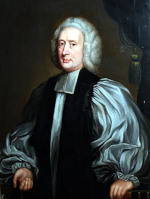
Joseph Butler (1692 – 1752)
“The greatest of all the thinkers of the English Church” (Stephen Neill, Anglicanism)
1692 Born Wantage, Oxon
1714 Abandons Presbyterianism, Enters Oriel College, Oxford
1718 Ordained Deacon and Priest at Salisbury
1718-1726 Preacher at Rolls Chapel (Sermons made him famous)
1726 Stanhope, Durham (lives in seclusion, engaged in pastoral duties, wrote Analogy of Religion
1736 Analogy of Religion
1736 Clerk of the Closet (Attends Queen Caroline)
1738 Bishop of Bristol (conflict with John Wesley)
1740 Dean of St. Paul’s
1750 Bishop of Durham
It is arguably the case that the foundations of Anglican theology began with King Henry VIII’s separation of the Church of England from communion with the bishop of Rome. Henry’s English Catholicism was succeeded by the more Protestant English Reformation during the reign of his son Edward VII, and culminated with the restoration of Prayer Book Anglicanism during the Elizabethan settlement of Henry’s daughter Elizabeth I. Theologically, the beginnings of Anglican theology are found in the writings of Thomas Cranmer, the 1549 and 1552 versions of the Book of Common Prayer, the Thirty-Nine Articles, and the sermons of the Book of Homilies. Anglican theological identity continues with the apologetic works of John Jewel during the Elizabethan settlement and the definitive articulation of Anglican identity in Richard Hooker’s Laws of Ecclesiastical Polity. However, the initial period of Anglican identity does not end with the reign of Elizabeth, but continues in the following period of the Caroline Divines, the English Civil War, and the restoration of the monarchy under William and Mary. Although they did not write theological tomes, the sermons and poetry of writers like Lancelot Andrewes, George Herbert, John Donne, and (although he was unknown) Thomas Traherne, are as fundamental to the foundations of Anglican identity as is the work of Thomas Cranmer.
The period after the Glorious Revolution is marked by a historical shift. If the initial period of Anglican theology was marked by moves to identify Anglicanism in conversation with and over against both Roman Catholicism on the one hand and other versions of Reformation Protestantism (especially Puritanism) on the other, Anglican theology found itself engaging with a new conversation partner beginning in the seventeenth and eighteenth centuries – what would over a period of centuries become not another version of Christian faith but an alternative to Christian faith altogether that would eventually become secular modernity. Joseph Butler is the first Anglican theologian to address the problem of modern unbelief. (more…)