
William G. Witt

June 10, 2026

The Caroline Divines

Filed under: Anglicanism,Sacraments,Spiritualty,Theology — William Witt @ 12:31 pm

James I (1566-1625)

1603 Death of Elizabeth; Accession of James
1605 Gunpowder Plot (More restrictions against Roman Catholics)
1611 Authorized Version of the Bible (KJV)

Charles I (1600-1649)
1625 Death of James; Accession of Charles, who marries Henrietta Maria of of France, a Roman Catholic.
1633 William Laud becomes Archbishop of Canterbury.
1642 English Civil War
1645 Execution of Laud
1646 Triumph of Presbyterianism
1649 Execution of Charles
1658 Death of Cromwell

Charles II (1660-1685)
1660 Charles II – Monarchy restored.
1662 Revised BCP
1685 Converts to Roman Catholicism on his deathbed.

James II (1685-1688)
A Roman Catholic and upholder of Divine Right of Kings
1688 James flees (The Glorious Revolution)

William III (of Orange) and Mary II (1689-1702)

1689 With flight of James, Parliament declared the throne vacant. Parliament invited William of Orange and his wife Mary (daughter of James) to take the throne.

Thomas Cranmer

The Caroline Divines were a group of spiritual writers who followed the Elizabethan settlement, and lived in a period when Anglicanism was now well established. They were far enough removed from the Reformation that Anglicanism was now “normal,” just the way things are. The period when England was Roman Catholic was now a distant memory.

The political background to the period of the Caroline Divines is a history of four terrible kings. The Caroline Divines receive their name from the Latin version of “Charles,” based on the names of two of those kings. It might seem that during a time of political unrest and crisis, not much in the way of good quality theology would be written. Paradoxically, the era of the Caroline Divines is considered to be one of the high points of Anglican history.

The Caroline Divines have two interesting characteristics as theologians. First, they were not theologians in the traditional sense, but were primarily preachers or poets, and their theology is found in their sermons and their poetry. Second is the contrast between the political turmoil taking place in the country as a whole and the profound theological reflection that we find in their writings. Paradoxically, the Caroline Divines say virtually nothing about the political conflicts of the time.

There is a similar parallel in the writings of the 19th century British novelist Jane Austen. Austen wrote her novels during the period of the Napoleonic Wars. Although soldiers play important roles in her plots, the ordinary reader would not know that a major war between England and France provided the historical setting in which Jane Austen’s novels were written. Something similar occurs when we read the writings of the Caroline Divines.

Historical Background

Because Queen Elizabeth never married, she had no children, and her death created the problem of a legitimate succession to the throne. It was decided that James VI, King of Scotland, would be Elizabeth’s successor. In 1603, James entered England from Scotland to become King James I of England. The Puritans were at first enthusiastic about having a Scottish King, and immediately presented James with some requests. They wanted to be rid of the surplice while leading worship and of the sign of the cross in baptism.

James responded by rejecting all of their requests. He had dealt with Presbyterians in Scotland, and had no patience for them now that he was king of England. James not only upheld apostolic succession, he defended in addition a political theory of the Divine Right of Kings. One was king because God intended it, and the authority of the king could not be questioned. James is known for the statement, “No Bishop, no King.”

In 1605, a group of Roman Catholics who attempted to blow up Parliament in the Gunpowder Plot were punished severely. In consequence, Roman Catholicism was placed under even more restrictions than had existed previously. After the Gunpowder Plot, Roman Catholics were no longer a political threat in England.

King James’s most significant historical contribution is likely the Authorized Version of the Bible, which he had translated under the leadership of Lancelot Andrews. Known popularly as the King James Version, it was certainly not known by either name when it was translated. A new translation of the Bible into English after the Great Bible is perhaps the one good thing that James accomplished during his reign. Overall, James was a terrible King. He was not devout or religious. Stephen Neill writes of him in his book Anglicanism: “James I loved the English church, yet he did greater harm than perhaps any other English monarch.”1

James was succeeded by Charles I, born in 1600. Charles became King in 1625, and married Henrietta Maria of France, a Roman Catholic. If James I’s response had made him unpopular with the Puritans, Charles’s marriage to a Roman Catholic only compounded the problem. Charles proceeded to make the situation even worse in 1633, when he appointed William Laud (1573-1645) as Archbishop of Canterbury. Laud is known for the vicious suppression of his opponents, doing such things as cutting off their ears, branding them, or slitting their noses.

In 1642, Puritans from inside of the Church of England joined with independent groups like Congregationalists and Baptists in the revolutionary English Civil War, leading to the eventual removal of the King by beheading. In 1645, Archbishop Laud was executed. In 1646, Presbyterianism triumphed in the war and became the official church in England, replacing the Thirty-Nine Articles with the Westminster Confession of Faith along with a Larger and Shorter Catechism. In 1649, King Charles was executed.

The Puritan regime lasted approximately ten years. Oliver Cromwell, leader of the Puritan cause, died in 1658. In 1660, the monarchy was restored, and Charles II reigned from 1660 to 1685. Charles’s main contribution to the long term future of Anglicanism was to revise the Prayer Book in 1662. Several centuries later, Parliament would reject a revision of the Book of Common Prayer in 1928, leaving the 1662 Prayer Book in place. The Alternative Service Book appeared in 1980, which was replaced in 2000 by Common Worship, which is not a single text, but a series of books used in many churches. While these revised rites are used in most contemporary parishes, the 1662 Book of Common Prayer is still the official Prayer Book of the Church of England.

In 1685, Charles II converted to Roman Catholicism on his deathbed. He was succeeded by James II, who reigned a short three years from 1685 to 1688. James II was a Roman Catholic, and also an upholder of the Divine Rite of Kings. James was so unpopular that he had to flee the country in 1688. With the flight of James, Parliament declared the throne vacant and invited William of Orange (a Protestant from the continent) and his wife Mary (daughter of James) to take the throne. William and Mary reigned from 1689 to 1702. This replacement by William and Mary of an entire dynasty of bad kings is referred to as the Glorious Revolution.

Several changes followed. Parliament passed the Toleration Act, which guaranteed religious freedom to Non-conformist Protestants, but not yet Roman Catholics or Unitarians. A Bill of Rights restricted the King’s authority over Parliament. A small group of Anglicans who remained faithful to King James were known as the Non-Jurors.

The Caroline Divines

An examination of the writings of the Caroline Divines will be preceded by some biographical material. (more…)

July 4, 2025

Sermon for the Feast Day of George Herbert

Filed under: Anglicanism,Sermons,Spiritualty — William Witt @ 12:36 am

Preached on February 27, 2025

George Herbert

I

t is my normal policy when I preach to focus on the lectionary readings. I am going to make an exception today because this is the Feast Day for George Herbert, and I want to say a few things about Herbert. As a theologian, my favorite Anglican authors are from the period in which the Church of England began to settle into its identity following the English Reformation and the Elizabethan Settlement: Richard Hooker and his Laws of Ecclesastical Polity and the period of the Caroline Divines following Hooker: John Donne, Lancelot Andrewes, Thomas Traherne, and, of course, George Herbert. I have more than once used the period of Lent to read through some of John Donne’s sermons or Herbert’s poetry. As Lent begins, I might encourage you to spend some time doing the same.

Who was George Herbert? Herbert was an Anglican priest who was born in 1593 and died of tuberculosis in 1633 at the age of only thirty-nine. He is an example of how to live a meaningful Christian life in the midst of troubled times. Herbert spent his early years trying to pursue a career in politics, and he even served in Parliament for a time. However, with the death of King James, Herbert became disillusioned with politics, and he abandoned the world of public influence to serve in a small village church. Herbert spent the last three years of his life as the rector in the rural parish of St. Andrews, Bemerton, and it is these three years Herbert spent as a priest for which he is remembered four hundred years later. Izaak Walton summarized his life: “Thus he lived and thus he died like a saint, unspotted of the world, full of alms’ deeds, full of humility, and the examples of a virtuous life.”

If I were to summarize the chief characteristic of these Anglican writers known as the Caroline Divines, I would say that they brought together a combination of theology and spirituality. Herbert left us two writings: a guide for priests entitled The Country Parson, and a collection of poems titled The Temple. In a short sermon, I cannot do more than give you a brief introduction to the theology and spirituality of George Herbert, but I will mention what I will call four pillars of the spiritual life according to George Herbert.

The first two pillars are a combination of word and sacrament in contrast to a spirituality that centers only on Scripture – the Word without the sacrament – or only on worship – the sacrament without the Word. One of the characteristics of Anglican spirituality of this period was that it was a way of prayer and worship that was informed by two books – first, the English Bible that appeared as the Great Bible of Henry VIII 1539 and later the Authorized Version of King James translated under the leadership of Lancelot Andrewes published in 1611, and, second, the third Elizabethan edition of the Book of Common Prayer of 1559.

This two-book spirituality is found throughout Herbert’s prose and poetry. First, the Bible. Herbert writes in The Country Parson that the chief source of the pastor’s knowledge is the “book of books, the storehouse and magazine of life and comfort, the Holy Scriptures. There he sucks and lives” (The Country Parson, 4). The lights of Scripture shine not only individually, but form constellations of the one Christian story. In Herbert’s poem, “The Holy Scriptures,” he writes:

Oh that I knew how all thy lights combine,
And the configurations of their glory!
Seeing not only how each verse doth shine,
But all their constellations of the story (“The Holy Scriptures II”).

(more…)

May 21, 2020

Renewal Past and Present

Filed under: Spiritualty,Trinity School for Ministry — William Witt @ 5:56 am

The following appeared in Trinity School for Ministry’s Seed & Harvest Spring/Summer 2020.

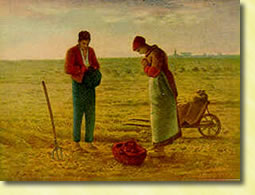
Angelus

Why renewal? Because the Christian church has been around for over 2,000 years, renewal becomes necessary as each generation must once again claim the faith for itself, but also must address the changes and challenges of a surrounding culture that may or may not be sympathetic to the Christian gospel. As the upcoming generation encounters the challenges of its own culture, it has to be faithful not only to what has come before, but also to address new challenges in new ways.

A renewal movement took place in the Episcopal Church in the 1970’s that had its roots in the charismatic movement that began in the 1960’s, characterized by the experience in mainline Protestant denominations of charismatic gifts that earlier had been characteristic of Pentecostalism. The renewal emphasized an experience of the presence of the Holy Spirit in worship that had been lacking in mainline denominations.

This renewal movement has continued to have an influence on the contemporary church. Many later church leaders got their starts or came to faith then. Charismatic renewal had a significant effect on styles of (contemporary) worship music. Within Anglican and Episcopal circles, charismatics are regularly included as one of the “three streams” of conservative Anglicanism identified as not only Evangelical and Catholic, but now also Charismatic.

While this renewal movement of the 1970s played a significant role in bringing revitalization within the mainline churches, it was only one of several renewal movements of the previous century. In what follows, I will mention three other renewal movements, and how they led me to become an Anglican.

Contemporaneous with charismatic renewal was the rise of “Evangelicalism” (as distinct from Fundamentalism) in denominations that were predominantly baptistic or revivalist, – “born again” Christianity. Evangelicalism likely reached its cultural high point when Newsweek recognized the election of Jimmy Carter as President by designating 1975 as the “Year of the Evangelicals.”

During my high school and college undergraduate years, my family were members of an Evangelical megachurch with a large youth group that became the center of my social circle. While other teenagers went to prom or played high school sports, I spent my time with my church friends. It was through this youth group that I became convinced that I had a vocation to some kind of Christian ministry, and I ended up doing my undergraduate studies at a local Evangelical liberal arts college. My Evangelical upbringing gave me a spirituality that focused on a “personal relationship” with Jesus Christ, a knowledge of and love for the Bible, and a way of responding to certain types of worship. Hymns like ‟Amazing Grace” still move me in ways that are hardly rational.

A second renewal movement took place during the twentieth century in the area of academic theology. (more…)

February 29, 2020

On the Reading of Old Books

Filed under: Spiritualty,Theology — William Witt @ 9:30 pm
Heron

C.S. Lewis’s essay “On the Reading of Old Books” has had a tremendous influence on me since I first read it in my 20’s. (By “old,” Lewis meant “chronologically old,” not a book I’ve owned for a long time.) Lewis recommends reading at least one old book every time one had read a new one. I have not been able to abide by this rule, and the meaning of “old” necessarily changes with time. What Lewis meant by “contemporary” would now mean “old.” I do find it a helpful exercise regularly to learn from previous generations.

The following is a list of “old” (at least not contemporary) books I’ve been reading recently with some comments:

E.L. Mascall, Corpus Christi: Essays on the Church and the Eucharist. Longmans, 1953.This book superbly addresses issues of disagreement in eucharistic theology that are still with us. Too often we presume that “no one has thought of this before.”

Mascall’s book led me to this one, which should be a classic in the biblical and historical foundations of eucharistic theology, with very helpful discussion of issues dividing Evangelicals and Anglo-Catholics:

Charles Gore. The Body of Christ: An Inquiry into the Institution and Doctrine of Holy Communion. John Murray, 1901, 1909.

J. B. Mozley. A Review of the Baptismal Controversy. E. P. Dutton, 1862.

Mozley was Newman’s brother in law, and wrote the definitive critique of Newman’s notion of development of doctrine. This book is a balanced discussion of the baptismal regeneration controversy in light of Scripture and the church’s tradition. Although Anglo-Catholic in his leanings, he makes the case that the Gorham controversy was rightly decided, and that the issue is not so straightforward as either nineteenth century Anglo-Catholics or Evangelicals tried to make it. (Both sides played fast and loose with the biblical and historical data.) (more…)

May 5, 2019

New Essay on the Anglican Spirituality of Thomas Traherne

Filed under: Anglicanism,Spiritualty — William Witt @ 6:16 am

Here is a link to an essay on the Anglican spiritual divine Thomas Traherne, which I just posted to my list of “Pages” on the right of my blog. This was originally published in Pro Ecclesia: A Journal of Catholic and Evangelical Theology, Vol. 25, No. 4, Fall. 2016. I thought this might be suitable for the Easter season.

July 25, 2016

Abounding in Thanksgiving: A Sermon on Prayer

Filed under: Sermons,Spiritualty — William Witt @ 3:53 am

Genesis 18:20-33
Psalm 138
Colossians 2:6-15
Luke 11:1-13

angelusThis morning’s lectionary readings focus on prayer. The Genesis passage continues the story of three travelers who visit Abraham and promise that he will have a son. One of the visitors is identified to be God, and Abraham has a discussion with God. In fact, Abraham actually argues with God; he haggles with him like someone in a Middle Eastern market. In the Psalm (as in many Psalms), we have a specific example of a prayer: “I give you thanks, O Lord, with my whole heart . . . I bow down toward your holy temple and give thanks to your name.” (Ps. 138: 1-2) In the gospel reading, Jesus teaches his disciples how to pray in Luke’s version of the Lord’s prayer; the next paragraph in Luke contains Jesus’ well known promise about prayer: “And I tell you, ask, and it will be given to you; seek, and you will find; knock, and it will be opened to you. For everyone who asks receives, and the one who seeks finds, and to the one who knocks it will be opened.” (Luke 11:9-10)

In my sermon this morning, I am going to try to answer the question, “What is prayer?” I am going to begin, however, with three examples of misunderstandings of prayer to help make clear what prayer is not.
(more…)

January 3, 2014

On “Lutheran” Anglicanism

Filed under: Anglicanism,Spiritualty,Theology — William Witt @ 7:56 pm

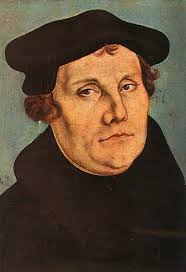
Luther"Last summer, my friend David Koyzis started a conversation about why there are so many Baptists who call themselves “Calvinists,” but no “Lutheran” Baptists.

David might be surprised to know that there are Anglicans who call themselves “Lutherans.” They have historical connection with Trinity School for Ministry in connection with a former Dean/President, and every year I discover at least one or two new students in my classes who identify with this “Lutheran” Anglicanism. The recent publication of this book reminded me that “Lutheran” Anglicanism is alive and well, and has prompted me to post my own assessment of “Lutheran” Anglicanism.

Before I give my own assessment of Lutheran Anglicanism, I should perhaps say a little about my own acquaintance with Luther and Lutheranism before I encountered the “Lutheran” Anglicans. During my years at graduate school, I came across Luther as part of my studies, and knew several Lutherans who were fellow students. I studied Luther primarily in courses on Christology and liturgy, and included a chapter on Luther in my dissertation. My assessment of Luther was mixed. I appreciated most Luther’s Christology and his sacramental theology, although I found his theology of the ubiquity of Christ’s ascended human nature problematic. I was less happy with Luther’s Bondage of the Will, where I thought he could have learned a thing or two from Thomas Aquinas or Augustine. Luther’s failure to distinguish adequately between natural and moral freedom combined with a failure to distinguish adequately between foreknowledge and predestination led to a determinist doctrine of human will and divine predetermination that made God responsible for sin. Luther’s way of stating the distinction between the “hidden” and “revealed God” was rightly repudiated by Karl Barth as undermining the fundamental theological thesis that God is in himself who he is in his revelation. I was also less than happy with Luther’s “law/gospel” hermeneutic, which, while it had some validity for interpreting certain passages in Paul’s letters to the Galatians and the Romans was largely a case of eisegesis if imposed on the Bible as a whole. As a Reformation Christian, I embraced Luther’s doctrines of sola scriptura, and justification by grace alone through faith alone, not because they were Luther’s but because I believe them correct – although I tended to understand the Reformation sola’s through Anglican eyes.

As part of my doctoral research, I read quite a bit in modern secondary literature on Luther. I read not only Luther, but became familiar with some of the key hallmarks of Lutheran theology – the Augsburg Confession, and much of the material in the Book of Concord. I also became familiar with a few modern Lutheran theologians: Soren Kierkegaard, Dietrich Bonhoeffer, Gustaf Aulen, Helmut Thielicke, and contemporary Lutherans such as Wolfhart Pannenberg, Carl Braaten and Robert Jenson, Gilbert Meilaender and David Yeago. Overall, my assessment of Luther and Lutheranism was mostly positive.

I discovered a very different “Luther” and approach to “Lutheranism” among the “Lutheran” Anglicans, a kind of Lutheranism I had never encountered before. This “Lutheran” Anglicanism was a variant on a way of reading Luther that Lutheran theologian Gilbert Meilaender calls “dialectical Lutheranism”1

Dialectical Lutheranism is distinguished by the following key characteristics: (more…)

August 27, 2012

How to be Happy: Some offhand remarks

Filed under: Ethics,Spiritualty,Theology — William Witt @ 9:28 pm

Over at StandFirm, Sarah Hey has interrupted the usual grousing to post “A Few Thoughts on Happiness: Is Happiness A “Moral Obligation”?”. This led to the following offhand remarks.

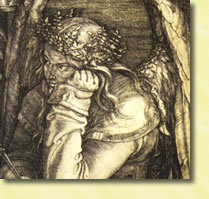
Melancholy While Aristotle (and Christian eudaemonists like Augustine and Thomas Aquinas and Richard Hooker) granted that beatitude (translated “happiness,” but more like “complete well being”) was correlated with character, they saw it as a byproduct of something else, namely doing a worthwhile activity.  To set out to pursue happiness in itself led to unhappiness.  However, doing something inherently worthwhile, and doing it well, can lead to happiness.

This is the unexpressed assumption in Ignatius Loyola’s Spiritual Exercises, the intent of which is to help sort out one’s vocation.  One begins not by asking “What makes me happy?,” but “What do I love?”

How to be happy? Pursue those things you love doing, and, to the extent it is possible, do good.  Don’t pursue happiness for its own sake.  Be aware that if you’re unhappy, that may be a sign that you need to change something you’re doing.

May be, not must be. Our ancestors were very savvy about the passions (not to be equated with the emotions, full stop), and recognized that some people just had a disposition to melancholy.

The most significant way in which Augustine, Thomas Aquinas, and Richard Hooker  differ from Aristotle on happiness is that Aristotle believed neither in a personal God nor in an afterlife.  Like so many of our contemporaries, Aristotle believed that if we were going to be happy, it had to be here and now. In contrast, the Augustinian tradition recognizes that God is the Greatest Good (summum bonum), and true happiness can be found only in the beatific vision (seeing God “face to face” and enjoying him forever). This is what we are made for, and it is the fuel that drives all our seeking for happiness.  As Augustine expressed it at the beginning of the Confessions: “You have made us for yourself, and our hearts our restless until they rest in you.” (more…)

Non Sermoni Res — William G. Witt is proudly powered by WordPress