
William G. Witt

April 9, 2026

John Jewel and the Catholicity of Anglicanism

Filed under: Anglicanism,Development of Doctrine,History,Sacraments,Theology — William Witt @ 1:40 pm

Dates (1522-1572)

1522 Born at Buden, Devonshire
1535 Enters Merton College, Oxford
1539 Transfers to Corpus Christi, Oxford
1540 Receives Bachelor of Arts
1545 Receives Master’s Degree
1548 Elected as Reader of Humanity and Rhetoric
1551 Receives license to preach at Sunningwell
1552 Accession of Mary Tudor; Jewel deprived of his fellowship at Corpus Christi
1554 Jewel signs articles agreeing with Roman Doctrine
1555 Jewel flees to Frankfurt, Strasbourg and later Zurich (with a letter from Cranmer); is deeply affected by disagreements among English exiles at Frankfurt
1558 Death of Mary and accession of Elizabeth; Jewel returns to England
1559 Jewel participates in disputation at Oxford against Roman clergy; Paul’s Cross “Challenge Sermon”

“If any learned man of all our adversaries . . . be able to bring any one sufficient sentence out of any old catholic doctor, or father, or out of any old general council or out of the holy scriptures of God, or any one example of the primitive church, whereby it may be clearly and plainly proved . . .”

1560 Consecrated Bishop of Salisbury
1562 Apologia Ecclesiae Anglicanae (Apology of the Church of England)
1565 Reply to Harding
1566 Defense of the Apology

“What mystical catholic ears M. Harding hath, that cannot abide the phrases and speeches of the ancient fathers.”

1570 Paul’s Cross Sermon against the Puritans (not published)

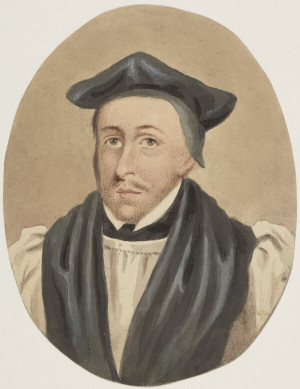
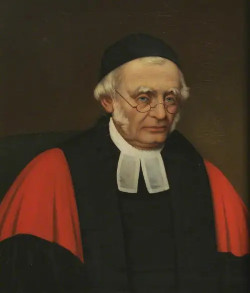
John Jewel

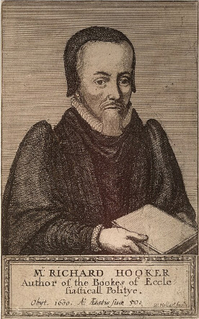
John Jewel (1522-1571) was a second-generation Anglican Reformer. He was a protege of Thomas Cranmer, and thus knew Cranmer personally. Later the great Anglican Divine Richard Hooker was a protege of Jewel’s. There is then something like a three-generation passing of the torch from Cranmer to Jewel to Hooker.

For a number of reasons, Jewel is unfortunately less well known than either Cranmer or Hooker. Cranmer is best known for his role in the creation of the Book of Common Prayer, which has provided the structure for Anglican worship for four hundred years. Richard Hooker is known for his writing of The Laws of Ecclesiastical Polity, which is probably the closest thing that Anglicans have to a systematic theology at the time of the Reformation. While his contribution is less, Jewel is nonetheless a significant figure, particularly for the development of Anglican ecclesiology – how Anglicans understand what it means to be a church, and, in that regard, how they address the question of the relationship between Anglicanism (or the Church of England) and the pre-Reformation western Catholic church.

In apologetic discussions, many Protestants and Roman Catholics agree in viewing the relationship between the medieval Catholic church and the post-Reformation Protestant churches as a simple break. This can be seen in such questions as “Did Henry VIII found the Church of England?” or “Where was your church before the Reformation?” or “Did the Church of England break with the Catholic church in order for Henry VIII to get a divorce?” Jewel’s approach to ecclesiology rejects this dichotomy. He refused to understand the Reformation as a simple break with the Roman Catholic church or to interpret the Reformation as a new beginning that leapt over sixteen hundred years of history to go straight back to Scripture, forgetting everything that had happened between the time of the death of the last apostle and Martin Luther’s 95 Theses.

At the heart of Jewel’s argument is the claim that Anglicanism was not the beginning of a new church; rather, the English Reformation was indeed a reformation, the reforming of the late medieval western Catholic church that Jewel claimed had in many ways departed from the historic church of the Patristic era and of the church of the New Testament Apostles before that. (more…)

March 21, 2026

Thomas Cranmer on the Sacraments and the Prayer Book

Filed under: Anglicanism,Ecumenism,Sacraments,Theology — William Witt @ 12:43 pm

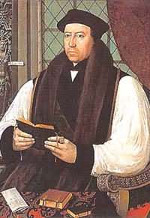
Today is the Feast Day of Thomas Cranmer, who placed his hand in the fire when he died at the stake on this day 470 years ago. I thought it a fitting day to post this essay on his sacramental theology.

Thomas Cranmer

A previous essay focused on Thomas Cranmer’s Reformation theology, specifically the way in which Cranmer embraced but also gave his own interpretation to the three Reformation principles of Sola Scriptura (the normative authority of Scripture alone), Sola Gratia (justification by grace alone), and Sola Fide (through faith alone). Cranmer affirmed the primacy and sufficiency of Scripture over all church tradition, while nonetheless also affirming the significance of tradition as the proper context for the interpretation of Scripture. He also affirmed both the reading of Scripture translated into the common language along with a focus on the reading of Scripture as a means of edification (the “priesthood of all believers”). Cranmer interpreted justification by faith alone to mean justification by Christ alone, with faith understood as the “lively faith” that embraced the crucified and risen Christ’s righteousness in contrast to what he called “dead faith.”

This essay will address the two other areas where Cranmer contributed most to the history of Anglican theology: his doctrine of the sacraments, particularly the Eucharist, and his contribution as author of the 1549 and 1552 versions of The Book of Common Prayer, focusing specifically on the eucharistic rites in the two books.

Reformation Eucharistic Theologies

If there was a general consensus among Reformation churches concerning the primacy and normativity of Scripture as well as justification by grace alone through faith alone, no such agreement existed for sacramental theology, style of worship, or church polity. The Reformers disagreed as much among themselves as they did with the Roman Catholic church concerning their theology of the sacraments, liturgical worship, and church orders (ordination). Concerning the sacraments, areas of disagreement concerned whether sacraments are means of grace, whether the risen Christ is present in the Eucharist, and, if so, in what manner, whether infants should be baptized, and whether baptism regenerates. Concerning worship, whether the church should retain or discard the historic liturgical worship of the church (the Catholic “mass”), and if retained, to what extent should the liturgy be preserved or modified. Concerning orders, whether the church should retain episcopacy, and, if not, whether the church should be governed by elders (presbyterian) or democratically (congregational).

Concerning the sacraments, there has been a history of disagreements in the Western church about the Eucharist – of how it is that the consecrated elements become the body and blood of Christ or how they unite the believer to Christ – that precedes the split between the Eastern and Western church. This has not been so much a concern in Eastern theology, and it may well have something to do with the Western understanding of how Christ makes himself immediately present in the Eucharist rather than the Eastern understanding that Christ is mediately present through the invocation of the Holy Spirit in the epiclesis.1 This fundamental difference between West and East concerning what can be designated as two separate “models” of Eucharistic presence has not been sufficiently recognized in discussions of Eucharistic theology, but is arguably as fundamental for understanding the Reformation-era disagreements as the disagreements themselves.2

The standard Western model of the Eucharist has a Christocentric emphasis. In the Western understanding, Jesus Christ as the risen and ascended Son of God acts directly and immediately to make himself present in the sacraments. During the Eucharistic prayer, the celebrant (or priest) represents the risen Jesus Christ. In Latin, the expression in persona Christi (in the person of Christ) means that the celebrant acts as a visible representation of the invisible risen Christ. When the celebrant pronounces the “Words of Institution” – “This is my body” and “This is my blood” – the physical elements of bread and wine are transformed to “become” (or make present) the body and blood of Christ.

The role of the Holy Spirit tends to be minimized. Insofar as the Spirit is present, the Spirit is present in either of two ways. First, by “appropriation.” That is, the Holy Spirit is present along with the risen Christ in the same manner in which the one God as the undivided divine nature acts throughout creation but specific divine acts are “appropriated” to a particular person because of a special fittingness. The phrase “all acts of the Trinity ad extra are one” (Opera Trinitatis ad extra indivisa sunt) means that all acts of the triune God outside God’s own nature (ad extra) are common to all three persons as to a single principle of action with the exception of acts specific to the mission of a specific person.

(more…)

November 27, 2022

Women’s Ordination and Sacramental Representation? How do Christians Represent Christ?

Filed under: Sacraments,Theology,Women's Ordination — William Witt @ 3:14 am

Holy GrailOne of the key disagreements in the discussion of women’s ordination concerns the question of how Christians represent or resemble Jesus Christ. This was a key concern in Icons of Christ, my book in favor of women’s ordination.

Protestant complementarians divide representation of Christ by sex. Males (not only clergy, but males in general) represent Christ by being “in charge,” exercising authority and specifically by exercising authority over women. Ironically, women also represent Christ, but in the opposite way, by submission. Complementarians claim that just as Jesus always obeys and is subordinate to God his Father, so there is a parallel within the ontological Trinity in which the eternal Son is always subordinate to and in submission to the eternal Father. In the same way, women are always subordinate to and in submission to male authority. Because clergy have positions of authority, no woman can be ordained because this would mean that women clergy would exercise authority over male parishioners. So Protestant complementarians divide Christological representation by dividing Christ. Males represent Christ by exercising authority, specifically over women. Women represent Christ by submitting to authority, specifically male authority over women.

The new Catholic argument against women’s ordination hinges not on issues of authority and obedience, but on sacramental representation. A male presbyter/priest represents a male Christ when presiding at the Eucharist. Because Jesus is male, only a male priest can represent a male Christ.

This is the third and last of my responses to Mark Perkins’ review of my book Icons of Christ: A Biblical and Systematic Theology of Women’s Ordination.1 In the previous two essays, I focused first on Perkins’ rhetoric and, second, on his discussion of history and tradition. In this essay, we finally get to Perkins’ positive argument. What does it mean for clergy to represent Jesus Christ, and why may only male clergy do so?

(more…)

December 5, 2011

New Article on Justification by Faith

Filed under: Announcements,Ecumenism,Sacraments,Theology — William Witt @ 7:27 am

Lamb of GodI regularly teach a course entitled The Anglican Way of Theology at an “Evangelical seminary in the Anglican tradition.” We begin the course with the English Reformation, and I am repeatedly surprised when I discover every year as I grade student papers that the Reformation doctrine of “justification by grace alone through faith alone” is frequently misunderstood and causes no end of trouble for my students to get their heads around. There seems to be a lot of confusion about just what the doctrine is, and I find that, in their papers, students either regularly defend, or criticize as troublesome or incoherent, something that they call “justification by faith alone” which is not the Reformation doctrine.

The above is the beginning of a rather lengthy article I have just written about the doctrine of “justification by faith.” The rest of the article can be found in my Pages Section to the left and is entitled “Anglican Reflections on Justification by Faith”.

November 5, 2011

A Question About Infant Baptism

Filed under: Sacraments,Theology — William Witt @ 9:43 pm

I received the following email:

Dr. Witt,

I’ve greatly appreciated many of your posts (your series on the development of doctrine was particularly helpful for understanding what Newman was trying to accomplish and the underlying assumptions of modern Roman Catholic apologists when they try to use it on unsuspecting evangelicals). I also found your summary of the modern debate about normative infant baptism to be helpful in articulating the direction that I have been heading. However, as I read through your article, I could not help but still ask the question: why baptize infants? I’m open (though I had using that term) to infant baptism even though I was reared Baptist and still attend a Baptist church. My frustration with adult-only baptism is that it seems inconsistent with the fact that I was reared (for all intents and purposes) as a Christian even though I hadn’t been baptized. Yet, as you noted in your article, adult baptism is the norm in the NT and the Early Church (Everett Ferguson cemented that fact in my mind). I don’t want to ramble on, but I hope that helps explain my question. Thanks for your time.

-Ryan

My response follows:

Dear Ryan,

This is a really good question.

River Baptism

I would suggest that the question of infant baptism is a classic question of hermeneutics, as opposed to exegesis. That is, how do we appropriate the teaching of Scripture in a different time and cultural setting, to respond to an issue not explicitly addressed by Scripture? In some ways, I would suggest that infant baptism is the classic case of a hermeneutical question in that the very nature of the question raised presupposes a setting different from that of the apostles. That is, baptism in the New Testament presupposes a missionary setting for the church. It presupposes a setting in which the recipients of the Good News were either Jews who had to consider the question of whether Jesus was the promised Messiah and fulfillment of biblical (not yet Old Testament) promise, or pagan Gentiles, and thus, with very few exceptions, all the members of the church would be converts. The practice of infant baptism presupposes a different cultural setting, a setting in which there is now a second (or even a third) generation of Christians who are the children or perhaps even grandchildren of such converts, and perhaps do not even remember a time when family members were not Christians. What is do be done with the infant children of Christians after this first generation? Should they wait until they have reached an age of sufficient maturity to understand the significance of baptism as discipleship and then be baptized, thus preserving the normative model of believer baptism presupposed in the theology of the New Testament (the Baptist model)? Or should they be baptized as infants, recognizing that, as the children of Christian parents, they do not fit into the category of converts (either from Judaism or from paganism), that as children of Christian believers, they in some sense are certainly members of the Christian community from birth, and should thus be initiated into the church as the Body of Christ as soon as possible, understanding baptism to be an initiation into the covenant community in analogy with circumcision in the Old Testament (the paedobaptist model)? The problem arises as a hermeneutical one because the New Testament simply does not address the question, “What is to be done with the infants of Christian converts?”

It seems obvious that the early church at some point must have had to address this question, and, the eventually prevailing practice of infant baptism in the patristic church indicates that it was addressed at some point in the early history of the church, which unanimously embraced the practice of infant baptism. (more…)

Non Sermoni Res — William G. Witt is proudly powered by WordPress