James I (1566-1625)
1603 Death of Elizabeth; Accession of James
1605 Gunpowder Plot (More restrictions against Roman Catholics)
1611 Authorized Version of the Bible (KJV)
Charles I (1600-1649)
1625 Death of James; Accession of Charles, who marries Henrietta Maria of of France, a Roman Catholic.
1633 William Laud becomes Archbishop of Canterbury.
1642 English Civil War
1645 Execution of Laud
1646 Triumph of Presbyterianism
1649 Execution of Charles
1658 Death of Cromwell
Charles II (1660-1685)
1660 Charles II – Monarchy restored.
1662 Revised BCP
1685 Converts to Roman Catholicism on his deathbed.
James II (1685-1688)
A Roman Catholic and upholder of Divine Right of Kings
1688 James flees (The Glorious Revolution)
William III (of Orange) and Mary II (1689-1702)
1689 With flight of James, Parliament declared the throne vacant. Parliament invited William of Orange and his wife Mary (daughter of James) to take the throne.
The Caroline Divines were a group of spiritual writers who followed the Elizabethan settlement, and lived in a period when Anglicanism was now well established. They were far enough removed from the Reformation that Anglicanism was now “normal,” just the way things are. The period when England was Roman Catholic was now a distant memory.
The political background to the period of the Caroline Divines is a history of four terrible kings. The Caroline Divines receive their name from the Latin version of “Charles,” based on the names of two of those kings. It might seem that during a time of political unrest and crisis, not much in the way of good quality theology would be written. Paradoxically, the era of the Caroline Divines is considered to be one of the high points of Anglican history.
The Caroline Divines have two interesting characteristics as theologians. First, they were not theologians in the traditional sense, but were primarily preachers or poets, and their theology is found in their sermons and their poetry. Second is the contrast between the political turmoil taking place in the country as a whole and the profound theological reflection that we find in their writings. Paradoxically, the Caroline Divines say virtually nothing about the political conflicts of the time.
There is a similar parallel in the writings of the 19th century British novelist Jane Austen. Austen wrote her novels during the period of the Napoleonic Wars. Although soldiers play important roles in her plots, the ordinary reader would not know that a major war between England and France provided the historical setting in which Jane Austen’s novels were written. Something similar occurs when we read the writings of the Caroline Divines.
Historical Background
Because Queen Elizabeth never married, she had no children, and her death created the problem of a legitimate succession to the throne. It was decided that James VI, King of Scotland, would be Elizabeth’s successor. In 1603, James entered England from Scotland to become King James I of England. The Puritans were at first enthusiastic about having a Scottish King, and immediately presented James with some requests. They wanted to be rid of the surplice while leading worship and of the sign of the cross in baptism.
James responded by rejecting all of their requests. He had dealt with Presbyterians in Scotland, and had no patience for them now that he was king of England. James not only upheld apostolic succession, he defended in addition a political theory of the Divine Right of Kings. One was king because God intended it, and the authority of the king could not be questioned. James is known for the statement, “No Bishop, no King.”
In 1605, a group of Roman Catholics who attempted to blow up Parliament in the Gunpowder Plot were punished severely. In consequence, Roman Catholicism was placed under even more restrictions than had existed previously. After the Gunpowder Plot, Roman Catholics were no longer a political threat in England.
King James’s most significant historical contribution is likely the Authorized Version of the Bible, which he had translated under the leadership of Lancelot Andrews. Known popularly as the King James Version, it was certainly not known by either name when it was translated. A new translation of the Bible into English after the Great Bible is perhaps the one good thing that James accomplished during his reign. Overall, James was a terrible King. He was not devout or religious. Stephen Neill writes of him in his book Anglicanism: “James I loved the English church, yet he did greater harm than perhaps any other English monarch.”
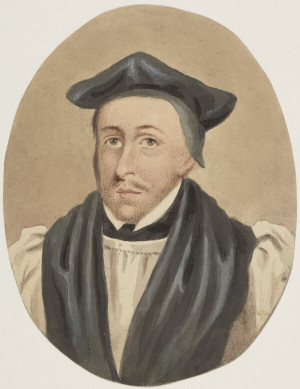
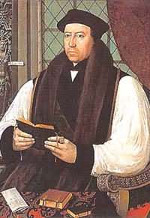
James was succeeded by Charles I, born in 1600. Charles became King in 1625, and married Henrietta Maria of France, a Roman Catholic. If James I’s response had made him unpopular with the Puritans, Charles’s marriage to a Roman Catholic only compounded the problem. Charles proceeded to make the situation even worse in 1633, when he appointed William Laud (1573-1645) as Archbishop of Canterbury. Laud is known for the vicious suppression of his opponents, doing such things as cutting off their ears, branding them, or slitting their noses.
In 1642, Puritans from inside of the Church of England joined with independent groups like Congregationalists and Baptists in the revolutionary English Civil War, leading to the eventual removal of the King by beheading. In 1645, Archbishop Laud was executed. In 1646, Presbyterianism triumphed in the war and became the official church in England, replacing the Thirty-Nine Articles with the Westminster Confession of Faith along with a Larger and Shorter Catechism. In 1649, King Charles was executed.
The Puritan regime lasted approximately ten years. Oliver Cromwell, leader of the Puritan cause, died in 1658. In 1660, the monarchy was restored, and Charles II reigned from 1660 to 1685. Charles’s main contribution to the long term future of Anglicanism was to revise the Prayer Book in 1662. Several centuries later, Parliament would reject a revision of the Book of Common Prayer in 1928, leaving the 1662 Prayer Book in place. The Alternative Service Book appeared in 1980, which was replaced in 2000 by Common Worship, which is not a single text, but a series of books used in many churches. While these revised rites are used in most contemporary parishes, the 1662 Book of Common Prayer is still the official Prayer Book of the Church of England.
In 1685, Charles II converted to Roman Catholicism on his deathbed. He was succeeded by James II, who reigned a short three years from 1685 to 1688. James II was a Roman Catholic, and also an upholder of the Divine Rite of Kings. James was so unpopular that he had to flee the country in 1688. With the flight of James, Parliament declared the throne vacant and invited William of Orange (a Protestant from the continent) and his wife Mary (daughter of James) to take the throne. William and Mary reigned from 1689 to 1702. This replacement by William and Mary of an entire dynasty of bad kings is referred to as the Glorious Revolution.
Several changes followed. Parliament passed the Toleration Act, which guaranteed religious freedom to Non-conformist Protestants, but not yet Roman Catholics or Unitarians. A Bill of Rights restricted the King’s authority over Parliament. A small group of Anglicans who remained faithful to King James were known as the Non-Jurors.
The Caroline Divines
An examination of the writings of the Caroline Divines will be preceded by some biographical material. (more…)

 For purposes of completeness, I need to wrap up my responses to criticisms of the exegetical and historical arguments in my book Icons of Christ (and in the essay I wrote with Grant LeMarquand “On Women and Holy Orders”) by addressing criticisms of my claim in the final two chapters (15 and 16) before the Conclusion that there is good evidence that women held office in the New Testament period. Is there evidence that women held office in the New Testament period?