
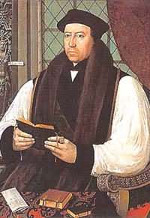
Today is the Feast Day of Thomas Cranmer, who placed his hand in the fire when he died at the stake on this day 470 years ago. I thought it a fitting day to post this essay on his sacramental theology.
A previous essay focused on Thomas Cranmer’s Reformation theology, specifically the way in which Cranmer embraced but also gave his own interpretation to the three Reformation principles of Sola Scriptura (the normative authority of Scripture alone), Sola Gratia (justification by grace alone), and Sola Fide (through faith alone). Cranmer affirmed the primacy and sufficiency of Scripture over all church tradition, while nonetheless also affirming the significance of tradition as the proper context for the interpretation of Scripture. He also affirmed both the reading of Scripture translated into the common language along with a focus on the reading of Scripture as a means of edification (the “priesthood of all believers”). Cranmer interpreted justification by faith alone to mean justification by Christ alone, with faith understood as the “lively faith” that embraced the crucified and risen Christ’s righteousness in contrast to what he called “dead faith.”
This essay will address the two other areas where Cranmer contributed most to the history of Anglican theology: his doctrine of the sacraments, particularly the Eucharist, and his contribution as author of the 1549 and 1552 versions of The Book of Common Prayer, focusing specifically on the eucharistic rites in the two books.
Reformation Eucharistic Theologies
If there was a general consensus among Reformation churches concerning the primacy and normativity of Scripture as well as justification by grace alone through faith alone, no such agreement existed for sacramental theology, style of worship, or church polity. The Reformers disagreed as much among themselves as they did with the Roman Catholic church concerning their theology of the sacraments, liturgical worship, and church orders (ordination). Concerning the sacraments, areas of disagreement concerned whether sacraments are means of grace, whether the risen Christ is present in the Eucharist, and, if so, in what manner, whether infants should be baptized, and whether baptism regenerates. Concerning worship, whether the church should retain or discard the historic liturgical worship of the church (the Catholic “mass”), and if retained, to what extent should the liturgy be preserved or modified. Concerning orders, whether the church should retain episcopacy, and, if not, whether the church should be governed by elders (presbyterian) or democratically (congregational).
Concerning the sacraments, there has been a history of disagreements in the Western church about the Eucharist – of how it is that the consecrated elements become the body and blood of Christ or how they unite the believer to Christ – that precedes the split between the Eastern and Western church. This has not been so much a concern in Eastern theology, and it may well have something to do with the Western understanding of how Christ makes himself immediately present in the Eucharist rather than the Eastern understanding that Christ is mediately present through the invocation of the Holy Spirit in the epiclesis.1 This fundamental difference between West and East concerning what can be designated as two separate “models” of Eucharistic presence has not been sufficiently recognized in discussions of Eucharistic theology, but is arguably as fundamental for understanding the Reformation-era disagreements as the disagreements themselves.2
The standard Western model of the Eucharist has a Christocentric emphasis. In the Western understanding, Jesus Christ as the risen and ascended Son of God acts directly and immediately to make himself present in the sacraments. During the Eucharistic prayer, the celebrant (or priest) represents the risen Jesus Christ. In Latin, the expression in persona Christi (in the person of Christ) means that the celebrant acts as a visible representation of the invisible risen Christ. When the celebrant pronounces the “Words of Institution” – “This is my body” and “This is my blood” – the physical elements of bread and wine are transformed to “become” (or make present) the body and blood of Christ.
The role of the Holy Spirit tends to be minimized. Insofar as the Spirit is present, the Spirit is present in either of two ways. First, by “appropriation.” That is, the Holy Spirit is present along with the risen Christ in the same manner in which the one God as the undivided divine nature acts throughout creation but specific divine acts are “appropriated” to a particular person because of a special fittingness. The phrase “all acts of the Trinity ad extra are one” (Opera Trinitatis ad extra indivisa sunt) means that all acts of the triune God outside God’s own nature (ad extra) are common to all three persons as to a single principle of action with the exception of acts specific to the mission of a specific person.