
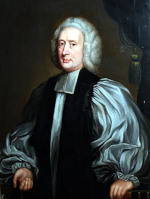
Joseph Butler (1692 – 1752)
“The greatest of all the thinkers of the English Church” (Stephen Neill, Anglicanism)
1692 Born Wantage, Oxon
1714 Abandons Presbyterianism, Enters Oriel College, Oxford
1718 Ordained Deacon and Priest at Salisbury
1718-1726 Preacher at Rolls Chapel (Sermons made him famous)
1726 Stanhope, Durham (lives in seclusion, engaged in pastoral duties, wrote Analogy of Religion
1736 Analogy of Religion
1736 Clerk of the Closet (Attends Queen Caroline)
1738 Bishop of Bristol (conflict with John Wesley)
1740 Dean of St. Paul’s
1750 Bishop of Durham
It is arguably the case that the foundations of Anglican theology began with King Henry VIII’s separation of the Church of England from communion with the bishop of Rome. Henry’s English Catholicism was succeeded by the more Protestant English Reformation during the reign of his son Edward VII, and culminated with the restoration of Prayer Book Anglicanism during the Elizabethan settlement of Henry’s daughter Elizabeth I. Theologically, the beginnings of Anglican theology are found in the writings of Thomas Cranmer, the 1549 and 1552 versions of the Book of Common Prayer, the Thirty-Nine Articles, and the sermons of the Book of Homilies. Anglican theological identity continues with the apologetic works of John Jewel during the Elizabethan settlement and the definitive articulation of Anglican identity in Richard Hooker’s Laws of Ecclesiastical Polity. However, the initial period of Anglican identity does not end with the reign of Elizabeth, but continues in the following period of the Caroline Divines, the English Civil War, and the restoration of the monarchy under William and Mary. Although they did not write theological tomes, the sermons and poetry of writers like Lancelot Andrewes, George Herbert, John Donne, and (although he was unknown) Thomas Traherne, are as fundamental to the foundations of Anglican identity as is the work of Thomas Cranmer.
The period after the Glorious Revolution is marked by a historical shift. If the initial period of Anglican theology was marked by moves to identify Anglicanism in conversation with and over against both Roman Catholicism on the one hand and other versions of Reformation Protestantism (especially Puritanism) on the other, Anglican theology found itself engaging with a new conversation partner beginning in the seventeenth and eighteenth centuries – what would over a period of centuries become not another version of Christian faith but an alternative to Christian faith altogether that would eventually become secular modernity. Joseph Butler is the first Anglican theologian to address the problem of modern unbelief.
The Wars of Religion
The political background to the era of the Caroline Divines was the English Civil War in which the Puritans overthrew the monarchy and beheaded both King Charles as well as the Archbishop of Canterbury, William Laud. After a period of around ten years, the monarchy was restored under William and Mary. This political conflict that temporarily removed a government in England was neither unusual nor distinct. One of the consequences of the Protestant Reformation was a series of wars that took place throughout Western Europe – the so-called “Wars of Religion.” In the Netherlands, the Eighty Years War (1568–1648) was fought between the Dutch Reformed Protestant church in the north in what became Holland and Spain with the Roman Catholic church in the south that became Belgium. In France, the Roman Catholic church more or less successfully exterminated the Protestants known at that time as Huguenots. Catholic success is one of the reasons why France continued to be a largely Roman Catholic country, although the later French Revolution certainly minimized Catholic significance in France. In Switzerland and Germany there were similar wars involving Protestants on the one side and Roman Catholics on the other. The Swiss Reformer Ulrich Zwingli died in battle fighting against Roman Catholics. Luther said afterwards that Zwingli’s death was God’s judgment for his eucharistic theology. The Thirty Years War (1618-1648) began as a conflict between Roman Catholics and Protestants in the Holy Roman Empire. It expanded to include participants from present-day Germany, Belgium, France, and Spain (on the Catholic side) and Sweden, Denmark, Norway, and Scotland (on the Protestant side). There were over eight million casualties.
One of the consequences of the Wars of Religion was a frustration with such wars and an accompanying distrust of the ability of religion to resolve conflict. The peoples of Europe had lived through a hundred years of violent disagreements between not only Roman Catholics and Protestants, but between different varieties of Reformation churches. Certainly the war in England was a war not so much between Catholics and Protestants as between two different kinds of Protestants, and there also had been disagreements on the continent between Lutherans and the Reformed. Finally, there were the Anabaptists, whom everyone persecuted. (If there was one ecumenical agreement between Roman Catholics, Lutherans, Reformed, and Anglicans, it was that it was a good thing to kill people who opposed infant baptism.) Far from being able to resolve conflicts raised by disagreement, different understandings of what it meant to be Christian was itself the major cause of disagreement until eventually all sides came to the conclusion that one could not resolve differences of theological opinion by killing one’s opponents.
A second consequence of the Wars of Religion was a concern for tolerance. It came to be understood that when there is strong theological disagreement and differences cannot be resolved except through violence, there can be no possible way to live together peacefully. There was an eventual realization that the best solution was to allow disagreement, to not fight or to kill one another about religious differences, but to be tolerant of one another.
Modern Science
A third and arguably unrelated change was the rise of the modern physical sciences. Copernicus, Galileo, and Newton were the three most prominent figures. Nicolaus Copernicus (1473–1543) is known for the so-called “Copernican Revolution,” the understanding that the planets revolve around the sun rather than the Ptolemaic view that the earth was at the center of the universe. Galileo Galilei (1564-1642) defended the Copernican position and made numerous discoveries with his telescope. Among other things, Isaac Newton (1643-1727) discovered the “laws of motion,” for which he is known. The work of Copernicus, Galileo, Newton, and others led to a confidence in the reliability of what came to be called the “scientific method.”
The historical overlap between the Wars of Religion and the rise of modern science led to a fundamental difference between the perceptions of science and religion. Science was different from religion in that science could give certain knowledge about which there could be fundamental agreement. The view arose that while we cannot have confidence in theology or religion, which only lead to irresolvable disagreements that end in violence and war, we can have confidence in the claims of science.
Modern Philosophy
Finally, along with the rise of confidence in science arose a confidence not in theological but in philosophical reason, specifically reason in contrast to faith. Faith tells us to believe certain things, yet different Christian groups tell us to believe different things. Roman Catholicism demands belief in the pope and transubstantiation. The Church of England denies belief in the pope and transubstantiation. Puritan beliefs differ from both the Roman Catholic church and the Church of England. These conflicting theological claims eventually lead to wars in which kings and archbishops are beheaded, and the Puritans are no better than the king they removed.
In contrast to religious faith, “reason,” specifically the kind of reason used in the physical sciences, leads to certain conclusions. There thus arose not only a confidence in science and reason, but a new approach to knowledge and to reason based on autonomous philosophy.
Previously, from the time of Augustine of Hippo, philosophical reasoning in Western culture operated within the parameters of theology: faith seeking understanding. In standard modern histories of Western philosophy, names that are included in the early medieval period through the time of the Protestant Reformation – thinkers like Augustine or Bonaventure or Thomas Aquinas – are discussed as philosophers, but they were actually theologians. William of Ockham, known for the logical tool of “Ockham’s Razor,” was a theologian, not a philosopher.
After the Wars of Religion, philosophers pursued philosophy as a task independent of theology. Philosophy thus became an independent autonomous discipline, much as it had been among the ancient Greeks and Romans, and this remains largely true today, with secular and even Protestant and Catholic colleges and universities housing separate faculties for Philosophy and Religion/Theology departments.
The first figure responsible for this shift is René Descartes (1596-1650), known for his statement, Cogito ergo sum (“I think therefore I am”).1 The starting point of Descartes’ philosophical system was the methodology of doubt: I will not believe anything unless it is indubitably certain. Descartes is associated with the rise of the philosophical approach of “rationalism,” which begins with the knowing mind or reason alone. Descartes was first a mathematician, and he thought that the way in which reason functioned deductively in mathematics should also be the model for how reason should function in philosophy.
Correlated with the Cartesian methodology of doubt is a “move to the self” as the starting point of philosophy – the priority of epistemology (theory of knowledge) over ontology or metaphysics (theory of being). Epistemology is the area of philosophy that has to do with how we know things, and how we know what we know. Metaphysics or ontology is the area of philosophy that has to do with the objects of knowledge – the things we know – the science or philosophy of “being.” Up to this point in the history of philosophy, the tendency had been to begin with metaphysics. Traditional philosophers (like Plato or Aristotle) consider what exists before they discuss how we know what we know about what exists. After Descartes, the starting point of philosophy shifts to such questions as “How do we know? How can we be certain that we know anything?” This Cartesian concern for epistemological certitude dominates modern philosophy.
The second important philosopher in this conversation was John Locke (1623-1704) – the father of the philosophy of empiricism, a methodology at the seeming opposite extreme from Descartes’s rationalism. While Descartes began with the knowing subject, Locke’s starting point was the world around us, what we can see, touch, feel, and taste – sense perception.2 Yet Locke shares with Descartes a fundamental concern of modern epistemology: the certainty of knowledge, but beginning from a different starting point. While Descartes gave priority to the knowing self, Locke gave priority to sensible experience of the physical world.
Theologically, the influence of Locke’s emphasis on “experience” can be seen in the adding of the fourth leg of “experience” to Richard Hooker’s so-called “three-legged stool” of Scripture, tradition, and reason. Locke was also a political philosopher, and an important theme in his political philosophy was a concerns for tolerance, reflecting again a reaction to the intolerance of the Wars of Religion.
In 1695, Locke wrote The Reasonableness of Christianity, the title of which reflects the new concern for the indubitable certainty of reason.3 Descartes and Locke were both rationalists in the sense that they agreed about the priority of reason. Where they disagreed was whether a rationalist approach to epistemology should begin with the knowing self or with known physical objects.
Deism
Modern philosophical movements that combined a priority of reason with a concern for epistemological certainty accompanied by a confidence in knowledge obtained through the physical sciences provide the historical background behind the new religious movement of Deism – a modern set of religious beliefs that affirms the existence of a creator God, but denies that this God is involved in the day-to-day course of the universe. The Deist God is the “first cause,” the creator of the universe, who, as it were, “wound things up,” let the universe run “under its own steam,” and left the universe and humanity to get by on our own.
Th God of Deism does not perform miracles because he does not interfere in our lives. He “lets us be.” Edward Herbert,Lord Herbert of Cherbury (1583-1648) was one of the first Deists.4 Significant as the brother of George Herbert, the great religious poet of the Caroline Divines who emphasized the involvement of God in everyday life, tt is ironic that Herbert’s lesser-known brother was one of the founders of Deism, someone who believed that God never involves himself in our everyday lives.
John Toland (1670-1722) laid down the basic principles of Deism that Joseph Butler would later address.5 The first principle of Toland’s Deism was what he called “natural religion.” Toland did not know much about, and could not have known much about, non-Western religions like Buddhism or Hinduism. These East Asian religions were an unexplored continent away, but Toland imagined that behind all actually practiced religions is “natural religion,” not practiced as an actual living religion, but a theoretical form of religion that all human beings would have practiced if they had not been encumbered by the actually existing religions. For Toland, if there had been no Hinduism or Buddhism. Judaism. Christianity, or Islam, there would have been “natural religion.”
A central characteristic of natural religion is a belief in God as creator, and, to a lesser extent, in God’s relationship to the world, but this relationship has nothing to do with revelation. The God of Deism is a God who does not speak and does not act.
Natural religion affirmed three postulates. First, that there is a God, and human beings can know that this God exists. Second, natural religion affirmed certain ethical principles. There are moral behaviors that everyone should practice, and others that everyone should avoid. There are morally “right” and “wrong” behaviors, and these ethical requirements correspond to much of the content of the Ten Commandments, certainly not the Sabbath commandment and perhaps not the commandment against making idols, but at least the second table of the Ten Commandments and the central gist of the first table. “Love God” and “love your neighbor” would be the two minimum moral demands that Deism would endorse.
Third is the notion of reward and punishment in an afterlife: What will happen to us in the afterlife has to do with how well we live out this system of ethical requirements in this life. There are numerous stories and jokes in which someone dies, goes to heaven, the person’s good deeds are weighed against their bad deeds, and if the good deeds outweigh the bad deeds, they get into heaven. This is Deist soteriology in a nutshell.
Anglican Responses to Deism
These three points make up the Deistic understanding of what religion is all about.
In the Church of England, there were several responses to Deism. Three will be mentioned before turning to the response of Joseph Butler. The Cambridge Platonists were active from around 1633 to 1688. Consistent with the times, the Cambridge Platonists were advocates of reason and tolerance who claimed that reason was the indwelling of God in the mind. The Cambridge Platonists received their name because they attempted to combine the philosophy of Neoplatonism with Christian faith. They had little to no influence in later English philosophy or theology.6
The Hutchinsonians were a group of Oxford followers of the Hebrew scholar, natural philosopher and cosmologist John Hutchinson (1674–1737), including George Horne (1730–1792), William Jones of Nayland (1726–1800) and Alexander Catcott (1725–1779). The Hutchinsonians defended a Trinitarian cosmology against the Newtonian Arianism of figures like Samuel Clarke (1675-1729). They combined a positive respect for “natural philosophy” (the philosophical study of nature) with a figurative reading of Scripture.7
The Latitudinarians were a mid-seventeenth century movement who were unhappy with controversy in theology, and advocated an alternative to theological conflict by focusing on piety and morality over theology. The Latitudinarians believed that the most important characteristics of Christian faith are first, piety – that Christianity is primarily concerned with spirituality or love and worship of God – and second, morality, the living out the Ten Commandments. The Latitudinarian solution to religious conflict was to suggest that Christians should be willing to agree about piety and morality without involvement in detailed esoteric discussions of theology that only lead to conflict.
The Latitudinarians were often “heterodox” in their doctrine of the Trinity. While not technically heretical, their views sometimes verged on the heterodox. The Latitudinarians advocated a harmonization between faith and reason. However, by contrast with the approach of someone like Richard Hooker they tended to understand reason in terms of what could be designated as “common sense.” What the Latitudinarians advocated was not so much a harmony between faith and reason as a harmony between faith and common sense. What the average upper-class educated English person would have believed in the mid-1600s was what they meant by reason, and personal faith always fit in with English “good common sense.”
Simon Patrick (1625 to 1707) wrote the book A Brief account of the New Sect of Latitude Men in 1662.8 Patrick had an influence on Christian missions in that he helped found the Society for the Promotion of Christian Knowledge (SPCK) as well as the Society of the Propagation of the Gospel in Foreign Parts (SPG). Patrick commented on Scripture, and also wrote controversial works against non-conformists and Roman Catholics. (The non-conformists were Protestants who were not part of the Church of England, for example, Congregationalists or Presbyterians). Patrick also wrote several devotional books.
Joseph Butler
Joseph Butler (1692-1752) was very important for Anglican theology in previous generations. However, despite Stephen Neil’s claim in his book Anglicanism that Butler was “the greatest of all the thinkers of the English Church,” Butler is more or less forgotten today.9 Butler is still a significant figure, if nothing else because of his place in defining Anglican identity during the transitional period to modern secularism.
Butler was born in 1662 in Wantage, in what is now Oxfordshire. He was raised Presbyterian, but in 1714 abandoned Presbyterianism and entered Oriel College, Oxford. Butler was ordained a deacon and priest at Salisbury in 1718. From 1718 to 1726, he was the preacher at Rolls Chapel.
Butler wrote many sermons, which led to a certain amount of fame. Butler’s sermons are unfortunately difficult to read. They are rational and abstract to an extreme, and their subject matter often focuses on virtue.10 In comparison with other Anglican figures, they are certainly not as accessible as the sermons of John Donne or Lancelot Andrewes.
In 1726, Butler went to Stonehope in Durham. He wrote his book The Analogy of Religion in 1736. In 1736, Butler became Clerk of the Closet, which meant that he worked for Queen Caroline. In 1738, Butler became Bishop of Bristol. In 1739, Butler had an infamous interview with John Wesley, and, given Butler’s rational approach to theology, it is not surprising that Butler did not trust Wesley’s more emotional approach. As Wesley recounted the conversation, Butler stated: “Sir, the pretending to extraordinary revelations and gifts of the Holy Ghost is a horrid thing, a very horrid thing.”11 In 1740, Butler became Dean of St. Paul’s Cathedral, and, in 1750, Bishop of Durham.
Even during his lifetime, Butler faced the criticism that his writings were difficult to understand.12 While the criticism is justified, a careful and patient reading will be rewarded with an understanding of Butler’s key themes.
Moral Philosophy
What are Butler’s chief contributions? Butler’s writings outside of The Analogy of Religion are largely in the area of moral philosophy. Butler was primarily opposed to Thomas Hobbes, a determinist philosopher of the time. The principles of Butler’s moral philosophy are as follows.
First, true morality is living in accordance with one’s nature. By “nature,” Butler did not mean to live in a manner that we think might make us happy, but the nature that God created us to have.
Second, Butler embraced the principles of self-love, benevolence, and conscience. Again, Butler does not mean self-love in the sense of putting oneself before others, but genuine self-love, loving the self that God has made us to be. Butler complained that our natural passions and instincts do not conform to self-love or benevolence. We may think that what our passions are driving us to do is to love ourselves, but Butler claims that that is often an illusion. To the contrary, those things that our passions lead us to do are often contrary to genuine self-love or benevolence to others. Butler insisted that true benevolence or the love of one’s neighbor is disinterested. We should love our neighbor regardless of what benefit might come to us or how we might be rewarded. Butler insisted that the principles of morality are intuitively self-evident. We just know what they are, and, finally, Butler claimed that conscience has supreme authority.
There are some similarities in Butler to the moral theology that we might find in Augustine of Hippo or Thomas Aquinas or Richard Hooker, but there are significant differences of emphasis. In particular, Augustine, Aquinas, and Hooker have a more positive view of the passions than does Butler and the teleological eudaemonist claim that all of our choices are rooted in a desire for happiness that is ultimately oriented toward union with God in the beatific vision would at the least be in tension with Butler’s insistence that love of neighbor is disinterested.
The Analogy of Religion
The full title of Butler’s book famous book is The Analogy of Religion Natural and Revealed to the Constitution and Course of Nature.13 The book is an apologetic defense of Christianity against Deism. Butler is sometimes thought to be a rationalist who in The Apology is arguing against other rationalists, but this is not quite correct. Butler’s approach is indeed rational, but Butler is using reason to defend Christianity against the Deists’ rationalist claim that Christianity is irrational. If the Deists are criticizing Christianity because they claim that it is unreasonable, it is necessary to respond with a reasonable defense, which is what Butler does.
In a Preface to the First Edition, Butler begins by pointing out that there are people in his time (as is the case today) who reject Christianity because they claim that it is irrational:
It is come, I know not how, to be taken for granted, by many persons, that Christianity is not so much as a subject of inquiry; but that it is now, at length, discovered to be fictitious. And, accordingly, they treat it as if, in the present age, this were an agreed point among all people of discernment; and nothing remained, but to set it up as a principal subject of mirth and ridicule, as it were by way of reprisals, for its having so long interrupted the pleasures of the world.
It is as common in our own day as it was in Butler’s for people to reject Christian faith not as a rational position with which one disagrees but as so irrational as only to deserve ridicule and contempt.
Butler’s way of responding to the Deists was to concede as much as possible to their position, but then to argue that logical consistency demands the Deists should embrace rather than reject revelation insofar as “natural” and revealed religion are equally reasonable, but that revealed religion supplies answers to questions that the Deist account of natural religion cannot address.
This approach is contrary to that of much popular modern apologetics. A common apologetic tactic is to find the ways in which one’s opponents are irrational or illogical – to look for inconsistencies in their position – and to refute them as illogical. Butler instead approaches his Deist opponents with a certain sympathy. He argues along something like the following lines: I will see how far I can go with you. I will concede as much to your claims as I can, but then I will argue that if you are really consistent, you should go a little bit further than you have gone, and recognize that the very things that you consider valuable only make sense if Christianity is true.
Something like a contemporary approach similar to Butler’s can be found in Alasdair MacIntyre’s suggestion of conversations between conflicting traditions in which participants engage in conversation with rival standpoints but would be neither partisan nor suppose that moral and intellectual judgments between positions is impossible. 14
Butler summarizes his entire argument in the following passage:
As God governs the world, and instructs his creatures, according to certain laws or rules, in the known course of nature, known by reason together with experience; so the Scripture informs us of a scheme of divine Providence, additional to this. It relates, that God has, by revelation, instructed men in things concerning his government, which they could not otherwise have known, and reminded them of things which they might otherwise know; and attested the truth of the whole by miracles. Now if the natural and the revealed dispensation of things are both from God, if they coincide with each other, and together make up one scheme of Providence, our being incompetent judges of one, must render it credible that we may be incompetent judges also of the other. (Part II. Ch. 3)
What Butler is saying is that there is a corelation between (1) what we can know in the world around us using our natural knowledge (“natural reason”), (2) the world that God has created, and (3) what God has told us in revelation. These three fit together, and Butler will explain how that is the case as he makes his argument. Butler’s method is to address the consistency between reason (specifically our “natural” knowledge of the world), between God and creation, and the way that divine revelation makes sense of both.
The way in which Butler makes these connections depends on a theoretical connection between “probability” and “analogy.” Butler claims that “probability” and “analogy” are the the two criteria to test truth, and this connection is Butler’s way of challenging the Deist insistence on the ability of absolute reason alone to establish our claims.
Critique of Rationalism
Butler’s critique of Deism begins with a rejection of the methodology of Cartesian rationalism. We do not live our day-to-day lives by rational argument alone, but rather by probability. Unless we ourselves have divine omniscience, we cannot know with absolute certainty that when we wake up tomorrow that the sun will rise again. However, Butler claims, we can be fairly certain of future occurrences based on what we have experienced in the past. We go through life using predictability based on probability that builds on previous experience. Butler writes: “For nothing which is the possible object of knowledge, whether past, present, or future, can be probable to an infinite Intelligence; since it cannot but be discerned absolutely, as it is in itself, certainly true, or certainly false. But, to us, probability is the very guide of life” (Introduction, 4). What Butler is saying is that if we are God, we do not need probability because we would know everything. But we are not God, we do not have absolute infallible knowledge, and so we have to get by on the basis of probability.
Butler points out that we experience difficulties in our everyday life and we experience difficulties when it comes to our knowledge of the universe. If we can get through life even though there are difficulties that we cannot resolve, then the fact that there are things in Scripture that cause difficulties for us should not lead us to presume ahead of time that Scripture does not have anything worthwhile to say. Rather this seems to be consistent with the difficulties we encounter in the world in which we live.
[H]e who denies the Scripture to have been from God, upon account of these difficulties, may, for the very same reason, deny the world to have been formed by him. On the other hand, if there be an analogy, or likeness, between that system of things and dispensation of Providence, which revelation informs us of, and that system of things and dispensation of Providence, which experience, together with reason, informs us of, that is, the known course of nature; this is a presumption, that they have both the same author and cause; at least so far as to answer objections against the former being from God . . . (Introduction)
Analogy
Butler is arguing that there is a kind of correspondence or “analogy” between nature as we know it and revelation. Butler makes this argument using a fourfold analogy between, first, nature, and, second, morality, and third, natural religion – a religion that the Deists claim that we should all be familiar with even if there had been no revelation, and, fourth, revealed religion.
Nature → Morality → Natural Religion → Revealed Religion
It might appear at first as though Butler is adopting the rationalist approach of his opponents because he begins by accepting what they had claimed about nature and natural religion. However Butler is actually undermining their rationalistic arguments. Butler is saying that in all four cases, we cannot know ahead of time or beforehand what the case should be. We have to look to our experience of how things actually are rather than deciding that we know beforehand how we think things should be, and then arriving at conclusions based on our disappointments when things do not turn out the way that we think that they should turn out.
In the end, Butler is claiming that there is a basic mystery to the universe that we simply have to accept, and that mystery follows all the way through. Mystery is present in nature. Mystery is present in morality. Mystery is present in what the Deists call natural religion. Mystery is present in revelation.
First, Butler looks to the analogy of the universe, of nature. If we could design our own universe, Butler suggests, the universe that we would design would likely be one in which, at the end of the day, everyone had a good time. We all know that if we were to design a universe, that is the kind of universe we would design. Yet clearly that is not the universe that exists.
Moreover, imagining how we could create a universe in which everyone would be happy is actually beyond our capacities. If I tried to come up with a universe in which not only I could be happy, but every single person in the world would also be happy at the end of every day, I could not possibly succeed. Anything that might make me happy is liable to make someone else unhappy. Butler writes:
[T]here are others who indulge themselves in vain and idle speculations, how the world might possibly have been framed otherwise than it is; and upon supposition that things might, in imagining that they should, have been disposed and carried on after a better model, than what appears in the present disposition and conduct of them. Suppose, now, a person of such a turn of mind to go on with his reveries, till he had at length fixed upon some particular plan of Nature, as appearing to him the best . . . . And it seems there could be no stopping, till we came to some such conclusions as these: That all creatures should at first be made as perfect and as happy, as they were capable of ever being . . . eventually, and in fact, always do what was right and most conducive to happiness, which would be thought easy for infinite power to effect . . . (Introduction)
Against something like Gottfried Wilhelm Leibniz’s (1646-1716) notion of a “best possible world,” Butler claims that we are not clever enough to figure out how to create a best possible universe. Butler writes:
[W]e are far from being able to judge what particular disposition of things would be most friendly and assistant to virtue; or what means might be absolutely necessary to produce the most happiness in a system of such extent as our own world may be . . . . Indeed, we are so far from being able to judge of this, that we are not judges what may be the necessary means of raising and conducting one person to the highest perfection and happiness of his nature. . . . . (Introduction)
Since we are not intelligent enough to create a universe in which we can figure out how to make everybody happy, this is obviously not how we should proceed. Butler then suggests that there there is an analogy between this natural universe and the moral universe. As we are unable through our own capacities to imagine how to make a universe on our own that would make everybody happy, so we also cannot figure out through or own rational capacities how to make a moral universe in which everything would turn out well.
The natural world then, and natural government of it, being such an incomprehensible scheme; so incomprehensible, that a man must really in the literal sense know nothing at all, who is not sensible of his ignorance in it: this immediately suggests, and strongly shows the credibility, that the moral world and government of it may be so too. Indeed, the natural and moral constitution and government of the world are so connected as to make up together but one scheme: and it is highly probable, that the first is formed and carried on merely in subserviency to the latter, as the vegetable world is for the animal, and organized bodies for minds. But the thing intended here is, without inquiring how far the administration of the natural world is subordinate to that of the moral, only to observe the credibility, that one should be analogous or similar to the other: that therefore, every act of divine justice and goodness may be supposed to look much beyond itself and its immediate object; may have some reference to other parts of God’s moral administration, and to a general moral plan; and that every circumstance of this his moral government may be adjusted beforehand with a view to the whole of it. (Part I. ch. 7)
Butler is claiming that in manner similar to the way that we cannot figure out how to create a natural universe in which everyone would be happy, we are also not intelligent enough to figure out how God could make a moral universe in which everything would turn out well. It is, so to speak, above our pay grade.
If we concede to the Deists that there is a God who could create a natural world, then we can also presume that the same God could create a moral world, and that this God would know what he was doing. However, we could no more know how God should establish a moral order any more than we could know how to instruct God in creating the universe. It is not our job to tell God ahead of time how he should create the natural universe or how to organize the moral realm within the universe.
Butler then ties this analogy to the concept of “natural religion.” By natural religion Butler is referring to the Deists’ understanding of what they assume we should know would be the case if there had been no revelation. Butler draws the same correlation between morality and natural religion as it had drawn between a created nature and morality. As there is an analogy between nature and morality, so there should also be an analogy between morality and natural religion. However, as we are unable to decide ahead of time in regard to the first two categories, we also cannot decide ahead of time as to the third. We cannot decide ahead of time how God should accomplish his purposes in natural religion.
But this is exactly what the Deists were doing. In essence, the Deists were claiming: If I were God, I would create a universe in which people would know that God existed, in which right and wrong would be rewarded and punished, in which there would be an afterlife to reward and punish, and I would not do anything more than that.
Butler again lays his criticism against such a priori reasoning. He counters that we are not competent judges to decide ahead of time how God should correlate moral government and human desert.
Thus the proof of religion is a proof of the moral character of God, and consequently, that his government is moral, and that every one upon the whole shall receive according to his deserts; a proof that this is the designed end of his government. But we are not competent judges what is the proper way of acting, in order the most effectually to accomplish this end. Therefore our ignorance is an answer to objections against the conduct of Providence, in permitting irregularities, as seeming contradictory to this end. Now, since it is so obvious that our ignorance may be a satisfactory answer to objections against a thing, and yet not affect the proof of it; till it can be shown, it is frivolous to assert, that our ignorance invalidates the proof of religion, as it does the objections against it. (Part I. ch. 7)
Butler’s account is wordy, but he is drawing a consistent argument all the way through. There is a kind of inability for us to know everything, to “see the big picture,” as it were. That we can live with the world as it exists, that we can live with nature without knowing ahead of time how the world should have been created, that we can live in a universe in which we accept the existence of moral rights and wrongs even though things do not always turn out the way we think that they should, and we do not know exactly how to reward the good and punish the evil has a parallel to what we can know (or rather cannot know) about natural religion.
Revealed Religion
At this point, Butler finally moves to discuss revealed religion. Butler claims that we need revealed religion because revealed religion resolves some of these difficulties. Discussing revealed religion, Butler claims first that we have to distinguish between objections against the evidence of Christianity and objections against Christianity itself.
What does that mean? There could be reasons to believe that Christianity is not true. Suppose, for example, that the bones of Jesus could be dug up in Palestine tomorrow, and we knew these really were the bones of Jesus. That would prove that Jesus had not risen from the dead.
Butler would say that this is a reasonable argument against Christianity, but to say ahead of time that one is not a Christian because one does not think that Christianity makes sense, that one is not a Christian because one does not think that God would deal with the good and evil in the world by sending his Son to die on a cross for the forgiveness of sin – and these are the kinds of objections that the Deists were raising, the same kinds of objections that people raise today – Butler claims that these kinds of objections are frivolous because they are presuming to know ahead of time how God should create and manage the universe, morality, and the relationship between morality and religious belief and practice.
Having dispensed with frivolous objections against Christianity, Butler asks, why do we need revelation? Butler claims, first of all, that Christianity is a republication of natural religion.
Christianity is a republication of natural religion. It instructs mankind in the moral system of the world: that it is the work of an infinitely perfect Being, and under his government; that virtue is his law; and that he will finally judge mankind in righteousness, and render to all according to their works, in a future state. And which is very material, it teaches natural religion in its genuine simplicity, free from those superstitions with which it was totally corrupted, and under which it was in a manner lost. (Part II. ch. 1)
This shows the extent to which Butler is willing to agree with the Deists as far as possible. Butler concedes to the Deists: “We agree that God exists. We live in a world of right and wrong. We agree that in such a world, good should be rewarded, and evil should be punished.” Butler does not disagree with this. However, he is also claiming that one of the purposes of revelation is to instruct us in those things that the Deists think we can figure out all on our own because (they claim) we do not need God’s revelation to tell us these things. Butler does not share this confidence. One of the things that revelation does is to fill us in on the details of things that we think we know already.
Second, revelation is an account of realities not known by natural religion.
Christianity is to be considered in a further view, as containing an account of a dispensation of things not at all discoverable by reason, in consequence of which several distinct precepts are enjoined us. Christianity is not only an external institution of natural religion, and a new promulgation of God’s general providence, as righteous Governor and Judge of the world; but it contains also a revelation of a particular dispensation of providence, carrying on by his Son and Spirit, for the recovery and salvation of mankind, who are represented in Scripture, to be in a state of ruin. (Part II. ch. 1)
This is the crucial distinction between Deism and the revealed religion of Christianity. Butler concedes that there are things that we might know by reason, but there are also things that reason cannot tell us. Reason alone cannot tell us that we need a Savior. Reason cannot alone tell us that God has provided a Savior. We can only know that through revelation.
Next, revelation provides us with the way of salvation. Revelation lets us know that the unanswered question of how providence deals with good and bad moral behavior is that we are not as good as we think we are. We are sinners. The Deists never imagined that they were the ones whose good deeds might not outweigh their bad deeds, nor did they ask the question whether such moral calculation even makes sense, as if good deeds and bad deeds could be weighed against each other on something like a moral scale of calculation.
In this darkness, or this light of nature, call it which you please, revelation comes in; confirms every doubting fear which could enter into the heart of man concerning the future unprevented consequence of wickedness; supposes the world to be in a state of ruin, (a supposition which seems the very ground of the Christian dispensation, and which, if not provable by reason, yet it is in nowise contrary to it) . . . (Part II. ch. 5)
Further Butler claims that Christianity not only tells us that we are sinners in need of salvation, but it provides that salvation.
[H]e hath mercifully provided, that there should be an interposition to prevent the destruction of human kind, whatever that destruction unprevented would have been. ‘God so loved the world, that he gave his only begotten Son, that whosoever believeth,’ not, to be sure, in a speculative, but in a practical sense, ‘that whosoever believeth in him should not perish ;’ gave his Son in the same way of goodness to the world, as he affords particular persons the friendly assistance of their fellow-creatures, when without it, their temporal ruin would be the certain consequence of their follies; in the same way of goodness, I say, though in a transcendent and infinitely higher degree. And the Son of God ‘loved us, and gave himself for us,’ with a love which he himself compares to that of human friendship; though, in this case, all comparisons must fall infinitely short of the thing intended to be illustrated by them. (Part II, ch. 5)
Butler then responds to the kind of particular objections that the Deists raised against Christianity. First, Deists tended not to believe in providence. They claimed that God had created the world and left it to run on its own. Butler responds:
I find no appearance of a presumption, from the analogy of nature, against the general scheme of Christianity, that God created and invisibly governs the world by Jesus Christ, and by him also will hereafter judge it in righteousness, i. e., render to every one according to his works; and that good men are under the secret influence of his Spirit. (Part II, ch. 2)
Second, Deists did not believe in miracles. Butler responds again by claiming that there are no rational objections against the possibility of miracles.
Take in the consideration of religion, or the moral system of the world, and then we see distinct particular reasons for miracles; to afford mankind instruction additional to that of nature, and to attest the truth of it. And this gives a real credibility to the supposition, that it might be part of the original plan of things, that there should be miraculous interpositions. (Part II, ch. 2)
The Deists also objected the idea of a Mediator. They saw themselves a competent moral agents who could do things on their own. They saw no more need for divine assistance provided by a Savior than do contemporary people, and they did not ask for such assistance. Butler responded:
There is then no sort of objection, from the light of nature, against the general notion of a mediator between God and man, considered as a doctrine of Christianity, or as an appointment in this dispensation; since we find by experience, that God does appoint mediators, to be the instruments of good and evil to us, the instruments of his justice and his mercy. And the objection here referred to is urged, not against mediation in that high, eminent, and peculiar sense, in which Christ is our mediator; but absolutely against the whole notion itself of a mediator at all. (Part II, ch. 5)
Against Deist self-assurance and assumptions of competence, Butler responded that to be human is to need assistance. All of us need help in our lives from day to day. Why should not God decide to provide a Mediator for our salvation? In the end, Butler’s “bottom line” is that as we cannot know beforehand how nature should operate, as we cannot know beforehand how providence works in morality and natural religion, so we cannot know beforehand how or if God should reveal himself and how he should address problems raised by human moral behavior:
As we are in no sort judges beforehand, by what laws or rules, in what degree, or by what means, it were to have been expected that God would naturally instruct us; so upon supposition of his affording us light and instruction by revelation, additional to what he has afforded us by reason and experience, we are in no sort judges, by what methods, and in what proportion, it were to be expected, that this supernatural light and instruction would be afforded us. (Part II, ch. 3)
The hear of Butler’s argument is that Christianity completes and fulfills the inadequacies of what the Deists called “natural religion.” Christianity provides the way of salvation that the natural religion of the Deists cannot. As Mediator between God and humanity, Jesus Christ provides the moral rescue that the Deists thought they did not need.
Mystery
At bottom, the Deists lived in a world in which there was no mystery. Everything that needed to be known already was, and known ahead of time through rationalist speculation. Contrary to all too common misreadings, Butler did not respond to rationalism with more rationalism, but by appealing to mystery. There is, claimed Butler, more to the universe than the Deists imagined: “The constitution of the world, and God’s natural government over it, is all mystery, as much as the Christian dispensation. Yet under the first, he has given men all things pertaining to life; and under the other, all things pertaining into godliness” (Part II, ch. 5).
There is a correspondence between (1) the mystery of creation (which we cannot know about ahead of time) and the mystery of morality, between (2) the mystery of morality and the mystery of natural religion and providence, and between (3) the mystery of natural religion and the mystery of revealed Christianity. We cannot know ahead of time or in advance why any of these things should be as they are. We cannot say ahead of time “this is how I think things should be.” Yet in each case, an after-the-fact investigation shows that the Christian claims are reasonable – that they “make sense.”
Positive Arguments
We might expect Butler to end with an appeal to mystery, but Butler does not simply respond to negative criticisms against Christianity. He does provide some positive arguments. First, Butler makes arguments for the historical trustworthiness of the Bible. (He also appeals to the fulfillment of prophecy.) Concerning history, Butler points out that history and miracle combine seamlessly in the biblical records. If we are going to take seriously that the Bible contains history, we also need to take seriously what the Bible say about miracles.
Second, Butler looks to the letters of the apostle Paul, and notes that Paul made claims to having experienced personal revelation. We cannot prove Paul’s claim to be true, but we have to make a decision. Is Paul hallucinating? Is Paul lying or do we take him seriously?
Third, Butler looks to the uniqueness of Christianity’s miraculous origins, specifically to the miracles of Jesus. Butler refers to the large number of converts who would have been able to confirm or challenge this historicity. Our general trust of human testimony implies the miracles should be taken seriously.
It is significant that four hundred years later, apologists make similar arguments. They point out that the books of the New Testament were written so closely to the time that these events took place that if the miracles of Jesus had not happened, there would have been plenty of people to discredit them. That the Gospels were written so closely to the time when Jesus lived means that we need to take them seriously as historical accounts.
At the same time, Butler does not claim that this kind of evidence proves that Christianity is true. He is not a rationalist. What Butler does claim is that when we correlate the historical evidence with the rational coherence of Christian faith, which he had argued for in terms of analogy and probability, we have enough to go on. Butler concludes:
[A]ll this together, which, being fact, must be acknowledged by unbelievers, amounts to real evidence of somewhat more than human in this matter . . . and indeed abundantly sufficient to act upon. . . . The general view of the evidence for Christianity, considered as making one argument, may also serve to recommend to serious persons, to set down every thing which they may think may be of any real weight at all in proof of it . . . and they will find, that, judging by the natural rules by which we judge or probable evidence and common matters, they amount to a much higher degree of proof . . . than could be supposed upon considering them separately . . . . But the truth of our religion, like the truth of common matters, is to be judged by all the evidence taken together. And unless the whole series of things which may be alleged in this argument, and every particular thing in it, can reasonably supposed to have ben by accident, (for here the stress of the argument for Christianity lies), then is the truth of it proved . . . (Part II, ch. 7)
There is a kind of proof, but it is the kind of proof of what Butler would call “probability.” The whole thing fits together, it makes sense, and it addresses the problems that we cannot answer when we look to nature alone or when we look to what the Deists called “natural religion” alone.
Conclusion
In conclusion, does Butler have anything to offer us today? There are two popular alternatives to Christian faith in contemporary culture to which Butler would seem to have something. The first is what has been called “moralistic therapeutic deism.” Moralistic therapeutic deism is not as sophisticated philosophically as the kind of Deism Butler addressed, but but it is embraced uncritically by a large number of people. These are not necessarily Christians, but they believe that some kind of God might exist. This God created the world, good people will go to some kind of heaven, and who knows what will happen to bad people?15
Butler’s response to moralistic therapeutic deism is to fill in the picture. Christian faith tells us something about who this God is. It tells us why the world is in the mess that it is, that morality is not a matter of “good things should happen to good people and bad things happen to bad people,” but that even so-called “good people” do bad things, and it tells us that God has provided a solution in the incarnation, life, death and resurrection of Jesus Christ.
A second alternative to Christian faith popular a couple of decades ago was the so-called “New Atheism.” We might think at first that Butler does not have nuch to offer to the New Atheists because the New Atheists are not Deists. They do not believe there is a God who created the world and left it to run on its own. They do not believe that there is any God at all. Nonetheless, there are real parallels between the New Atheists and the Deists of Butler’s time, and Butler’s argument effectively responds to the New Atheists in the same manner that he responded to the Deists.
First, the New Atheism is very interested in modern science. However, contrary to the rhetoric we read in the New Atheists, the modern physical sciences are not simply based upon facts, but rather on “facts” and “interpretation” in conjunction. Modern science attempts to provide an interpretation of the facts that provides a “best fit.” To the extent that a contemporary scientist is a good scientist, he or she cannot decide ahead of time in what direction the facts are going to lead. Scientists have to examine the facts, and after having done that to follow the facts wherever they go, but those facts only make sense as they are understood within a broader interpretive framework. Methodologically, this is closer to Butler’s approach than it is to that of the New Atheists.16
One of the disappointing characteristics of the New Atheists is that they tend to approach religion the same way that the Deists did. The New Atheists decide ahead of time that they know what God should or should not have done if God were going to create a world, and that it should be a world in which suffering and evil do not exist. When the New Atheists read the Bible, or when they examine Christian faith, their arguments can be summarized something along the lines of “That is not what I would have done if I were God, and therefore Christianity cannot be true.”
This is where Butler is helpful, and his argument for Christian faith still holds. We cannot decide ahead of time how God should create a world, how God should deal with the human situation, or how God should or should not reveal himself. We can perhaps quarrel with arguments concerning the intellectual coherence of Christianity, and whether we can establish whether Christianity is historically tenable. But we cannot claim to know in advance what kind of universe the God we claim not to believe in should have created unless we share in some kind of divine omniscience.
The second characteristic of the New Atheists to which Butler’s approach can be helpful is that the New Atheists are woefully prosaic. They seem to lack any sense of mystery. To read the books of the most widely published of these authors is to read the words of those who claim to have it all figured out. Butler helps people to realize that we have not figured it all out. We cannot look at the world and say ahead of time that “this is how the world should work.”
Once we have opened our eyes to a sense of what Butler called “mystery” in the world around us, we realize, as Shakespeare wrote, that “there are more things in heaven and earth, Horatio, than are dreamt of in your philosophy.” We may find ourselves opening up to to the possibility that there is a God who is behind the things in heaven and earth. This God may have something going on that we do not know about, that we do not understand, and we may even find ourselves considering what we read in the New Testament about this person, Jesus Christ, in whom the Gospel writers tell us that God has come to meet us. Perhaps there is a mystery here that we need to take seriously.
1 René Descartes, Discourse on Method and Meditations, Laurence J. Lafleur, trans. (New York: Bobb-Merrill,1960).
2 John Locke, “An Essay Concerning Human Understanding,” The English Philosophers from Bacon to Mill, Edwin A. Burt, ed. (New York: Modern Library, 1967), 238-402.
3 John Locke, The Reasonableness of Christianity as Delivered in the Scriptures (London: Black Swan, 1695).
4 Edward Herbert, De Veritate, Prout Distinguitur a Revelatione, a Verisimili, a Possibili, et a Falso (London, 1645); De Veritate, Meyrick H. Carre, trans. (Bristol: University of Bristol, 1937).
5 John Toland, Christianity Not Mysterious or a Treatise Shewing That there is nothing in the Gospel Contrary to Reason, Nor Above it; and that no Christian Doctrine can be properly call’d A Mystery (London: 1696). Aa less charitable response than Butler to Toland was Oliver Hill, A Rod For the Back of Fools: in Answer to a Book by Mr. John Toland, Called Christianity Not Mysterious (London: William Turner, 1702).
6 Charles Taliaferro and Alison J. Tepley, eds. Cambridge Platonist Spirituality (Classics of Western Spirituality) (Mahweh, NJ: Paulist Press, 2004).
7 For a short introduction to William Jones, see David Ney, “The Multiplicity of Scripture Words: William Jones of Nayland and Figural Reading,” All they Lights Combine: Figural Reading in the Anglican Tradition, Ephraim Radner and David Ney, eds. (Bellingham, WA: Lexham, 2022), 195-217.
8 Simon Patrick, A Brief account of the New Sect of Latitude Men (London: Cambridge and Oxford, 1662).
9 Stephen Neill, Anglicanism (New York: Oxford University Press, [1958] 1978), 184.
10 Joseph Butler, Fifteen Sermons Preached at the Rolls Chapel, to Which are Added Six Sermons Preached on Public Occasions (London: 1749).
11 John Wesley, The Works of John Wesley Volume 19: Journal and Diaries II (1738-1743), W. Reginald Ward, ed. (Nashville: Abingdon, 1990), 471.
12 Butler responded to the criticism in the Preface to the Analogy of Religion: “It must be acknowledged that some of the following discourses are very abstruse and difficult, or, if you please, obscure; but I must take leave to add, that those alone are judges, whether or no, and how far, this is a fault, who are judges, whether or no, and how far, it might have been avoided—those only who will be at the trouble to understand what is here said, and to see how far the things here insisted upon, and not other things, might have been put in a plainer manner; which yet I am very far from asserting that they could not.”
13 There are countless editions of Butler’s book. One of the most recent is Joseph Butler, The Analogy of Religion, David McNaughton, ed. (Oxford: Oxford University Press, 2021).
14 Alasdair MacIntyre, Whose Justice? Which Rationality? (Notre Dame, IN: 1988),389-403; Three Rival Versions of Moral Enquiry: Encylopaedia, Genealogy, and Tradition (Notre Dame, IN: University of Notre Dame Press, 1990), 216-236.
15 Robert Bellah et al refer in their book Habits of the Heart: Individualism and Commitment in American Culture (Harper & Row, 1985) a religion they call “Sheilaism,” the self-described religion of a young woman named Sheila that has the characteristics of moralistic therapeutic deism.
16Modern insistence upon a broader interpretive framework to enable interpretation of scientific “facts” would be Thomas S. Kuhn, The Structures of Scientific Revolutions, 2nd edition (Chicago: University of Chicago Press, [1962] 1970) and Michael Polanyi Personal Knowledge: Towards a Post-Critical Philosophy (Chicago: University of Chicago Press, 1962).

[…] previous essay examined Joseph Butler’s response to Deism, a modern religious movement that affirmed the […]
Pingback by Non Sermoni Res — September 20, 2026 @ 5:04 pm