
The previous essay examined Joseph Butler’s response to Deism, a modern religious movement that affirmed the existence of a creator God, but denied that this God was involved in everyday life, and rejected any notion of divine revelation or miracles. Accordingly, Deism denied the creedal content of Christian faith: the doctrines of the Trinity, God’s covenant with Israel, the incarnation of God in Jesus Christ, the atonement, and doctrines of grace, the church, and eschatology. For all its strengths, Butler’s writings were abstruse and beyond the reach of the ordinary lay person.
Arguably, the Evangelical Revival was a second response to Deism that touched people more in their everyday lives, was more effective, and has certainly had a greater influence on the history of Anglicanism and even the greater church.1 Evangelicalism still exists as one of the historic “parties” of Anglican identity. The influence of the Wesleyan movement extended beyond Anglicanism to the formation of the Methodist churches (one of the largest Protestant denominations) and extended beyond Methodism to the “Holiness Movement” and Pentecostalism (one of the largest movements in modern global Christianity). The Great Awakenings in North America, revivalism, and modern American evangelicalism arguably can be traced to this movement. The hymns of Charles Wesley (Hark! The Herald Angels Sing) and John Newton (Amazing Grace) have extended beyond Anglicanism to become part of the hymnody of the broader Christian world. The mission movement that led to the evangelization of Africa and Asia began with the Evangelical Revival. The social conscience of the Evangelical Revival led to the abolition of the slave trade in England and to the eventual elimination of slavery both in Europe and the Americas.
The historical background to the Evangelical Revival lay in social changes that occurred throughout Europe, particularly the beginnings of the Industrial Revolution (1760-1830/40). Before the middle of the eighteenth century, most people in England and elsewhere in Europe lived in the countryside and made their living as farmers. As a consequence of the Industrial Revolution, a population shift took place as large numbers began moving to the cities to find work, and fewer made their living as farmers. As the cities grew more crowded, there was a corresponding rise of poverty and social inequality. The wealthy grew wealthier, the poor poorer. Although they lived in a later period, Charles Dickens’s novels like Oliver Twist and Elisabeth Gaskell’s North and South provide pictures of the social situation.
Another consequence of the population shift to cities like London was the collapse of the English parish system. George Herbert’s The Country Parson provides an example of how the system worked. As the pastor of a small village, Herbert was responsible for every person in that village. The word “parish” is often used today to refer to a particular church congregation, but in England the parish was a region in a primarily rural system.
When thousands of people began moving into the cities, pastoral care became a problem. In what parish did these new urban dwellers belong ? Unfortunately the English clergy were largely content to leave things as they were – to continue along the lines of the old parish system. There were thus no efforts to respond to a new problem. As a result, with no serious pastoral care for the new urban residents, they became unchurched.
The French Revolution (1789-1799) occurred contemporaneously, and was in many ways a reaction to the same kinds of changes in France that were taking place in England. Gaps between the wealthy and the poor were extreme. The French Revolution was anti-clerical in that it was perceived that the church was largely responsible for these problems, or at least was not doing anything to alleviate them. One could reasonably worry whether England would go through its own version of the French Revolution if the country’s leadership did not respond to problems of social inequality and poverty.
In the area of spirituality, the Pietist movement in German Lutheranism was a reaction against what was perceived to be a dry and overly intellectual confessionalism. Lutheran orthodoxy was dominated by Protestant scholasticism, a theological methodology that focused on intellectual depth and precision, but did not necessarily reach ordinary people. Critics accused the Protestant Scholastics of substituting the correct theological explanation of justification by faith for Luther’s life-changing doctrine.
Johann Arndt, the founder of Pietism (1555-1621), wrote True Christianity in 1605.2 Arndt claimed that justification by faith should not be understood merely as a doctrine, but was rather a lived faith in Jesus Christ. Justification had to touch people in their everyday lives, and change the way they live. Arndt’s views were similar to Thomas Crammer’s notion of “lively faith.”
Philip Jacob Spener (1635-1705), author of Pia Desideria (1675), began the practice of small groups meeting in local homes, designated “Colleges of Piety.”3 In these gatherings, participants would pray together and read the Bible. A key theme in Spener’s theology was that personal faith has priority over dogma. Like Arndt, Spener was suspicious of detailed systematic theology that he feared was excluisvely intellectual.
August Hermann Franke (1663-1727) was the founder of orphanages, schools, and a seminary. Although he was frequently opposed (and even expelled from Erfurt and Dresden) because of his Pietism, he finished his career teaching Greek and Oriental languages at the University of Halle, where he was also pastor and professor of theology. Under Franke’s influence, Halle became a center for Pietism and missions. Finally, Count Nicholas Ludwig von Zinzendorf (1700-1760) was influenced by Spener and was associated with the Moravian Church. The Moravians are important as the historical link between the continental movement of Pietism and Evangelicalism in the Church of England, specifically for their influence on John Wesley.
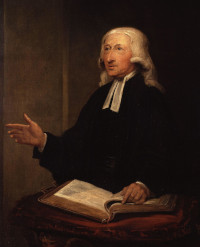
John Wesley
The Evangelical movement in the Church of England can be understood as a form of Anglican Pietism. In 1726, John Wesley (1703-1791) began his studies at Oxford, where he and some other undergraduates formed a group called the “Holy Club.” These students were labeled “Methodists” because they were “methodical” in their practices of praying and Bible study. The moniker was not self-chosen, but originated with critics.
In 1735, Wesley and his brother Charles went to the American colony of Georgia to serve as missionaries. On the voyage to Georgia, Wesley met up with a group of Moravians. During a storm, Wesley and everyone else on board the ship was terrified, but not the Moravians, who were praying. Wesley could not understand why the Moravians did not fear death. Wesley returned to England in 1737, largely having failed in his mission.
On May 24, 1738, Wesley attended a Moravian society meeting at Aldersgate Street, London, where someone read Martin Luther’s “Preface to the Epistle the Galatians.” Wesley wrote in his journal that as he heard Luther’s understanding of justification by faith being spoken about, his heart was “strangely warmed.” This was the moment that historically has been described in Methodist hagiography as Wesley’s conversion experience, although later he speculated that this was not necessarily the beginning of his Christian faith.
Almost immediately afterward, Wesley began field preaching, one of the unique characteristics of the Methodists. Rather than preaching in church buildings where they often were not welcome, Wesley and his followers and companions began preaching in the countryside. George Whitefield (1714-1770) was Wesley’s partner for a while. In 1740, Wesley broke with the Moravians, primarily over the issues of quietism and the use of the sacraments as means of grace. Wesley also believed that the Moravians did not take seriously enough the moral seriousness of the law. In 1741, Wesley and Whitefield broke mutually over the issue of predestination.
In 1744, Wesley began holding conferences of lay preachers. This was unusual in that non-ordained laity were engaging in Wesleyan field preaching. By 1751, Wesley’s lay preachers had covered the entire British Isles. The beginning of the break with the Methodists from the Church of England began in 1784, when Wesley ordained Thomas Coke to be a “superintendent” of the American Methodist Church. As Wesley’s followers began to spread in the American colonies, they encountered the problem of a lack of bishops. Because English bishops did not come to the colonies to confirm people, in order to be ordained, Anglicans in the colonies had to sail to England to attend seminary or university, probably Oxford or Cambridge, and then return. In consequence, despite the centrality of episcopacy for Anglican ecclesiology, Anglican colonists in North America had to get by without bishops. Because the Church of England was unwilling to accommodate Wesley’s concern for oversight of his followers in North America, Wesley himself ordained Thomas Coke out of frustration, although Wesley was not a bishop, but simply a priest.4 Although this move inevitably meant a split of Methodism from the Church of England, Wesley himself died an Anglican.
When Wesley died in 1791, there were 294 Methodist preachers, 71,668 members in Great Britain, 19 missionaries, 5,300 mission members, 198 preachers, and 43,265 members in North America.5 One of the ironies of the Evangelical Revival is that the Methodists reluctantly left the Church of England because English bishops were unwilling to work with them. In consequence, Methodism became much larger in the United States than Anglicanism. Even today, there are around four or five Methodists of one variety or another for every Episcopalian or Anglican in the USA.
What are some of the characteristics of Methodism?
In a manner similar to the earlier history of Anglicanism, the Methodist revival was a synthesis of theology and piety. In Wesley’s sermons and journals, spirituality and theology are closely connected.
A second characteristic of Methodism was its focus on outdoor preaching. When the Church of England failed at the task of providing pastoral care following the Industrial Reveolution for the new urban dwellers, the Methodists took it on. Wesley traveled on horseback, sometimes preaching three or four times a day. Wesley preached thousands of times all over England. At a time when Anglican bishops and parish priests were jealous to protect their specified boundaries, Wesley wrote in his Journal:
I look upon all the world as my parish; thus far I mean, that, in whatever part of it I am, I judge it meet, right, and my bounden duty to declare unto all that are willing to hear, the glad tidings of salvation. This is the work which I know God has called me to; and sure I am that His blessing attends it.6
The Methodist movement was also characterized by what were called “Methodist Societies.” These were similar to Spener’s Colleges of Piety, and were made up of small groups of laypeople and Methodist preachers who would meet to pray together and read and discuss the Bible. The societies became a close-knit parallel to the local congregation, but not necessarily separate from the local church. The model was that of an ecclesiola in ecclesia – a small renewal movement functioning within the larger church. Nonetheless, one of the unintended consequence of the societies was that Methodism became known for its disregard of Anglican order. Over time, the societies themselves inevitably became a kind of parallel church. When Wesley decided to ordain Coke, although he himself was not a bishop, this led to an eventual split with the Church of England in 1771.
Another way in which Methodism influenced not only the Church of England, but also Protestantism in general was the introduction of hymn singing in worship. John Wesley’s brother Charles wrote thousands of hymns, many of which are sung today throughout the Christian world.
An unuusual and controversial characteristic of Methodism was what could be called “external manifestations.” As Wesley would preach, bizarre behavior would sometimes accompany his preaching. Hearers would pass out. They would scream. This anticipated some of the characteristics of later revivalism and the Pentecostal movement, but was not at all typical of historic Anglican spirituality or worship.
Methodism also introduced a notion of sanctification or “holiness” understood as “perfection.” What Wesley meant by this is debated, but Wesleyan “holiness” had significant influence on later evangelical movements. The theology endures in the modern “holiness churches” (e.g., Church of the Nazarene) and anticipates the charismatic notion of the baptism of the Holy Spirit. (This will be discussed further below.)
Finally, Wesley rejected the Calvinist predestinationist theology of Whitefield to embrace “Arminianism.” (This also will be discussed further below.)
John Wesley’s Theology
John Wesley was one of the most prolific writers in the history of Christian theology. This, combined with Wesley’s influence on Methodism, means that volumes have been written on his theology. The following account is thus selective and necessarily concise.
Most studies have focused on Wesley’s theology of grace and the ways in which it is either similar or distinct from traditional Western (Catholic and Protestant) theologies. Because Wesley was primarily a pastoral theologian, this is where he placed his emphasis. Nonetheless, it is important to situate Wesley’s theology of grace within his theology as a whole.
An account of Wesley’s theology will begin with his understanding of authority; Wesley’s theology of grace will be sandwiched within a preliminary discussion of his Trinitarian theology and conclude with his unique understanding of the church – or ecclesiology. Wesley’s trinitarian theology leads into his theology of grace; his theology of grace leads to his understanding of the mission of the church.
Sources of Theology: The “Wesleyan Quadrilaterial”
Wesley’s understanding of Scripture and of authority within the church is often summarized by Methodists as the “Wesleyan Quadrilateral,” with four branches: Scripture, reason, tradition, and experience. In the same way that Richard Hooker’s so-called three-legged stool was not really a stool, the Wesleyan Quadrilateral is not actually a bench.
There is a consensus among Wesley scholars that in a manner similar to Richard Hooker, Wesley placed Scripture first and foremost in his sources of authority:
At any price, give me the book of God. I have it. Here is knowledge enough for me. Let me be homo unius libri [a man of one book]. . . . At any price, give me the book of God. . . . I read His book [meaning God’s book, the Bible] for this end, to find the way to heaven.7
Wesley’s position concerning Scripture was historically Anglican. He held to the primacy and sufficiency of Scripture.8
Like Hooker, Wesley believed that the function of reason was primarily to help to understand revelation. Reason does not operate independently of Scripture, and it does not provide an additional source of revelation. Reason is a logical faculty that enables us to order the data of revelation, and along with tradition, guards against unbridled interpretation of Scripture.9
Concerning tradition, Wesley was “catholic” in the sense that he looked especially to the patristic church (especially the pre-Constantinian church), but again, only in submission to Scripture. Over time, Wesley’s emphasis shifted more to early patristic figures like Macarius, and he became suspicious of the Constantinian settlement. Wesley came to refer to the “deplorable state of the Christian church, from the time of Constantine till the Reformation,” which he described as “the coming of Satan and all his legions from the bottomless pit.”10 Wesley claimed that this same fallen condition continued to his own day, and the Church of England was not exempt.11 Despite this criticism of the contemporary Church of England, Wesley’s understanding of tradition included the historic Anglican sources of the Thirty-Nine Articles, the Homilies, and historic Anglican Divines.12
The fourth leg of Wesley’s so-called bench makes it different from the typical Anglican way of understanding the relation between Scripture, reason, and tradition – the additional category of “experience.” However, again, Wesley did not understand experience to be something independent of Scripture, tradition, or reason.
It is important to distinguish two distinctive ways in which Wesley understood “experience.” First, Wesley strongly emphasized a personal assurance of God’s acceptance in salvation, an “inward” sensation of God’s love. Second, Wesley appealed to experience to defend doctrinal claims, but, in typically Anglican fashion, Wesley claimed that the point of experience, the goal of the testimony of the Spirit, is to enable us to understand Scripture better.13 Wesley wrote:
The testimony of the Spirit is an inward impression on the souls of believers, whereby the Spirit of God directly testifies to their spirit that they are children of God. Experience is sufficient to confirm a doctrine which is grounded on Scripture. Let none ever presume to rest in any supposed testimony of the Spirit, which is separate from the fruit of it. Let none rest in any supposed fruit of the Spirit without the witness.14
If we can not find Scriptural grounding for our experience, then the experience is to be questioned.
An important distinction concerns whether “experience” is understood as a pre-linguistic timeless experience or rather what might be called “situated” historical experience. For Wesley, experience was wisdom acquired through living, not immediate spiritual intuitions.15
Trinity
Similar to the theology of Richard Hooker and the Caroline Divines was an overall trinitarian structure to Wesley’s theology. This trinitarian focus has already been noted in Hooker’s theology and in the theology and spirituality of the Caroline Divines. Wesley’s approach differed from Hooker’s in that he focused entirely on the economic Trinity and was skeptical of theological speculation concerning the ontological Trinity. This pragmatic focus characterized Wesley’s theology throughout.
Wesley’s understanding of God as Father concerned not primarily the trinitarian relationship between the Father and the Son (whether economically or immanently), but rather God as Creator: God as Creator and Sustainer of the universe; God’s providential care for humanity; God’s moral governance of creation; and God as the healer of the corruption of sin.16
Over against the Calvinist understanding of divine sovereignty, Wesley insisted that God’s goodness and love, his “mercy” and “fairness,” are prior to God’s “justice.” Divine sovereignty cannot be understood in isolation from divine love. God’s glory consists not in the condemnation of sin, but in the display of God’s love. In this regard, Wesley rejected Calvinist determinism as undercutting human integrity and responsibility. God governs creation not through irresistible coercion, but through grace as empowerment. Wesley’s doctrine of the fall acknowledged “total depravity” as emphatically as did Calvinism, but Wesley correlated the theology of original sin with a doctrine of universal “prevenient grace,” which restores spiritual health without rendering participation in salvation automatic.17
Wesley affirmed the traditional orthodox doctrines of the Trinity and the full deity and humanity of Jesus Christ, while emphasizing Christ’s deity as necessary for salvation.18 In both cases, his emphasis was practical, disavowing any interest in speculative theories concerning persons or natures. Given his interest in Eastern fathers like Macarius and what could be called a “therapeutic” theology of grace, one might expect that Wesley’s Christology would reflect the incarnational understanding of atonement that one finds in Irenaeus, Athanasius, or Cyril of Alexandria.19 However, Wesley scholars acknowledge that Wesley’s Christology fits entirely within the Western and post-Reformational theology of his time. There are no hints of either the incarnational model found in Irenaeus and Athanasius, or of the Christus Victor model of many of the church Fathers.20
Wesley insisted that the atonement was the central distinction between Christianity and Deism, and he interpreted the atonement within the Western medieval and Post-Reformation categories of satisfaction and penal substitution. Atonement was necessary to satisfy not only God’s justice, but God’s wrath:
But it is certain, had God never been angry, He could never have been reconciled. . . . . I firmly believe He was angry with all mankind, and that He was reconciled to them by the death of His Son. And I know He was angry with me till I believed in the Son of His love; and yet this is no impeachment to His mercy, that He is just as well as merciful.21
At the same time, Wesley encompassed an atonement model of penal substitution within an overall framework of divine love that echoed in some ways the atonement theology of Peter Abelard. The substitutionary death of Jesus Christ upon the cross revealed God’s reconciling love for human beings, leading to a theology of grace that enables love of God and neighbor in return.22
Although Wesley wrote no treatises on the Holy Spirit, the Spirit was central to his understanding of the Christian life. In particular, Wesley associated the Holy Spirit with the power of God working through grace to heal and transform human lives toward holiness. In addition, Wesley emphasized a palpable awareness of the Spirit’s presence both for the assurance of salvation and for personal guidance.23
Wesley on Grace
There are similarities between Wesley’s theology of grace and the earlier theologies of Richard Hooker and the Caroline Divines. Randy L. Maddox finds in John Wesley’s theology an Eastern patristic theology of grace as “therapeutic” (theosis) that he contrasts with a Western theology of grace that focuses largely on issues of guilt and forgiveness. Maddox recognizes nonetheless that Wesley’s theology contains more a balance than a contrast between the two approaches.24 However, this balance between a forensic understanding of justification as forgiveness (imputation) with a “realist” understanding of sanctification as genuine change was already present in Cranmer’s notion of “lively faith,” was spelled out in greater detail by Richard Hooker, and is a major theme in the Caroline Divines. Arguably, Wesley’s approach was not so much original as an echo of the earlier Anglican theologies already discussed in previous essays. Perhaps most distinctive in Wesley’s theology of grace is what Maddox calls “Responsible Grace.”
Justification
Wesley’s understanding of justification was similar to what we have already seen in Cranmer. Wesley begins by saying that all are sinners, and no one can be saved by works. Next, Wesley affirmed justification by faith and by faith alone. Justification is received of God’s mercy and Christ’s merits, embraced by faith. Wesley asks:
[H]ow are we justified by faith? In what sense is this to be understood? I answer, Faith is the condition, and the only condition, of justification. It is the condition: none is justified but he that believes: without faith no man is justified. And it is the only condition: this alone is sufficient for justification. Every one that believes is justified, whatever else he has or has not. In other words: no man is justified till he believes; every man when he believes is justified.25
Wesley certainly affirmed justification grace alone through faith alone. Wesley echoes Cranmer’s language that we are justified only by a true and lively faith, but Wesley (like Cranmer) also makes clear that our faith is not what justifies us. What justifies us is God’s mercy, and justification by faith means that we trust only in God’s mercy and Christ’s sacrifice on the cross.26
It is clear that Wesley was an evangelical, not only in the sense of being an Evangelical Anglican, but in the historic sense of the Protestant Reformation. Wesley understood justification by faith similarly or even practically identically to the way that Martin Luther understood it.
Sanctification
Traditional Reformed discussions of the process of salvation describe an ordo salutis (Order of Salvation). Recent Wesley scholars suggest a “Way of Salvation” as more appropriate for discussing Wesley’s theology of grace than an Order of Salvation, with its distinct stages moving from one to another. Initially, Wesley understood being “born again” (which he identified with conversion) and sanctification as distinct moments, with assurance and freedom from sin as necessary concomitants of salvation. Later, he came to understand salvation as a “process,” with distinct characteristics, but not necessarily an inevitable identical order in each person: awareness, repentance, tension between holiness and indwelling sin, progress in holiness with possibilities of relapse or even apostasy.27 This again would place him in continuity with Caroline spirituality.
Even within this overall continuity, there are nonetheless distinctives of Wesley’s theology of grace – “events” which he understood to occur at distinct conscious moments in an individual’s life.
Repentance: For Wesley, awakening and repentance are a process prior to conversion in which one comes to know oneself to be a sinner. For Wesley’s hearers, this awakening was sometimes accompanied by extraordinary behaviors: outcries, convulsions, and trances. Wesley differed from the Calvinist position in that Calvinism held that regeneration took place before humans can respond to God in any way. For Wesley, awakening and repentance were only possible through prevenient grace; nonetheless, they were prior to regeneration.28
One of the most distinctive characteristics of Wesley’s theology was the identification of the event of conversion with the “new birth.” Wesley believed that justification and regeneration occurred simultaneously; however, justification is a relative change in which God declares the sinner to be forgiven in Christ. Regeneration is a real change or transformation that is the first step in the gradual spiritual and moral transformation of sanctification.
But though it be allowed, that justification and the new birth are, in point of time, inseparable from each other, yet are they easily distinguished, as being not the same, but things of a widely different nature. Justification implies only a relative, the new birth a real, change. God in justifying us does something for us; in begetting us again, he does the work in us. The former changes our outward relation to God, so that of enemies we become children; by the latter our inmost souls are changed, so that of sinners we become saints. The one restores us to the favour, the other to the image, of God. The one is the taking away the guilt, the other the taking away the power, of sin: So that, although they are joined together in point of time, yet are they of wholly distinct natures.29
The distinction between justification and sanctification is parallel to similar material in Richard Hooker. Distinctive to Wesley’s own approach is that Wesley identified the “new birth” with a conscious moment of decision or awareness – as he had experienced at Aldersgate. In modern parlance, Wesley was a “born again” Christian.30
Assurance: Assurance of salvation was a major concern throughout Wesley’s life. After his Aldersgate experience, he associated this assurance with the “inner witness” of the Holy Spirit, and believed that it was available to all Christians. In his Journal, he wrote concerning the Aldersgate experience:
In the evening I went very unwillingly to a society in Aldersgate Street, where one was reading Luther’s preface to the Epistle to the Romans. About a quarter before nine, while he was describing the change which God works in the heart through faith in Christ, I felt my heart strangely warmed. I felt I did trust in Christ, Christ alone, for salvation; and an assurance was given me that He had taken away my sins, even mine, and saved me from the law of sin and death.31
While Wesley continued to believe that such assurance was the normal experience of Christians, he later acknowledged that there might be exceptions, and he came to distinguish between “the faith of a servant” (those who have doubts concerning their salvation) and “the faith of a son (those who have assurance).32
Perfection: Finally, perhaps the most controversial of Wesley’s beliefs concerning sanctification was his doctrine of perfection – that not only might it be theoretically possible for the Holy Spirit to cleanse Christians from sin, but that a complete sanctification – a freedom from any and every sin – was not only possible in this life, but was to be expected. (To be discussed below).
Predestination
Perhaps the two most controversial aspects of Wesley’s theology of grace concerned his rejection of the Reformed doctrine of unconditional election or predestination, and the possibility of Christian perfection. These will be discussed in what follows.
As mentioned above, Wesley and Whitefield separated their partnership over the issue of predestination. This first major disagreement between Wesley and historic Calvinism as much concerns his doctrines of grace and atonement as it does the theology of predestination.
First, the doctrine of God’s universal love for and Christ’s atoning death for all human beings was a controlling point in Wesley’s theology that created a fundamental divide between Wesley and traditional Calvinism. As all humanity has fallen into sin and is separated from God, so Wesley claimed that God has sent his Son to die for everyone, and the benefits of Christ’s atoning death extend to everyone.33
The second point in Wesley’s understanding of predestination is that it is impossible to separate positive predestination from negative predestination. Wesley claimed that unconditional election cannot be separated from unconditional reprobation. To believe one demands believing the other. Wesley stated:
To be consistent with yourself, you must openly assert that without reprobation, this election cannot stand. You know it cannot. You know, if God has fixed a decree that these men only shall be saved, in such a decree, it is manifestly implied that all other men shall be damned.34
Wesley disapproved of the notion of positive predestination if that meant that predestination is unconditional and unconditional predestination entails unconditional reprobation. Wesley claimed that the Calvinist notion of reprobation, that God would send some to hell unconditionally, is incompatible with God’s declared will to save sinners and the biblical affirmation that Jesus Christ died for all.
Wesley makes his argument in three points. First, based on on 2 Corinthians 4:15, Wesley claims that Christ died for all. All those who were dead in sin are the ones for whom Christ died. Second, Wesley appeals to 1 John 2:2 to claim that Christ is the propitiation for the sins of all those for whom he died. Third, appealing to 2 Corinthians 5:15, Wesley insists that the consequence of Christ’s dying for all is that they should not live unto themselves, but unto him who died for them. Wesley challenges those who disagree with him.
Show me the scriptures wherein God declares in equally expressed terms, Christ did not die for all, but for some only. That Christ is not the propitiation for the sins of the whole world or that he did not die for all, at least not with the intent that they should live unto him who died for them. Show me, I say, the scriptures that affirm these three things in equally expressed terms. You know, there are none. Last, or almost last, the foundation of the gospel is that God is love.35
Wesley insists that God’s love extends to those even who do not love him:
Our blessed Lord does indisputably command and invite all men everywhere to repent. He calls all. He sends his ambassadors in his name to preach the gospel to every preacher. He himself preaches deliverance to the captives without any hint of restriction or limitation. It is not written God is justice or God is truth, although he is just and true in all his ways, but it is written God is love. Loving the abstract without bounds, there is no end of his goodness. His love extends even to those who neither love nor fear him. He is good even to the evil and the unfaithful. For the Lord is loving or good to every man. His mercy is over all his works.36
Finally, Wesley affirms a position that distinguishes his stance from the position of Semi-Pelagianism rejected at the Second Council of Orange. As noted above, prevenient grace is a distinctive theme in Wesley’s theology of grace. Wesley believed that regeneration is a gradual process, and that God’s prevenient grace both accompanies and makes possible the repentance of sinners.37 Wesley claimed not only that prevenient grace is the beginning of God’s work of salvation, but that it is given to all. Wesley did not then believe that human beings have faith in Christ through their own “free will” efforts. Rather, it is necessary for sinful human beings to receive God’s grace before they can believe, and in this Wesley agreed with his Calvinist opponents. Where Wesley disagreed with Calvinism is in his claim that the prevenient grace that enables sinners to believe is given to everyone, even to those that refuse it.38
Perfection
Perhaps the most controversial area of Wesley’s theology is his notion of entire sanctification or sinless perfection. Wesley was fairly unique in the history of theology in believing in the possibility of a complete freedom from sin, but not, he would say, freedom from error.39 Wesley believed that we could be entirely sanctified in the sense that we could fully love God and neighbor. Even if we sometimes make errors, the one thing that we could be certain of is that we do in fact love.
This is controversial especially insofar as Wesley was insisting not only on moral actions but on human motives – that we can reach a point in this life where not only our actions but our intentions are entirely disinterested, and only motivated by love. It is possible to read Wesley’s account of perfection as an affirmation of a continual progress in holiness which is never entirely reached in this life. That Wesley affirmed that entire sanctification could be reached in a moment of “instantaneous” attainment would seem to count against this reading. Most problematic in Wesley’s position is his distinction between external actions (in which we can sometimes err) and internal motives – which he claims can be entirely motivated by love. In the history of spirituality, it is the disinterestedness of motives that most spiritual writers find the most problematic – what the history of moral theology and spirituality calls the problem of “concupiscence.” Certainly most Christians in the history of Christian ethics and spirituality would disagree with Wesley’s position, including his brother Charles.40
Wesley on the Sacraments
The introductory essay discussed how historic Anglican theology affirms both justification by grace alone through faith alone and a sacramental theology that includes baptismal regeneration and some understanding of the Eucharist as a means of communicating the presence of the crucified and risen Christ. Earlier essayss have shown this to be the case for Thomas Cranmer, John Jewel, and Richard Hooker. I also noted that both Puritan theology and later “Arminian” theology tended to downplay the sacraments, placing emphasis either on predestination (Puritanism) or on the decision of the individual will (Arminianism) while downplaying means of grace. Given Wesley’s “Arminian” theology and his equation of the “new birth” with conversion, to what extent was Wesley able to hold together his theology of grace with a traditional Anglican understanding of the sacraments?
Studies of Wesley’s theology acknowledge that there is little in Wesley’s works of a discussion of baptism. In 1756, he revised an essay on the subject of baptism written by his father, Samuel Wesley.41 The only other references to baptism occur in two sentences in his “Notes on the New Testament” and a few lines in two sermons and A Farther Appeal to Men of Reason and Religion.42 The 1756 “Treatise” refers to infant baptism as the “washing away” of the guilt of original sin, admission to the church, being made members of Christ as head of the church, and states that by water “as a means . . . we are regenerated or born again.” In Wesley’s sermon “Awake Thou That Sleepest,” he refers to an “inward universal change,” “birth from above,” that is “figured out by baptism, which is the beginning of that total renovation. that sanctification of spirit, soul, and body, ‘without which no man shall see the Lord.’”43 In Wesley’s sermon, “The Marks of the New Birth,” he asks what is meant by being born again, being born of God, or born of the Spirit? “What is implied in the being a son or a child of God, or having the Spirit of adoption . . . [T]hese privileges, by the free mercy of God, are ordinarily annexed to baptism (which is thence termed by our Lord in a preceding verse, the being “born of water and of the Spirit”) . . .”44 This would seem to be in accord with historic Anglican sacramental theology. Later in the sermon, Wesley states however:
The question is not, what you was made in baptism . . . . but, What are you now? Is the Spirit of adoption now in your heart? To your own heart let the appeal be made. I ask not, whether you was born of water and of the Spirit; but are you now the temple of the Holy Ghost which dwelleth in you I allow you was “circumcised with the circumcision of Christ”; (as St. Paul emphatically terms baptism;) but does the Spirit of Christ and of glory now rest upon you? Else “your circumcision is become uncircumcision.”
He continues:
Say not then in your heart, “I was once baptized, therefore I am now a child of God.” Alas, that consequence will by no means hold. How many are the baptized gluttons and drunkards, the baptized liars and common swearers, the baptized railers and evil-speakers, the baptized whoremongers, thieves, extortioners? What think you, Are these now the children of God? . . . . “Ye are of your father the devil, and the works of your father ye do.”
Wesley scholars agree that Wesley viewed baptism as the “ordinary means” by which people enter the Christian life, and this usually takes place in infancy. However, since God does not work irresistibly, the assurance of salvation is not associated with baptism but with the “new birth” that comes with a conscious acceptance of Christ as Savior.45 In essence, this would imply two separate “new births,” the first in baptism (later lost), and a second at conversion. A more moderate interpretation suggests that Wesley affirmed that infant baptism conveys the regenerating presence of the Holy Spirit, bu that the full effectiveness of grace emerges gradually, as the child (or adult?) responsibly exercises faith.46
The Eucharist or “Lord’s Supper” was important for Wesley’s personal spirituality. Wesley himself received communion far more regularly than would have been the practice at the time.47 In a sermon on “The Duty of Constant Communion,” Wesley states that it is the duty of every Christian to receive the Lord’s Supper as often as they are able.48 Wesley’s parting from the Fetter Society concerned their unwillingness to use the “means of grace,” and, for Wesley, this meant primarily the Lord’s Supper.
Wesley affirmed the traditional Anglican understanding that the Eucharist was a “means of grace,” a sacrament that conveys Christ’s presence, and his position has been identified as “receptionism.” On the question of the manner in which Christ is present, the early Wesley seemed to believe that it is Christ’s “deity” that is united with believers in communion.49 (This would put him at odds with Hooker’s eucharistic theology. Hooker insisted [as discussed in a previous essay] that in the Eucharist, we are united to Christ’s human nature.) Distinctive to Wesley’s approach was first the understanding of the Eucharist as a “converting ordinance,” a means of prevenient grace to lead those baptized as infants to a mature conversion as adults. (For this reason, Wesley encouraged the communion of children.)50 Second, Wesley echoed a more Eastern and patristic notion that Christ’s presence takes place “through the Holy Spirit.” He reintroduced the epiclesis (prayer for the descent of the Holy Spirit) through Charles Wesley’s hymn in Hymns on the Lord’s Supper:
Come, Holy Ghost, Thine influence shed,
And realize the sign;
Thy life infuse into the bread,
Thy power into the wine.Effectual let the tokens prove,
And made, by heavenly art,
Fit channels to convey Thy love
To every faithful heart.
In addition to the sacraments, Wesley included other “means of grace” as well: Prayer Book Worship, Scripture Reading, Hymn Singing, Field Preaching, Catechesis and Sunday Schools.51
The Radical Wesley: Ecclesiology and Social Mission
In previous essays, discussions of Anglican ecclesiology have focused on Anglican polity, specifically on the way in which Anglicanism retained the threefold-ministry of the historic episcopate, presbyters (called “priests”), and deacons from the late medieval Roman Catholic church that other Reformation churches abandoned. The exception has been the discussion of Anglican pastoral ministry, particularly as found in George Herbert’s Country Parson. The congregation attached to a local parish church was the manner in which Anglican clergy provided pastoral care following the Reformation. Thomas Cranmer’s “Preface to the Great Bible” emphasized the “priesthood of all believers” in the sense that he encouraged lay people to read the Scriptures for themselves, and much of Cranmer’s purpose in creating the Prayer Book was to provide a pastoral setting for the edification of the local congregation. As noted above, the Industrial Revolution led to the collapse of this parish system, and the Anglican clergy failed to respond to this new need.
Wesley provided an ad hoc solution to the problem that was incredibly effective. Wesley never abandoned the historic Anglican ministry structure. However, he created a parallel structure of the “class meeting” and “bands” which in essence formed an ecclesiola in ecclesia, a “small church within the larger church.” The class meetings were “in effect house churches,” led largely by lay people, meeting in the neighborhoods where they lived. The bands were smaller more selective groups. Classes focused on biblical exhortation and discipline; bands focused on spiritual progress. Approximately twenty percent of the Methodist people were in the bands; all Methodists were class members. Classes averaged around twelve members, bands around six. There were approximately two or three classes for every band. In addition, Wesley appointed lay preachers who moved from place to place.52
At a time when the Anglican clergy were failing to provide pastoral care, the classes provided a “system of discipline in community” and were the source of a “continuous wave of revival” that swept the country. What Herbert’s Country Parson provided in an earlier agricultural setting, Wesley’s class system provided in the new urbanized industrial era. Howard A. Snyder writes: “The system which emerged gave lie to the argument you can’t build a church on poor and uneducated folk. Not only did Wesley reach the masses; he made leaders of thousands of them.”53
Arguably, Wesley’s use of “lay preachers” anticipated a focus on lay ministry that would be embraced by Episcopal and Anglican Commissions on Ministry in the modern era. However, at that time, he faced opposition. How could Wesley justify the ministry of lay preachers who were not ordained clergy in the Church of England? Wesley justified the practice by distinguishing between two different kinds of Christian ministers: pastors and bishops, whose responsibility it was to preside over a local congregation and administer the sacraments, and evangelists, whose responsibility it was to preach and evangelize.54
Wesley’s frustration with lack of support from the Church of England led to the eventual separation of Methodism from Anglicanism with Wesley’s ordination of Thomas Coke in 1784; however, Wesley had begun to question any inherent distinction between presbyters and bishops much earlier than that. The Minutes of the Methodist Conference of 1747 acknowledge that the three orders of Bishops, Priests, and Deacons are “plainly described in the New Testament,” but that it is “not assured” “that God designed the same plan should obtain in all churches, throughout all ages.”55
Wesley’s entire ministry was largely focused on serving the poor. In addition to the Methodist societies composed of classes and bands, Wesley opened a free school for children, a shelter for widows, and the first free dispensary in London since the breakup of the monastaries. At a time when the wealthy purchased church pews, Wesley put plain benches in his chapel.56 Concerning the poor, Wesley wrote: “I myself as well as the other Preachers in town, diet with the poor, on the same food, and at the same table; and we rejoice herein, as a comfortable earnest of eating bread together in our Father’s kingdom.”57
Wesley’s understanding of the gospel was not restricted to an individual doctrine of salvation from sin, but had implications for broader society as well. His views challenged common assumptions concerning wealth, alcohol consumption and the slave trade. Concerning wealth, Wesley at first sounds like Max Weber’s proverbial Calvinist: “Gain all you can; Save all you can.” His conclusion is radical, however: “Give [away] all you can.”58 Wesley was opposed to the manufacture of liquor not because he was a teetotaller but because he believed that the practice of distilling consumed wheat and barley that could have fed the poor and used it to manufacture hard liquor.59 Wesley’s “Thoughts Upon Slavery” argued for abolition of the practice as contrary to natural justice, and to God’s love for every human being:
O thou God of love, thou who art loving to every man, and whose mercy is over all thy works . . . . Arise, and help these that have no helper, whose blood is spilt upon the ground like water! Are not these also the work of thine own hands, the purchase of thy Son’s blood? Stir them up to cry unto thee in the land of their captivity; and let their complaint come up before thee; let it enter into thy ears! Make even those that lead them away captive to pity them, and turn their captivity as the rivers in the south. . . . .Thou Saviour of all, make them free, that they may be free indeed !60
Charles Wesley’s Hymns
Charles Wesley (1707-1788), John’s brother, is primarily known as a hymn writer who wrote more than 6,500 hymns. Beginning with the Methodist side of the Evangelical Revival, a worship change took place in England. Before the Evangelical Revival, the normal form of Sunday morning worship in the Church of England would consist of not only using the Prayer Book, but singing the Psalter in a manner similar to what the Reformed were doing at the time. Older versions of the Prayer Book contain not only the Coverdale Psalter but the complete metrical Psalms. Beginning with the Evangelical Revival, Anglicans began to write hymns that were not simply paraphrased version of the Psalms. Today not only Methodist hymnals, but Anglican hymnals, the hymnals of other Protestant denominations, and even Roman Catholic hymnals, include Charles Wesley’s hymns. Some of Wesley’s most familiar hymns include “O For a Thousand Tongues to Sing,” “Christ the Lord is Risen Today,” and “Hark the Herald Angels Sing.” Charles’s hymns are as much of a source of Wesleyan theology as his brother John’s sermons, and perhaps the Wesleys have had more ongoing influence through Charles than through John.61
The Clapham Sect
Another Anglican hymn writer from this period was John Newton. Newton is associated with the second group of Evangelicals who lived at the same time, but were very different from the Wesleyan Evangelicals. Many of them were associated with the Clapham Sect, a group of wealthy Evangelical Anglicans who lived near Clapham (a village south of London), where they worshiped in its parish church.62
The Clapham Sect Evangelicals had a keen sense of moral responsibility and believed that Christianity should influence the social order. As noted above, John Wesley and his followers also had a strong sense of social morality. Wesley disapproved of slavery, and he disapproved of distilled alcoholic beverages. However, Wesley’s small groups tended to focus on personal morality. They were not primarily concerned with reorganizing society. Distinctive of the Clapham Sect was an interest in changing law, in making English society a more Christian place to live.
John Newton
John Newton (1725-1807) was the elder states person of the Clapham Sect. Newton was a converted slave trader and a hymn writer who wrote around 280 of the hymns included with his friend William Cowper in Olney Hymns (1779). Some of Newton’s hymns include: “Amazing Grace,” “How Sweet the Name of Jesus Sounds,” and “Glorious Things of Thee Are Spoken.” Newton was not a theologian, but he did share his theological views in his letters.
A series of three letters in Newton’s Forty-One Letters on Religious Subjects, discusses three stages in the spiritual life: “A; or, Grace in the Blade (Mark 4:28)” is a person “who is under the drawings of God, which will infallibly lead him to the Lord Jesus Christ for life and salvation.”63 The person is young in the knowledge of God, and beset with temptations, yet the “grace of God influences both the understanding and the affections.”
His faith is weak, but his heart is warm. He will seldom venture to think himself a believer; but he sees, and feels, and does those things which no one could, unless the Lord was with him. The very desire and bent of his soul is to God, and to the word of his grace. His knowledge is but small, but it is growing every day. If he is not a father or a young man in grace, he is a dear child. The Lord has visited his heart, delivered him from the love of sin, and fixed his desires supremely upon Jesus Christ.
Next is “B; or, Grace in the Ear (Mark 4:28).” If A’s state is one of desire, B’s is marked by conflict. Like Israel, B has been delivered from slavery in Egypt, but now faces an unknown wilderness of temptation.
‘B’ knows, in general, the nature of his Christian warfare, and sees his right to live upon Jesus for righteousness and strength. He is willing to endure hardships as a good soldier of Jesus Christ; and believes, that, though he may be sore thrust at that he may fall, the Lord will be his stay. He knows, that his heart is “deceitful and desperately wicked;” but he does not, he cannot, know at first, the full meaning of that expression.
Through the influence of the Holy Spirit, B grows in self-knowledge and of the Lord.
Much has been forgiven him, therefore he loves much, and therefore he knows how to forgive and pity others. He does not call evil good, or good evil; but his own experiences teach him tenderness and forbearance. He exercises a spirit of meekness towards those who are overtaken in a fault; and his attempts to restore such, are according to the pattern of the Lord’s dealings with himself.
The final stage is that of “C; or, The full Corn in the Ear (Mark 4:28).” The state of C is that of “contemplation.” C has attained “more comprehensive views of the mystery of redeeming love; of the glorious excellency of the Lord Jesus, in his person, offices, grace, and faithfulness; of the harmony and glory of all the Divine perfection’s manifested in and by him to the church; of the stability, beauty, fullness, and certainty of the Holy Scriptures; and of the heights, depths, lengths, and breadths of the love of God in Christ.” A and B know that they ought to be humbled, but C is truly so, because having come to know most of himself and of the Lord. C has both submission to the will of God and tenderness toward fellow Christians. C experiences a “peaceful reliance on the Lord.”
The sun, in his daily course, beholds nothing so excellent and honorable upon earth as “C”, though perhaps he may be confined to a cottage, and is little known or noticed by men. But he is the object and residence of Divine love, the charge of angels, and ripening for everlasting glory. Happy “C”! his toils, sufferings, and exercises, will be soon at an end; soon his desires will be accomplished; and He who has loved him, and redeemed him with his own blood, will receive him to himself, with a “Well done, good and faithful servant; enter you into the joy of your Lord.”
One cannot help but notice parallels in Newton’s account of spiritual progress not only to John Wesley’s account of sanctification as a “way” from repentance to conversion to assurance to Christian holiness, but also parallels to the earlier spirituality of the Caroline Divines, and to historic medieval and Catholic spirituality in writers like Walter Hilton, John of the Cross and Teresa of Avila.64
William Wilberforce
William Wilberforce (1759-1833) was one of the great Clapham Sect leaders. At one point Wilbeforce considered ordination, but Newton persuaded him to serve in Parliament rather than become a priest. Newton suggested that Wilberforce could accomplish more good as a politician than he could in the pulpit. Wilberforce was the founder of The Church Missionary Society (which still exists) and The British and Foreign Bible Society. In 1787, Wilberforce founded the Proclamation Society for the Reformation of Manners. This was not about “manners” in the sense of etiquette, but a challenge to the deterioration of British culture, with the aim to make a cultural moral transformation. Wilberforce’s 1797 The Practical View of the Prevailing Religious System of Professed Christians complained that despite the self-identification of most English people to be Christian, this made no real difference in their lives.65
In 1807, Wilberforce wrote A Letter on the Abolition of the Slave Trade, and in the same year, the slave trade was abolished.66 In 1833, the Emancipation Act was passed, which abolished slavery in Britain.
Hannah More
Hannah More (1745-1833) was a religious writer and a philanthropist. More established schools for public education, was friends of both Newton and Wilberforce, and was a member of the Clapham Sect. In her writings, More focused on the love of God.
When the adoring soul is gratefully expatiating on the inexhaustible instances of the love of God to us, let it never forget to rise to its most exalted pitch, to rest on its loftiest object, His inestimable love in the redemption of the world by our Lord Jesus Christ. This is the crowning point; this is the gift which imparts their highest value to all his other gifts. It combines whatever can render Divine munificence complete, — pardon of sin, acceptance with God, perfection and perpetuity of blessedness. Well may the Christian, in the devout contemplation of this sublime mystery which the highest of all created intelligences “desire to look into,” exclaim in grateful rapture, “Thou art the God that doest wonders!” A redeemed world is the triumph of infinity. Power and goodness, truth and mercy, righteousness and peace, incorporated and lost in each other!67
Charles Simeon
Finally, Charles Simeon (1759-1836) is probably the most influential of the Anglican Evangelicals in the non-Wesleyan non-Methodist camp. Unfortunately, while Wesley was one of the most prolific Christian writers, Simeon’s works are difficult to find in modern print, and little has been written about him. In 1782, Simeon became a fellow of King’s College, Cambridge, and was ordained the next year in 1783. He was then appointed the vicar of Holy Trinity, Cambridge, and remained in this one parish his entire life. Simeon was not popular when he first arrived at the parish in Cambridge and the congregation initially locked the doors against him. Over a period of time, he won them over and eventually became perhaps the most influential person in the city of Cambridge. In 1799, Simeon became one of the founders of The Christian Missionary Society.
Simeon’s stability contrasts with Wesley’s itineracy. Where Wesley’s traveling preachers became a characteristic of Methodist piety, and, again, of Methodism as it spread throughout the United States, Simeon developed a pattern that became typical of Anglican Evangelicalism in England – to establish oneself and make a difference in a local parish.
Simeon was the author of numerous sermons, and one of his major accomplishments was a series of books that contained sermon outlines.68 Simeon believed that one of the problems with English church life was that British clergy did not know how to preach, and his sermon outlines provide examples of how to preach on any possible passage of Scripture.
Simeon took a typically evangelical stance concerning Scripture. In his Memoirs, Simeon wrote:
I love the simplicity of the Scriptures; and I wish to receive and inculcate every truth precisely in the way, and to the extent, that it is set forth in the inspired Volume. Were this the habit of all divines, there would soon be an end of most of the controversies that have agitated and divided the Church of Christ.69
Simeon advocated moderation in theology. He was not interested in theological controversies between different parties in the church. While Wesley and Whitefield parted over the issue of predestination, Simeon took a position that he claimed was neither Calvinism nor Arminianism. Concerning the question of predestination Simeon wrote with a bit of sarcasm:
Here are two other extremes, Calvinism and Arminianism (for you need not to be told how long Calvin and Arminius lived before St Paul). “How do you move in reference to these, Paul? In a golden mean ?” “No.” — “To one extreme ?” “No.” – “How then?” “To both extremes; today I am a strong Calvinist, to-morrow a strong Arminian.” – “Well, well, Paul, I see thou art beside thyself; go to Aristotle, and learn the golden mean.”70
Along the same lines, Simeon claimed that Scripture was more comprehensive than theological systems:
[The author] is disposed to think that the Scripture system is of a broader and more comprehensive character than some very dogmatical theologians are inclined to allow; and that, as wheels in a complicated machine may move in opposite directions and yet subserve one common end, so may truths apparently opposite be perfectly reconcilable with each other and equally subserve the purposes of God in the accomplishment of man’s salvation. The author feels it impossible to avow too distinctly that it is an invariable rule with him to endeavour to give to every portion of the Word of God its full and proper force, without considering what scheme it favours, or whose system it is likely to advance. Of this he is sure, that there is not a decided Calvinist or Arminian in the world who equally approves of the whole of Scripture . . . who, if he had been in the company of St Paul whilst he was writing his Epistles, would not have recommended him to alter one or other of his expressions.71
Simeon believed that if we derive our theology from the Bible, and it turns out that the Bible is more comprehensive than our systems of theology, then we simply have to affirm what Scripture says without trying to figure out how we can fit everything that Scripture says into a consistent system.
Concerning a quest for Christian perfection that echoed John Wesley, Simeon responded:
You are too much occupied in looking at yourself and too little in beholding the Lord Jesus Christ. It is by the former you are to be humbled; but it is by the latter that you are to be “changed into the divine image.” You want a greater measure of holiness to warrant your confidence in the divine promises; when it is only by apprehending those promises that you can attain the holiness you are seeking after (2 Cor. vii. 1). You must learn to “glory in your infirmities, that the power of Christ may rest upon you.” You are nothing, and it discourages you; but you must be content to be nothing, that Christ may be “all in all.” 72
Simeon’s approach to Christian perfection would seem to be preferable to Wesley’s in this regard, and more in accord not only with Anglican, but with historic catholic and evangelical spirituality.
As were the Puritans at the time of Richard Hooker, many non-Anglican groups (Dissenters) during this period were critical of the use of the Book of Common Prayer in the Church of England. Although Simeon was an Evangelical, he defended the liturgy of the church. Concerning the liturgy, Simeon responded to evangelicals who were skeptical about the need for a Prayer Book, who worried that the Prayer Book got in the way of faith in Jesus Christ. Simeon conceded that Prayer Book worship could be dull and overly formal, but if we actually pay attention to what we are doing when we celebrate the liturgy, it will change our lives. The Prayer Book was indispensable at the time of the Reformation. Simeon wrote:
We say then that the Liturgy was of great use at the time it was made. . . . . If then the pious and venerable Reformers of our Church had not provided a suitable form of prayer the people would still in many thousands of parishes have remained in utter darkness; but by the diffusion of this sacred light throughout the land, every part of the kingdom became in a good measure irradiated with scriptural knowledge and with saving truth.73
It is still valuable today however:
But we must go further, and say, that the use of the Liturgy is equally expedient still. . . . Only let any person be in a devout frame, and he will be far more likely to have his soul elevated to heaven by the Liturgy of the Established Church, than he will by the generality of prayers which he would hear in other places of worship; and, if anyone complain that he cannot enter into the spirit of them, let him only examine his frame of mind when engaged in extemporaneous prayers, whether in public, or in his own family; and he will find, that his formality is not confined to the service of the Church, but is the sad fruit and consequence of his own weakness and corruption.74
Simeon asks what differences might be made if Anglican clergy would use the Prayer Book as it was intended rather than merely reciting the words by rote and “going through the motions,” as it were:
What might not be hoped for, if all who have undertaken the sacred office of the ministry fulfilled their engagements in the way we have described? What if all prayed the prayers instead of reading them, and laboured out of the pulpit as well as in it? If there were such exertions made in every parish, we should hear no more complaints about the increase of dissenters. . . . Let me not be misunderstood, as though I meant to suggest anything disrespectful of the dissenters; for I honour all that love the Lord Jesus Christ in sincerity, of whatever Church they be, and I wish them, from my heart, every blessing that their souls can desire. But whilst I see such abundant means of edification in the Church of England, I cannot but regret that any occasion should be given to men to seek for that in other places which is so richly provided for them in their own Church. Only let us be faithful to our engagements, and our churches will be crowded, our sacraments thronged, our hearers edified; good institutions will be set on foot; yea, and “our wilderness world will rejoice and blossom as the rose.”75
One of the questions that Reformation Christians have to address concerns the relationship between justification by faith and baptism. In particular, in those churches that practice infant baptism, it is sometimes asked how the baptism of an infant is related to justification by faith, since an infant cannot have faith. Simeon addressed this question in his Memoirs:
Great, exceeding great benefit accrues to the soul from Baptism. Where the ordinance is really attended upon in faith, and prayer is offered up to God in faith, we do believe that God bestows a peculiar blessing on the child, though we cannot ascertain that He does so but by the fruits that are afterwards produced. . . .76
Simeon also writes that “Baptism is a change of state: for by it we become entitled to all the blessings of the new covenant; but it is not a change of nature.”77 In his essay “On the Excellence of the Liturgy,” Simeon addresses the question of what the Prayer Book says about baptism, and how this fits in with the understanding of faith that is so important for evangelicals. Simeon writes:
In the baptismal Service we thank God for having regenerated the baptized infant by his Holy Spirit. Now from hence it appears that in the opinion of our Reformers, regeneration and remission of sins did accompany baptism. But in what sense did they hold this sentiment? Did they maintain that there was no need for the seed then sown in the heart of the baptized person to grow up, and to bring forth fruit; or that he could be saved in any other Way than by a progressive renovation of his soul after the Divine image ?. . . so far from harbouring such a thought, they have, and that too in this Very prayer, taught us to look unto God for that total change both of heart and life, which, long since their days, has begun to be expressed by the term, regeneration. After thanking God for regenerating the infant by his Holy Spirit, we are taught to pray, “that he, being dead unto sin, and living unto righteousness may crucify the old man, and utterly abolish the whole body of sin”:and then declaring that total change to be the necessary mean of his obtaining salvation, we add, “So that finally, with the residue of thy holy Church he may he an inheritor of thine everlasting kingdom?” Is there I would ask, any person that can require more than this? Or does God in his word require more?78
Simeon agrees then that the Prayer Book teaches that in the baptismal service the infant is indeed regenerate, but what is important is the faith that follows baptism, and without that faith, Simeon is not willing to talk about regeneration. Simeon seems to think of regeneration as an entire process that begins with the infant being baptized, but continues throughout the person’s life, and through which the faith that follows baptism is crucial. The theology here is similar to Wesley’s.
Conclusion
Two different versions of Evangelical Anglicanism appeared in the late 1700s and early 1800s, the Wesleyan version that eventually became Methodism and focused on small discipleship groups, itinerant ministry, and on preaching wherever and whenever it was possible to preach. There was also the version of the Clapham Sect associated with people like John Newton, William Wilberforce, and Charles Simeon that focused on the local parish, and which believed that the best way in which Evangelicals could make a difference in the church was to stay where they were, to focus on changing the church from within, to emphasize strong parish preaching, and to celebrate the liturgy in such a way as to mean the prayers we pray.
The different approaches had much in common. Both affirmed the primacy and sufficiency of Scripture. Both affirmed the importance of justification by faith alone. There was probably also a certain overlap in an appreciation for the liturgy. However, fundamentally different approaches meant that the successors of Methodism were likely movements like the revivalist and charismatic movements in the United States – movements that are less connected to the local parish. In contrast, the Evangelical movement associated with Charles Simeon was about reforming the church from within. The successors of the Clapham Sect remained within Anglicanism; the Methodists did not – to the great loss of Evangelicalism within the Church of England – if not a loss for the Methodists.
The church today is undergoing new changes that are as disruptive and radical as anything that happened during the Industrial Revolution with its transformation from an agrarian to an urban form of Christian faith. As the church moves to a post-modern and even post-Christian setting, it may be that both of these approaches in different ways have relevance to our new setting.
In terms of evaluation, both the Methodist revival and the Clapham Sect had positive contributions for the future of Anglicanism.
The spiritual revival associated not only with the Wesleys but with the Clapham Sect Evangelicals gave a new vitality to a Church of England that many at that time had considered moribund. An argument could be made (and Wesley made it) that the Evangelical revival was a more effective rebuttal of Deism than were attempts at intellectual refutation.
The hymns of Charles Wesley and John Newton, along with those of other hymn writers like the Congregationalist Isaac Watts, were also a great gift to the church. The legacy of hymnody that came out of the Evangelical Revival has continued to benefit not only Anglicanism, but the greater church as a whole. Hymns like “Amazing Grace” and Christmas carols like “Hark! the Herald Angels Sing” have meant that the evangelical message of grace has indelibly penetrated modern culture.
The notion of a mission of the laity – characteristic of Wesley’s classes, but also the involvement of lay leaders like William Wilberforce and Hannah More, was also part of this legacy. Later Anglicanism will appreciate the theological contributions of laity like C. S. Lewis, Dorothy L. Sayers, and Evelyn Underhill. Outside of Anglicanism, the recognition of a ministry of the laity would be a major theme in the documents of the Roman Catholic Second Vatican Council.
Wesley’s critique of slavery and Wilberforce’s political involvement that eventually led to the abolition of slavery and the slave trade throughout the British Empire laid the groundwork for a notion of church ministry that included not only “spiritual,” but social and political matters. This concern would continue in subsequent generations. Figures like Frederick Dennison Maurice, Charles Gore, and Archbishops of Canterbury William Temple and Arthur Michael Ramsey will continue to make clear that Christian faith must challenge not only personal but social evils, and work toward not only spiritual but social and economic freedom and equality.
Finally, the concern for evangelism that motivated Wesley combined with the mission movement of the Clapham Sect that led to the creation of organizations like The Church Missionary Society were probably more responsible for the worldwide spread of Anglicanism than any other historical factor. Anglicanism is now a global movement, with Anglicans in the Global South and Asia outnumbering their Northern and Western counterparts by large majorities. We owe this to the Wesleys and the Clapham Sect.
At the same time, there were tensions within the Evangelical Revival – instabilities that pointed to needed corrections in following generations. In both Wesley and figures like Newton and Hannah More, an individualist and experientially-focused spirituality points to a danger of subjectivism that arguably had lost some of the sacramental and ecclesial identity of Anglicanism. Simeon’s apology for the liturgy of the Book of Common Prayer provided a corrective, but the lack of balance could also lead to the future crisis of the Gorham controversy or the downplaying of the sacraments in an Evangelical writer like J. C. Ryle.79 A case could be made that the Oxford Movement of the next generation with its shift toward a highly sacramental Anglicanism and a strong emphasis on episcopacy was not so much a rejection of the Evangelical Revival as a deepening of evangelical spirituality by anchoring it more solidly in the objective means of grace provided by sacraments and ecclesial orders.
Finally, the Evangelical Revival was marked by a kind of intellectual pragmatism that could not last for ever. The intellectual challenges raised by Deism would later be added to with challenges raised by modern science and the critical study of history. Future Anglicans would need to address these concerns. Both the Evangelical Revival and the Oxford Movement would have successors in the “critical orthodoxy” of figures like the Cambridge trio of Westcott, Hort, and Lightfoot, and the Lux Mundi group associated with Charles Gore. The theologically pragmatic approach of figures like Wesley to doctrines like the Trinity and the Incarnation would need to be corrected by later generations of Anglicans in the areas of patristic theology, philosophical theology, and critical theologies of the Trinity, incarnation, grace, and the sacraments.
1 Howard A. Snyder points out that John Wesley saw God’s providence in Deism’s undermining of the “traditional Christianity” of the time: The Radical Wesley: Patterns of Church Renewal (Downers Grove, IL: InterVarsity, 1980); “Preface,” i; citing sermon “Of Former Times,” The Works of John Wesley, Thomas Jackson, ed. (London: John Mason, 1829-1831), VIII: 165.
2 Johann Arndt, True Christianity, trans. Peter C. Erb. (New York: Paulist Press, 1978).
3 Philip Jacob Spender, Pia Desideria, trans Theodore G. Tappert. (Philadelpha: Fortress, 1964).
4 Ryan Nicholas Danker places the blame for the split on both the intransigence of the Church of England hierarchy, but also on Wesley’s unwillingness to compromise: Wesley and the Anglicans: Political Divisions in Early Evangelicalism (Downers Grove, IL: InterVarsity, 2016).
5 “John Wesley,” The Oxford Dictionary of the Christian Church, F. L. Cross and E. A. Livingstone, eds. (Oxford: Oxford University Press, 2005), Third Edition Revised, 1740.
6 John Wesley, Journal, June 11, 1739.
7 John Wesley, “Preface,” Sermons 1-53.
8 Randy L. Maddox, Responsible Grace: John Wesley’s Practical Theology (Nashville, TN: Abingdon, 1994), 46. The term “Wesleyan Quadrilateral” is not actually in Wesley, but originated with Wesleyan historian Albert Outler. See the discussion in Maddox, Responsible Grace, 36-47. Colin W. Williams, John Wesley’s Theology Today (Nashville, TN: Abingdon, 1960), 23-28.
9 Maddox, Responsible Grace, 40-42; Williams, Wesley’s Theology Today, 30-32; Wesley rejected any “natural theology” or the Deist notion that we could know anything of value concerning God apart from revelation; John Wesley, An Earnest Appeal to Men of Reason and Religion.
10 John Wesley, “Sermon 61: The Mystery of Iniquity,” 27-28; Snyder, The Radical Wesley, 80-83.
11 John Wesley, “A Farther Appeal to Men of Reason and Religion” (London, 1745).
12 Maddox, Reponsible Grace, 42-44; Williams, Wesley’s Theology Today, 29.
13 Maddox, Responsible Grace, 44-46; Williams, Wesley’s Theology Today, 32-38.
14 John Wesley, Sermon 11, “The Witness of the Spirit: Discourse Two.”
15 Maddox, Responsible Grace, 46.
16 Maddox, Responsible Grace, 58; 48-64.
17 Maddox, Responsible Grace, 53-55, 65-93.
18 Maddox expresses concern that Wesley emphasizes Christ’s deity to the neglect of his humanity; Maddox, Responsible Grace, 115-118. As seen below, this may be reflected in Wesley’s sacramental theology.
19 William G. Witt and Joel Scandrett, “Atonement as Incarnation: Irenaeus and Athanasius,” Mapping Atonement: The Doctrine of Reconciliation in Christian History and Theology (Grand Rapids, MI: Baker Academic, 2022), 15-37.
20 Maddox, Responsible Grace, 96-109; Williams, Wesley’s Theology Today, 74-97.
21 John Wesley, Letter (Feb. 7, 1778).
22 Joel Scandrett, “Atonement as Divine Love,” in Witt and Scandrett, Mapping Atonement, 82-100.
23 Maddox, Responsible Grace, 119-134.
24 Maddox, Responsible Grace, 23, 65-68, 73-74, 77-78, 82-84, etc.
25 Sermon 43, “The Scripture Way of Salvation.”
26 See Wesley’s sermon, “The Doctrine of Salvation, Faith and Good Works”; Maddox, Responsible Grace, 157-175; Williams, Wesley’s Theology Today, 47-73.
27 Maddox, Responsible Grace, 157-158.
28 Maddox, Responsible Grace, 160-163; Williams, Wesley’s Theology Today, 57-6.
29 John Wesley, Sermon 19.2, “The Great Privilege of Those That Are Born of God.”
30 In 1738, the Moravian Peter Bohler, convinced Wesley that conversion is an instantaneous experience. Wesley later modified this to recognize that the Holy Spirit can work in numerous ways. Nonetheless, he always insisted that the new birth is accompanied by an awareness of a real change – a before and after. Williams, Wesley’s Theology Today, 101-102.
31 John Wesley, Journal (May 24, 1738).
32 Williams, Wesley’s Theology Today, 112-114.
33 Wesley, Letters, Feb. 10, 1748; Willliams, Wesley’s Theology, 74-76. On the centrality of divine love in the theology of the Wesley brothers, see Scandrett, “Atonement as Divine Love: Peter Abelard and the Wesleys,” Witt and Scandrett, Mapping Atonement, 82-100.
34 John Wesley, “Predestination Calmly Considered.”
35 Wesley, Predestination Calmly Considered.
36 Wesley, Predestination Calmly Considered.
37 Maddox, Responsible Grace, 159-160.
38 This was Jacob Arminius’s position, and, as seen in a previous essay, the position of Richard Hooker.
39 Wesley’s views can be found in Sermon 40, “Christian Perfection” as well as A Plain Account of Christian Perfection (London: Epworth Press, 1952).
40 For nuanced (and somewhat sympathetic) accounts of Wesley’s position by Methodists, see Williams, Wesley’s Theology Today, 167-178; Maddox, Responsible Grace, 176-191; Ben Witherington III, The Problem With Evangelical Theology: Testing the Exegetical Foundations of Calvinism, Dispensationalism and Wesleyanism (Waco, TX: Baylor University Press, 2005), 215-218.
41 John Wesley, A Treatise on Baptism, 2nd. edition (J. R. Netherton, 1851).
42 Williams, Wesley’s Theology Today, 115-116.
43 John Wesley, Sermon 3, “Awake Thou That Sleepest.”
44 John Wesley, Sermon 18, “The Marks of the New Birth.”
45 William, John Wesley’s Theology Today, 121.
46 Maddox, Responsible Grace, 225.
47 Maddox states that Wesley communed every week if possible, and daily during the “octave of Easter” (Easter Week), and the twelve days of Christmas; Maddox, Responsible Grace, 202.
< div id=”sdfootnote48″>
48 John Wesley, Sermon 101, “The Duty of Constant Communion.”
49 Letter to Susannah Wesley, (Feb. 28, 1732).
50 Maddox, Responsible Grace, 219-221.
51 Maddox, Responsib le Grace, 205-219, 225-229.
52 Snyder, The Radical Wesley, 53-64.
53 Snyder, The Radical Wesley, 53, 57.
54 John Wesley, Sermon 115; “The Ministerial Office,” Snyder, The Radical Wesley, 92-93
55 John Wesley, Minutes of the Methodist Conferences (London: John Mason, 1862), vol. 1: 36; Snyder, The Radical Wesley, 98-102.
56 Snyder, The Radical Wesley, 48-49;
57 John Wesley, A Plain Account of the People Called Methodists (Bristol, 1749), 30.
58 John Wesley, Sermon 50, “The Use Of Money.”
59 John Wesley, Thoughts on the Present Scarcity of Provisions.”
60 John Wesley, “Thoughts Upon Slavery.”
61 On the use of hymns in the Wesleyan revival, see Maddox, Responsible Grace, 208.
62 Stephen Tomkins, The Clapham Sect: How Wilbeforce’s Circle Transformed Britain (Lion Hudson, 2010).
63 John Newton, Forty-One Letters on Religious Subjects (Pittsburgh: Luke Loomis, 1831), 54-69.
64 Walter Hilton, The Ladder [or Scale] of Perfection; John of the Cross, Ascent of Mount Carmel, Teresa of Avila, The Interior Castle.
65 William Wilberforce, A Practical View of the Prevailing Religious System of Professed Christians in the Higher and Middle Class in This Country Contrasted With Real Christianity (London: Caddell,1797).
66 William Wilberforce, A Letter on the Abolition of the Slave Trade (London: Caddell,1807).
67 Hannah More, Practical Piety or the Influence of the Religion of the Heart on the Conduct of Life (New York: Richard Scott, 1812), Chapter 7: “The Love of God,” 69-70.
68 Charles Simeon, Horae Homileticae, 21 vols.
69 Charles Simeon, Memoirs of the Life of the Rev. Charles Simeon (New York: Robert Carter, 1847), 10.
70 Simeon, Memoirs, 352.
71 Simeon, Memoirs, 309-310.
72 Simeon, Memoirs, 427-428.
73 Charles Simeon, The Excellence of the Liturgy: Four Discourses (Columbus, OH: Isaac N. Whiting, 1831), Sermon II, 29.
74 Simeon, The Excellence of the Liturgy, 30.
75 Simeon, The Excellence of the Liturgy, Sermon IV, 85-86.
76 Simeon, Memoirs, 319.
77 Simeon, Memoirs, 319.
78 Simeon, The Excellence of the Liturgy, Sermon II, 37
79 J. C. Ryle, Knots Untied Being Statements on Disputed Religion From the Standpoint of an Evangelical Churchman (London: William Hunt, 1885).

[…] previous essay discussed the Evangelical Revival in the Church of England, associated on the one hand with the movement of John and Charles Wesley […]
Pingback by Non Sermoni Res — October 3, 2026 @ 4:29 pm