
 For purposes of completeness, I need to wrap up my responses to criticisms of the exegetical and historical arguments in my book Icons of Christ (and in the essay I wrote with Grant LeMarquand “On Women and Holy Orders”) by addressing criticisms of my claim in the final two chapters (15 and 16) before the Conclusion that there is good evidence that women held office in the New Testament period. Is there evidence that women held office in the New Testament period?
Preliminary Observations
Before addressing the criticisms, it is necessary to lay out some preliminary observations.
First, it does not actually matter. In Icons of Christ, I followed Anglican Divine Richard Hooker in making a fundamental distinction between a regulative hermeneutic and a permissive (or “normative”) hermeneutic. Hooker’s Puritan opponents endorsed what has been called the “regulative principle”: the contemporary church is allowed to do nothing in its worship that is not explicitly commanded in Scripture. To the contrary, Richard Hooker embraced a permissive or “normative” hermeneutic: whatever Scripture does not explicitly forbid is allowed. So, unlike Puritans, Anglicans sing hymns, worship with a Prayer Book containing written prayers, and have preserved the historic threefold office of bishops, priests, and deacons even if Scripture does not explicitly command any of these practices.
In addition, Hooker made another important distinction, that between what Scripture commands and merely historic matters that Scripture mentions. Historical incidents mentioned in Scripture should not be treated as explicit legal requirements for the church to practice today. As Hooker wrote: “When that which the word of God doth but deliver historically, we counter without any warrant as if it were legally meant, and so urge it further than we can prove it was intended, do we not add to the laws of God, and make them in number seem more than they are?”1
In both Icons of Christ and my blog posts, I have pointed out that the most prominent complementarian opponents of women’s ordination belong to denominations that historically adopt some version of the regulative principle, e.g., Baptists. The claim that women cannot be ordained today because there are no examples of ordained women in the NT at least implicitly follows the logic of the regulative principle. Moreover, the claim that restrictions placed on women’s speaking or teaching in 1 Corinthians 14:34 or 1 Timothy 2:12 (however we interpret them) must be permanently binding echoes the conflation Hooker noted between law and merely historical matters.
For churches that practice the normative hermeneutic, whether women held church office during the NT period provides an important precedent, but is not decisive for whether women can hold church office today. In contemporary churches where women do not wear head coverings, where the congregation sings hymns that are not paraphrases of the Psalms, where infants are baptized, and in liturgical churches that use written prayers or have bishops, the departure from the regulative principle is already in effect. On Hooker’s hermeneutical principles, whether women can be ordained is a matter for the church to decide, not a matter of asking “Were there any women presbyters or bishops during the historical period of the New Testament?”
Second, (as I have pointed out numerous times in my essays), the key issue is hermeneutical, not exegetical. Opponents of women’s ordination make the claim that no women were ordained in the NT period, but they base this claim primarily on a priori theological assumptions. For evangelical complementarians, since ordination is primarily about authority and women cannot exercise authority over men, it follows of logical necessity that there could have been no women office holders in the NT. Exegetically, complementarians appeal to Paul’s prohibition of women speaking and teaching in the church (1 Cor. 14:34b-35; 1 Tim. 2:11-15) and to Paul’s reference to the episkopos as having one wife (1 Tim. 3:2), but in both cases the complementarian concern has to do with an analogous correlation between a claimed authority of husbands over wives in marriage and a corresponding implied authority of men over women in the church. The person speaking to the congregation exercises authority over the congregation. The male episkopos exercises authority first over his wife and children, but also over the congregation.
For Catholics, since ordination is about resembling a male Christ in celebrating the Eucharist, there could have been no women priests in the New Testament period, although the New Testament says nothing about how the Eucharist was celebrated in the apostolic period. Because modern [Roman] Catholics follow the teaching of the more recent popes, they are egalitarians, and so do not (or at least should not) appeal to the Pauline passages that are the complementarian linchpins. Instead, Catholics appeal to the precedent that Jesus chose twelve male apostles, and claim that no NT women could have held office because Jesus had no women apostles.
Central to the argument of my book is to challenge both the evangelical complementarian and sacramental Catholic notions of what it means for Christians to resemble Christ. The primary purpose of ordination is to preside over the community in preaching the Word and administering the sacraments. Women can do both, and do them well. All Christians resemble Jesus Christ through cruciform mutual service, not through either exercising authority over others or through a physical resemblance to Christ’s masculinity when administering the Eucharist. Since all but the two chapters on office in Icons of Christ address the theology lying behind the mutually contrary Protestant complementarian and Catholic sacramentalist arguments against women’s ordination, and I have written numerous further essays addressing these issues, I refer readers to the book and to my essays. My point here is that the standard Protestant and Catholic arguments against women’s ordination prejudge the question of whether women exercised office in the NT church on a priori grounds before they actually examine the evidence. A good example of this can be found in the negative review of my book by Matthew Colvin. At the very beginning of his essay, Colvin appeals to the office of bishop in the Pastoral Epistles (to be discussed below):
The pastoral epistles assume that a man will be “the husband of one wife” and “manage his household well,” “having his children in submission with all reverence” (1 Tim. 3:4). The natural family, headed by the husband and father, is the normal background out of which the episkopoi and presbyteroi of the church are produced and selected. Such a norm is valuable in part because it proves that a man has the proper affections, habits, and experience of male leadership in his own family – and these same things are necessary for holding the office of episkopos in the church. In the Pastoral epistles, the marriage of a Christian pastor is not the performative expression of his chosen sexual identity. It is an aspect of his male existence within the context of the family (underlined italics my emphasis).2
This theme of “male leadership” is the fundamental hermeneutical guide through which Colvin reads the Bible and church history and provides the essential rationale throughout his critique of Icons of Christ. He concludes:
In the midst of culture-wide confusion over sexual identity and roles, the push for female officers in the Church requires distortions of Scripture and the cultivation of hermeneutical skills that it would be better not to know. Practicing these methods will only lead the church further down the road of expressive individualism, with predictable consequences that are already beginning to be seen.
It is not surprising then that Colvin dismisses my discussion of Romans 15 concerning whether women in the early church held office with the single sentence: “These claims have failed to move opponents of WO in the past, and they will not persuade them now either.”
Third, as I point out in Icons of Christ, there is an ambiguity of terminology: it is not easy to distinguish between (1) office, (2) what could be designated “lay ministry,” and (3) charism in the NT. Despite their technical use in Christian history and theology, the New Testament words used to describe office – episkopos (bishop), presbyteros (presbyter), diakonos (deacon), apostolos (apostle) – are common words with ordinary meanings: (episkopos) “overseer,” (presbyteros) “elder/old person,” (diakonos) “servant,” (apostolos) “messenger.” The OT word for “priest” translated as hiereus in the LXX translation of the OT is never used to refer to those who hold office in the NT. Moreover, especially in the earlier writings of the NT, it is not always clear whether someone who exercises some sort of ministry is a holder of a permanent office or is rather exercising a temporary charismatic function. A presbyteros might be an “elder/presbyter,” but might just be an old person. A diakonos might be a deacon, but might simply be a servant of some kind. An apostolos might be an apostle, but might simply be (in the words of the Blues Brothers) “on a mission from God.” Since the texts themselves do not provide interpretive rules for distinguishing between the generic use of the titles and their application to church office, arguments one way or the other depend on how we interpret NT context, and will always be persuasive at best.
What follows will primarily address the evidence that women exercised office in the New Testament, along with responses to criticisms of my earlier claims either in Icons of Christ or in “On Women and Holy Orders.” However, as I pointed out in Icons of Christ, the connection that evangelical complementarians and Catholic sacramentalists make to the manner in which a male pastor or priest resembles Jesus Christ (and a woman does not) is not actually based on careful readings of how the earthly Jesus interacted with women in the NT Gospels or the kinds of ministries that women exercised in the NT church. What complementarians and sacramentalists do instead is to make different kinds of arguments about how male clergy resemble Christ – either by exercising male authority or as sacramentally resembling a male Christ. The NT nowhere makes these connections when discussing church order, but this is their real argument. So again, it is necessary to point out that neither evangelical complementarians nor Catholic sacramentalists base their positions on a careful reading of the kinds of things that women actually did in the New Testament.
Women as Disciples of Jesus
As a preliminary observation, there were no church orders of episkopos, presbyter, or deacon during the ministry of Jesus. The offices are not mentioned prior to the Pauline letters (especially the Pastoral Epistles) and the Book of Acts. What this means is that an examination of the ministry of Jesus and his relationships to women can provide only an indirect argument either for or against the ordination of women in the later church. What such an examination can show is how Jesus interacted with women, and, in light of this, to provide some kind of analogous precedent for later practice. Crucial for the discussion is that Jesus included women among his disciples.
None of Jesus’ twelve apostles were women. I explain the typological significance of not only the masculinity, but also the number and Jewishness of the Twelve in Icons of Christ (Chapter 13: The Argument from Symbolism) I also gave examples of women who are described as “disciples” of Jesus. Acts 9:36 describes Tabitha (Dorcas) as a mathētria (disciple, f.). In Matt. 12:48-50, Jesus asks: “‘Who is my mother, and who are my brothers?’ And pointing to his disciples, he said, ‘Here are my mother and my brothers! For whoever does the will of my Father in heaven is my brother and sister and mother.’” The text affirms that Jesus points to a mixed group described as his “disciples,” and describes them as not only “brothers,” but “sisters” and “mothers.” Luke 8:1-3 describes Jesus as traveling through cities and villages, “proclaiming the kingdom of God.” Luke continues “The twelve were with him, as well as some women . . . who ministered to them out of their own resources.” Kenneth Bailey pointed out that even in the contemporary Middle East, it would not be possible for women to travel with a group of men who were not their relatives. Yet Jesus traveled with both men and women who were his disciples.3
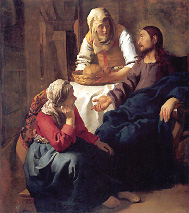
Significant for the Gospels is the story of Jesus visiting Mary and Martha in Luke 10:38-42. In Icons of Christ, I pointed out that this is an example of “Christological subversion,” a “special use of irony or paradox [as] literary devices that uses words in ways that seem the opposite of their original meaning” (Icons, 77). For example, the power of God is hidden in the weakness of the cross of Jesus; Jesus, the crucified peasant from Nazareth is the king of the Jews. The immediate context of the story of Mary and Martha follows the Parable of the Good Samaritan; both Mary and the Good Samaritan model what it means to be a disciple of Jesus in unexpected ways: “a Samaritan was not supposed to be a model of what it means to be a neighbor; a woman was not supposed to sit at the feet of men as a disciple” (Icons, 90). In his critical review of Icons of Christ, Matthew Colvin complained that I had misread the meaning of “sitting at the feet of” as a metaphor for discipleship. The earliest example is from the Maccabaean-era rabbi Yose ben Yoezer (fl. 170-140 BC): “the expression describes the actions, not of those climbing the ladder of rabbinic ordination, but of lay Israelites who ought to hold their exalted teachers in reverence and place their homes at their disposal. There is nothing here that conflicts with the patriarchal norms of Jewish society; subversion of those norms is neither implied nor intended by Jesus’ commendation of Mary. She is not in training to be either a rabbi or a teacher in the church.”4 Colvin uses a tactic characteristic of other complementarians and that he used elsewhere in his criticism – determining the meaning of a passage in the New Testament by pointing to examples found elsewhere. For example, like other complementarians, Colvin decides what the Apostle Paul means by his use of the metaphor “head” (kephalé) by looking to sources outside the NT rather than examining Paul’s own use within his actual context.5 This pattern (of looking outside the NT) misses the context of Luke’s passage, which I had pointed out. Luke is the author of both his Gospel and the Book of Acts. A position at the feet of Jesus indicates discipleship or insight in Luke’s Gospel (5:8, 7:38, 8:35, 41; 17:16). More important is that in Acts 22:3, Paul describes himself as having been trained “at the feet of Gamaliel.” Paul was not claiming that he was merely a layperson who entertained Gamaliel in his home. He was Gamaliel’s student and disciple. This is the same language that Luke uses when describing Mary’s relation to Jesus.
Moreover, Colvin ignores my citation from Ben Witherington – “for a rabbi to come into a woman’s house and teach her specifically is unheard of” – and what I wrote on the very next page: “While women did indeed learn in the synagogue, it would have been unheard of for a rabbi to enter into the home of a woman to whom he was not married and teach her as a disciple” (Icons, 90, 91). Mary’s action contrasts with Martha in that Martha took on what would have been the expected domestic role of a woman at the time, while Mary was crossing an expected social boundary and, in effect, “acting like a male” (Icon, 90).
And, of course, Christological subversion would be the opposite of Colvin’s description of “climbing the ladder of rabbinic ordination,” since, as I point out later in this chapter, for those who are disciples of Jesus, leadership means taking on the role of a servant (Icons of Christ, 92-94). Colvin also misses the point of the paradoxically symbolic character of Christological subversion. That Mary “sits at the feet of Jesus” does not mean that Mary was literally “training to be a rabbi” any more than Jesus’ riding into Jerusalem on a donkey (Matthew 21:1–11; Mark 11:1–11; Luke 19:28–44; John 12:12–19)means that Jesus literally intended to be crowned as a king when he arrived in Jerusalem (Zech. 9:9). Yet the symbolism speaks truth. The title on Jesus’ cross is clear: Jesus is king; Caesar is not.
Dorothy A. Lee’s The Ministry of Women in the New Testament (published after Icons of Christ), discusses the passage at greater length and concludes: “Mary is a model of true discipleship, while her sister, though a sincere disciple, is an example of how service can go awry . . . if it loses its focus on the word of Jesus. . . . Jesus does not make [burdensome domestic] demands nor restrict women to their traditional roles. Luke’s use of women to make this lesson sends a signal to all disciples, placing women on an equal plane with men so that men, too, can learn from women’s exemplary discipleship.”6
Lee’s book goes into greater detail than I did in Icons of Christ about what the discipleship of women as followers of Jesus means in the four Gospels (Lee, 15-58, 75-95). She concludes:
When we take Matthew and Mark together, we are left with a profound impression of the strength and resilience of women’s discipleship. . . . This portrait of women reflects the ministry of Jesus and his extraordinary openness to women as disciples . . . . (34, 35) Women [in Luke’s Gospel] act as prophets and as models of discipleship . . . . (58) Each of the women in the Fourth Gospel plays a significant role in displaying the meaning of discipleship and what is involved in Christian ministry and leadership within the community of faith . . . . Together they form a trajectory, a future pathway, for women as disciples and leaders in the ongoing life of the community (95).
Women in the Book of Acts: Lydia and Priscilla
Of similar importance to the story of Mary and Martha in the Gospel of Luke is Luke’s mention of Lydia in Acts 16:14-15, 40. Lydia is described as a “worshiper of God” connected with a group of women who gather near the river at a “place of prayer.” Given that Lydia’s name is Greek, she is likely a Gentile God-fearer, similar to Cornelius in Acts 10. That the gathering is at the river indicates that there was no available synagogue. Lydia is a businesswoman (a “dealer in purple cloth”), who owns her own home. Significantly, although Lydia and her household members are baptized, no husband is mentioned. In verse 40, Lydia’s home has become the meeting place for the local converts in Philippi. After being released from prison, Paul and Silas visit Lydia, where they see and encourage the “brothers” (τοὺς ἀδελφοὺς, tous adelphous). Since the plural “brothers” is generic, and we already know that Lydia was connected with a number of women, “brothers” means both men and women – “brothers and sisters.”
There is no discussion in the NT whatsoever of how the Eucharist was celebrated, and who if anyone presided. The apostle Paul’s discussion in 1 Corinthians 11 indicates that the early Eucharist was an actual meal consumed in the physical location of a house church. Since the house church met in the home of the woman Lydia (Acts 15:14-15), the logical conclusion would be that since Lydia was the host, she would have been the “presider” over the meal.
The other key woman in Acts is Priscilla, mentioned with her husband Aquila. She is also mentioned in Paul’s epistles, so will be discussed below.
A key point to note before turning to Paul’s epistles is that the women of the Gospels and Acts do not fit the prescribed complementarian “roles.” They either have no husbands (Mary and Martha, Lydia [likely]), nor are they described as being in submission to them if they do (Priscilla). They are not described as primarily caregivers of children. Indeed, no children are specifically mentioned in reference to these women.
Women and Office in the Pauline Epistles
Icons of Christ discusses whether women might have held church office first in a discussion of Romans 16 (chapter 15), and then in a discussion of the Pastoral Epistles asks whether the NT addresses the question of female bishops, presbyters and deacons (chapter 16). The following responds to criticisms of both Icons of Christ and “Women and Holy Orders” concerning that discussion.
First, it is important to note that in the NT, the terms episkopos and presbyteros are applied to classes of persons, not to specific individuals. The only specific individuals referred to by these titles are Jesus himself (referred to as the Shepherd and Bishop of our souls; 1 Peter 2:25), the anonymous author of the Johanine epistles who self-identifies as the “elder” in the opening greeting of 2 and 3 John and the author of 1 Peter, who refers to himself as a “fellow elder” in 1 Pet. 5:1. If the author of the Johannine epistles is the “beloved disciple” of John’s Gospel identified traditionally with John the son of Zebedee, and assuming the author of 1 Peter is Simon Peter the apostle, then we can say that in these two cases, we know of two male “elders” (presbyteroi), but this says nothing about whether the generic class (presbyteroi) included women (presbyterae) as well. The only deacon mentioned by name in the NT is the woman Phoebe in Rom. 16:1. The apostle Paul refers to himself and Apollos as diakonoi in 1 Corinthians 3:5, but context indicates that this is not referring to the NT office, but should be translated “servants” as do modern English translations.
Opponents of women’s ordination sometimes point out that no women are identified by name as bishops or presbyters in the NT. However, (as noted in the previous paragraph) since no men (who were not among the Twelve) are mentioned by name either, this is irrelevant. The authors of the “Response of the Diocese of the Living Word” state that “This is a confusing argument . . . . Peter clearly refers to himself as a presbyter and so does John and both are, of course, men.” They conclude: “There is no evidence in the New Testament that any woman at any time occupied the office of presbyter but there is abundant evidence that men did.”7
However, the argument is not confusing. The claim is not that there were no male presbyters mentioned in the NT whatsoever. We know that Peter and John were males because they were two of the twelve apostles. The question then is not whether the twelve apostles were male – which no one denies – but whether the office of presbyter as distinct from that of the Twelve is exclusively male. Opponents of women’s ordination claim that the NT nowhere mentions any specific women as presbyters or bishops. To the contrary is that the NT nowhere mentions any specific men either, again, apart from the two apostles. The claim that “there is abundant evidence that men did [occupy the office of presbyter]” (my emphasis) is simply false, since with the exception of the references to the two apostles, all references to individuals who held the office of presbyter in the NT are generic plurals and not identified by sex. Indeed, the only individual (not one of the Twelve) mentioned by name to hold a church office is a woman – the deacon Phoebe.
Second, when discussing church office in the writings of Paul, three distinct periods must be kept in mind: (1) mission letters (Romans, 1 and 2 Corinthians, Galatians, 1 and 2 Thessalonians); (2) prison epistles (Ephesians, Philippians, Colossians, Philemon); (3) Pastoral Epistles (1 and 2 Timothy; Titus).
Structures of ministry in the NT period were complex and seem to have developed gradually. Ben Witherington III notes that in Paul’s earlier letters, there is a distinction between (1) apostles; (2) prophets; (3) teachers; (4) miracle workers and those with other gifts. Paul ranks church structures as (1) apostles; (2) Paul’s traveling “fellow-workers” who were involved in local congregations (Priscilla, Aquila, Timothy); (3) local leaders.8 In Philippians 1:1 ( a prison epistle), Paul addresses “the saints in Christ Jesus who are at Philippi, with the overseers (episkopois) and deacons (diakonois).” This is the only letter in which Paul addresses these office holders by title, and there is no discussion of their duties. There is nothing to indicate their sex and Romans 16 has already made clear that the woman Phoebe was a deacon.
“Elders”/presbyters (presbyteroi, pl.) are mentioned several times in the Book of Acts (11:30; 14:23; 15:2, 4, 6, 22, 23; 16:4; 20:17; 21;18), but (as noted above), no individual elders are identified by name; neither are their ministries described in detail.
It is only in the Pastoral Epistles that there is any lengthy discussion of the offices of bishop/overseer (episkopos), presbyter/elder (presbyteros), and deacon (diakonos).
In order to avoid anachronism – reading more developed practices of church ministry from the Pastoral Epistles (or even later) into the earlier periods of Paul’s ministry, these distinctions between apparent earlier stages of ministry and later developments must not be conflated. For example, the Responders of the Diocese of the Living Word acknowledge that “Drs. LeMarquand and Witt begin this section by focusing on the prominent roles women played during the apostolic age. In particular they highlight Phoebe, Priscilla, and Junia, all three named and commended by Paul in Romans 16.” In the next paragraph, they conclude: “To establish that women played key roles and held power and influence in the apostolic era does not establish that they were presbyters during that time or that they ought to be presbyters now.”9 The Responders compare our discussion of Phoebe to Justin Martyr’s description of the practice of worship approximately a hundred years later (150 AD):
Notice that [in Justin Martyr] the “president of the assembly” is distinguished from the deacons. The title, “president of the assembly” seems to refer to an ecclesial office, probably overseer/elder, rather than to the owner of the home where the Church meets or to the ‘benefactor’ of the congregation. He is not described as the president of the ‘household’ or patron or benefactor, but as the “president of the assembly.’”. . . . The deacons – the office some argue that Phoebe occupied – do not officiate but distribute to the absent. . . . . While Phoebe hosted a Corinthian congregation in her home, it does not necessarily follow that she officiated the Communion feast.10
This is anachronistic. The Responders not only read back into Paul’s Letter to the Romans the more developed office of the Pastoral Epistles, but also read into the first century the liturgical practices of a century later. The Responders claim that the Eucharist “was and is not a regular meal.” However, Paul’s discussion in 1 Cor. 11:17-34 makes clear that at the time he was writing, the Eucharist was indeed a “regular meal.” By the time when Justin Martyr wrote, the Eucharist seems already to have become a ceremonial meal. As mentioned above concerning the house church of Lydia, the owner of the household would have been the normal “host” of what at the time was a common meal. At the same time, the NT nowhere discusses how the Eucharist was celebrated or who presided. Finally, since I nowhere made the claim (in either “On Women and Holy Orders” or Icons of Christ) that Phoebe held the office of presbyter, the objection is beside the point.
Finally, why Romans 16 and the Pastoral Epistles? As noted above, there are few references to church office in the NT. The Pastoral Epistles are the only place where the offices of episkopos, presbyteros and diakonas are discussed at length, and Romans 16 is the only place in Paul’s earlier mission epistles where he mentions specific individuals holding what were likely the earliest forms of church office: apostles, deacons, teachers, fellow workers, local leaders.
Romans 16
In Romans 16, Paul mentions twenty-six persons, of whom ten are women. In the list, he describes women as “deacons,” “patrons,” “leaders,” “apostles,” “co-workers,” and “hard workers.” James D. G. Dunn notes: “Paul attributes leading roles to more women than men in the churches addressed.”11 Ben Witherington, III, states: “While contemporary believers divide over ordination of women, women teaching men and the like, this chapter suggests that such objections, in general, would have puzzled Paul. . . . The conclusion then follows that Paul has no problem with women as teachers (Priscilla) or leaders, proclaimers, or missionaries of the Good News.”12
In my discussions of Romans 16 in both Icons of Christ, and “On Woman and Holy Orders,” (with the Rev. Dr. Grant LeMarquand) I argued for the holding of office by three women: Phoebe (deacon and “benefactor,” “patron”), Priscilla (teacher), and Junia (apostle). The following will respond only to criticisms of what I had written. Readers can find my detailed discussion in Icons of Christ, 295-315.
Phoebe
It is worth noting that my critics disagree among themselves in their criticisms. Matthew Colvin seems to think that Phoebe was not a deacon, while the Responders acknowledge that she was. Colvin agrees with me that Junia was an apostle, while the Responders insist that she was not.
Concerning Phoebe, Colvin is critical of my statement that “The noun diakonos is masculine in gender (not the expected feminine . . .).” He claims “The word διάκονος does not have separate feminine forms in the 1st century.”13 Colvin is correct here, and I am willing to be corrected. N. T. Wright states in a footnote (which I should have noticed): “Too much should not be made of the masculine form of διάκονος [diakonos] . . . since the fem. form was not available and the word could be used with reference to either gender.”14 Unfortunately, Colvin focuses on a single clause, and ignores what I had written in the rest of the paragraph:
. . . . if Paul had meant “servant,” he would likely have used a verbal form such as “one who serves” (διακονέω, diakoneō) (Romans 15:25) or the general term “ministry” (διακονία, diakonia) (1 Cor. 16:15). The participle ousan (οὖσαν διάκονον, ousan diakonon, “being a deacon”) would seem to refer to an ongoing ministry. This, combined with the qualifier, “of the church in Cenchrae,” points to a recognized office in the church.15
I continue by citing Dunn – “Phoebe is the first recorded ‘deacon’ in the history of Christianity”; N. T. Wright – attempts to make the term mean anything else than “deacon” fail; and Craig Keener – readers would assume the meaning “deacon” if the passage did not refer to a woman.16 The more recent study by Lee states that Phoebe “may well have been the leader of a church that meets in her own house,” and the title “deacon” suggests a “leadership role” in a likely small community.17
Contrary to Colvin, the Responders are willing to concede that “Phoebe is certainly described as a deacon,” but make the suggestion that Paul may be “commending her in more generic fashion as a minister/servant.”18 The more detailed discussions in Wright, Dunn, Keener, and Philip Payne argue against this “generic” interpretation (“servant”). The Responders concede that Phoebe was almost certainly Paul’s ambassador, and that women may have read scripture and even taught publicly. They even state “There are wonderful women teachers in the Church who God has appointed to carefully exposit and explain the Bible.”19 This is a positive concession. However, it is at odds with the usual complementarian position with which they identify themselves, and even with the general position of the Response in which pastoral office is tied to authority and teaching. (More on this below)
Priscilla/Prisca
Priscilla is one of the most significant women in the NT. She is always mentioned with her husband Aquila, and the two were likely a husband-wife ministry team. She appears in Rom. 16:3-4; 1 Cor. 16:19; 2 Tim. 4:19; Acts 18:2-3, 18-19. Priscilla’s name is usually mentioned first. Luke uses the diminutive “Priscilla,” Paul refers to “Prisca.” Paul refers to Prisca and Aquinas as “my fellow workers” (τοὺς συνεργούς μου, tous synergous mou), and a church meets in their home. Paul uses the term synergos twelve times in the NT, and it always refers to an associate of Paul’s who works with him in mission. Acts 18:1-3, 34-26 also make clear that the two were teachers who taught Apollos. That her name is mentioned first would seem to indicate that she was the primary teacher.
Despite her significance, neither Colvin nor the Responders have much to say about Priscilla. Colvin suggests that her name being placed first might simply indicate the “linguistic consideration” of “paired names,” like “butcher, baker, candlestick maker”: “‘Aquila and Prisca’ sounds wrong, while ‘Priscilla and Aquila’ sounds right. In the early 20th century, American etiquette writers advised placing a wife’s name before her husband’s in order to avoid separating the husband’s surname from his given name.”20
However, Paul and Luke were hardly guided by early 20th century American etiquette writers, and, as I mentioned in Icons (303), Linda Belleville points out that when their occupation is listed as tent-makers, Aquilla’s name is mentioned first, but when ministry is mentioned, Priscilla’s name is first.21 Colvin’s linguistic paired names theory does not work.
The Responders echo the standard complementarian argument that Priscilla only taught in a private setting: “Priscilla, together with her husband, it is true, instructed Apollos in private. They ‘took him aside.’”22 However, as Ben Witherington III notes (whom I cited in Icons, 304), that the conversation took place in private is “probably not very significant.”23 There is nothing in the text to indicate that Luke was trying to avoid having Priscilla teach Apollos in a public context. Also, Acts mentions that both Priscilla and Aquila “took him aside” (Acts 18:26, ESV). If Priscilla’s teaching in public was a problem, then the same would have been true for the male Aquila.
Junia
Concerning Junia, Colvin concedes my conclusions:
Witt is, in my judgment, correct about Junia being a woman, and being called an apostle; but an apostle of what? And what bearing does this have on office in the church? Any attempt to answer this question must take into account the background of the institution of apostleship in ancient Judaism. Witt does not do so.24
The recognition that Junia is a woman and an apostle has bearing on “office” because “apostles” held office in the NT church, as I pointed out on pages 310-311 in Icons of Christ. Paul would not have been claiming that Junia was among the twelve apostles, nor using the term in the non-technical sense of “messengers” (2 Cor. 8:23, Phil. 2:25). Rather, Paul’s unqualified use of “the apostles” refers to an office larger than the twelve, which includes himself and those like himself to whom the risen Christ had appeared and who had been commissioned to preach to gospel. As noted above, whenever Paul describes church leadership in his mission letters, he always lists the office of apostle as first in order. Given the extent to which Paul defends his apostleship, he would not have used the term loosely in applying it to others.25 Assuming that “ancient Judaism” means the OT, there is no institution of “apostleship” in ancient Judaism. Colvin again appeals to an example outside the historical context of the NT to explain something that occurs hundreds of years later. To the contrary, one can only know what it meant to be an apostle in the NT era by examining what the NT authors write about it.
In contrast to Colvin, the Responders repeat now discredited arguments. They cite Daniel B. Wallace to claim that the passage should be translated as does the ESV: “…well known to the apostles…” They also suggest that Junia may have been the male Junias.26 My discussion on Junia is one of the longer passages in Icons of Christ (304-312). The male name “Junias” does not appear in the ancient world while the female “Junia” is abundant. Native Greek speakers such as John Chrysostom interpreted the passage as referring to a female Junia who was an apostle. The arguments by Daniel B. Wallace (along with co-author Michael R. Burer) have been shown definitively to be mistaken by Richard Bauckham, Linda Belleville, and Eldon Epp. I discuss this material at length in Icons, but also referred to the definitive book by Epp in a footnote in “On Women and Holy Orders,” which the Responders clearly had not read. I refer readers either to my material in Icons or to the definitive work of Bauckham, Belleville, and Epp. Junia was a well-known woman apostle, not a man who was well-known to the apostles.
The Pastoral Epistles
The Pastoral Epistles are important for any discussion of ordained ministry because it is only in two passages in 1 Tim. 3:1-12 and Titus 1:5-9 that the NT discusses qualifications for the offices of bishop, presbyter, and deacon at any length. The key question for this discussion concerns whether 1 Timothy and Titus present male family leadership as an essential requirement for church office. Both Colvin and the Responders claim this to be the case. They present two arguments. First, the episkopos/presbyteros must be the male head of a family over which he exercises authority in the same manner over which he exercises authority over the church.
As noted above, Colvin wrote:
The natural family, headed by the husband and father, is the normal background out of which the episkopoi and presbyteroi of the church are produced and selected. . . . In the Pastoral epistles, the marriage of a Christian pastor is . . . an aspect of his male existence within the context of the family.
The Responders summarize their own position:
The one who cannot manage at home, will not be capable of managing an entire congregation. It is interesting to note in passing, moreover, that in the patriarchal context of the first century Greco-Roman households, it would be impossible for a wife and mother to meet this requirement and unfair to place such an expectation on her since it would demand a level of household authority she would not possess.27
Second, the Responders appeal to the standard complementarian claim that the episkopos is the male head of a family because Paul lists as one of the requirements to be a “one woman man” (μιᾶς γυναικὸς ἄνδρα, mias gunaikos andra), translated something like the ESV translation: “the husband of one wife.” The Responders write:
Paul refers to the presbyter using the specific word for “male.” In 1 Timothy 3:2, Paul writes: “δεῖ οὖν τὸν ἐπίσκοπονἀνεπίλημπτον εἶναι, μιᾶς γυναικὸς ἄνδρα (bold added), νηφάλιον σώφρονα κόσμιον φιλόξενονδιδακτικόν…” Had Paul intended to include women, he might have used the generic, “ἀνθρωπος” instead of a word, “ἄνδρα,” that exclusively refers to the human male.28
The essential argument of both Colvin and the Responders is that the “job requirements” for an overseer/presbyter are gender specific, namely: (1) to “manage a household,” something of which women are supposedly incapable, and (2) to be the “husband of one wife.” These are the standard arguments used by complementarians since the first appearance of the position and repeated countlessly ever since.
I addressed these two claims in Icons of Christ as follows.
First, I pointed out that standard English translations are misleading. The Greek of 1 Timothy 3:1-12 and Titus 1:5-9 do not contain a single masculine pronoun. Throughout they use the single pronoun tis (τις), properly translated “whoever.” I included my own literal translation.
Trustworthy is the saying: Whoever [tis] aspires to [the office of] overseer/bishop desires a good work. It is necessary (δεῖ, dei) therefore that the overseer/bishop be without approach, a “one woman man” [literal translation], temperate, self-controlled, respectable, hospitable, apt at teaching, not an excessive drinker, not violent but gentle, not quarrelsome, not greedy; managing one’s own household well, having children in subjection with all gravity – but if someone [tis] does not know how to manage one’s own family, how would one care for God’s church? – not a recent convert, lest being puffed up, one become conceited and fall into the devil’s snare. (1 Tim. 3:1-7)
With the exception of the single three-word expression “one woman man,” there is nothing in the passage that indicates that the person being described is a male. The immediate context of the three-word expression is morally exclusive – no adulterers – not that the bishop must necessarily be a married male.
In this light, the qualifications for overseers/elders/deacons in 1 Timothy 3:1-12 and Titus 1:5-9 are moral qualifications, not job descriptions. NT scholar Ben Witherington III points out that they focus on “character description. They explain how a leader should behave, not what the leader’s full job description looks like.” They contrast five vices to avoid and six virtues to pursue, in addition to demanding sexual fidelity in marriage.29
Confirming this reading is the exact parallel language between overseers/presbyters and women in the Pastoral Epistles. The following is a chart (borrowed from Philip Payne) that I included in Icons of Christ.
|
Overseer Description |
Statements About Women |
Pastoral Epistle Odds |
|
1 Tim. 3:1 (καλοῦ ἔργου, kalou ergou “good work”) |
5:10 (ἔργοις καλοῖς, ergois kalois “good works”) |
8/14 |
|
3:2 (ἀνεπίλημπτον, anepilēmpton “irreproachable”) |
5:7 (ἀνεπίλημπτοι, anepilēmptoi “irreproachable”) |
3/14 |
|
3:2 (μιᾶς γυναικὸς ἄνδρα, mias gunaikos andra “one woman man”) |
5:9 (ἑνὸς ἀνδρὸς γυνή, henos andros gunē “one man woman”) |
4/14 |
|
3:2 (νηφάλιον, nēphalion “temperate”) |
3:11 (νηφαλίους, nēphalious “temperate”) |
3/14 |
|
3:2 (σώφρονα, sōphrona “sober”) |
2:9, 15 (σωφροσύνης, sōphrosynēs “sobriety,” “propriety”) |
6/14 |
|
3:2 (κόσμιον, kosmion “orderly”) |
2:9 (κοσμίῳ, kosmiō “orderly”) |
2/14 |
|
3:4 (σεμνότητος, semnotētos “gravity,” “respect”) |
3:11 (σεμνάς, semnas “to be grave”) |
6/14 |
|
3:6 (κρίμα, krima “judgment” to be avoided) |
5:12 (κρίμα, krima “judgment” to be avoided) |
2/14 |
|
3:7 (μαρτυρίαν καλὴν, marturian kalēn “good witness”) |
5:10 (καλοῖς μαρτυρουμένη, kalois marturoumenē “witnessed” by “good” works) |
3/14 |
The use of identically phrased language to describe both the overseer and women cannot be a coincidence. The third column is based on Payne’s calculations that the thirty-six lines of 1 Timothy explicitly referring to women (out of 517 lines in the Pastoral Epistles) come to approximately one fourteenth of the Pastoral Epistles. The total number of times an expression appears divided by fourteen gives the odds of a random occurrence. The probability of a random distribution of all the expressions in thirty-six lines of the Pastoral Epistles is the product of each of the separate odds for each of the appropriate columns, approximately one in six million. Regardless of the math, that Paul uses identical language to describe women that he uses for the requirements for the office of an overseer makes clear that the requirements cannot be exclusive to males because they are identically used of women. Again, the requirements are moral requirements, not job descriptions, and they are not gender specific.
In “On Women and Holy Orders,” I wrote:
It cannot be coincidental that identical language is used to describe women throughout the pastoral epistles. Even the requirement that the bishop be a “one woman man” (1 Tim. 3:2) (“faithful to his wife,” NIV) is exactly parallel to the requirement that a widow be a “one man woman” (1 Tim. 5:9) (“faithful to her husband,” NIV). The concern here is clearly morally exclusive (no adulterers), not that the bishop must necessarily be a married male.
“One Woman Man”
The Responders contrast Paul’s use of parallel language in reference to episkopoi and widows: “But the gender dissimilarity in these very similar texts undermines their argument, demonstrating that Paul is conscious and purposeful in his use of gendered terms.”30
This is question begging. Again, the language used to describe episkopoi and women is so identical as to not be coincidental. Even the phrasing of “one woman man” and “one man woman” is so close as to indicate that in both cases, the concern is the same – a moral qualification (no adulterers). The claim that the “gender dissimilarity . . . . undermines their argument” would mean that in every single one of nine cases, identical language has identical meaning, but in this single case, it means something different.
If the passage means that the overseer must necessarily be male, then it would equally follow that the he must be married, own his own house, and have multiple children old enough to be submissive and respectful. These requirements would have excluded the apostle Paul himself who was not married, who recommended singleness when possible (1 Cor. 7:8), and who as a traveling apostle/evangelist had no home.
Philip Payne comments on the logical structure of the passage:
Since “one woman man” is a set phrase that functions as an exclusion, any claim that a single word of it (“man”) also functions separately as a requirement must posit a double meaning. This is not warranted by the context. It is bad hermeneutics to isolate a single word (“man”) from a set phrase (“one woman man”) that functions as an exclusion (of polygamists and probably adulterous husbands) and to elevate that single word to the status of an independent requirement (that all overseers be men).31
In addition, the same terminology is used in the following verses describing deacons. Deacons are to be “grave/honorable/above reproach” (σεμνούς, semnous) (3:8; cf. 3:4), not heavy drinkers of wine, not greedy (cf. 3:3). Verse 12 reads: “Let deacons be the husband of one wife (μιᾶς γυναικὸς ἄνδρες, mias gunaikos andres), and let them manage their children and their households well; for those who serve well as deacons gain a good standing for themselves and also great confidence in the faith which is in Christ Jesus” (1 Tim. 3:12, RSV).
Context indicates, however, that the sandwiched verse which reads literally “Similarly, women (γυναῖκας ὡσαύτως, gunaikas ōsautōs) [to be] grave/worthy of respect (σεμνάς, semnas), not slanderers (διαβόλους, diabolous), sober (νηφαλίους, nēphalious), faithful in all things (πιστὰς ἐν πᾶσιν, pistas en pasin)” (my translation)” (1 Tim. 3:11) refers to women deacons, not (as in the ESV translation) “their wives.” Grammatically, the sentence depends on 3:2 and the word “must” (δεῖ, dei). 1 Tim. 3:8 with its description of deacons is tied to 3:2 by the word “likewise” (ὡσαύτως, ōsautōs). 3:11 is then tied to 3:8 by an additional appearance of the word “likewise.” The passage is a continued discussion of church office – “women deacons,” not “wives of deacons.”32 Church fathers like John Chrystotom recognized that the passage referred to women deacons. In addition, there is the example of the woman deacon Phoebe (discussed above).
If the expressions “one woman man” and “managing one’s household” as character descriptions of the office of deacon (3:12) does not exclude female deacons (3:11; Rom. 16:1), then the same language describing overseers and presbyters cannot exclude women.
Household Management
As noted above, both Colvin and the Responders insist that household management is essential to the identity of bishops/presbyters, and this is exclusively tied to male authority. They base this on 1 Tim. 3:4-5: “managing one’s own household well, having children in subjection with all gravity – but if someone [tis] does not know how to manage one’s own family, how would one care for God’s church?” (my translation). The Responders write: “It should be noted once more that Paul’s requirements (my emphasis) for presbyters/overseers in 1 Timothy 3 and Titus 1, assume the continuation of these social arrangements in the context of the Christian Church. The presbyter is to manage his household in such a way that his children are not rebellious.”33
This claim reads things into the passage that are not there. As noted above, the commands are moral qualifications, not job requirements. The command about having children in submission is a moral requirement, not a job description – or else only those with at least two children could be overseers. If the overseer has a disruptive family, this is a moral disqualification since it speaks to poor parenting skills.
As I wrote in Icons of Christ, there is a confusion here of “Paul’s accommodation to the normal social setting of the Mediterranean household with an endorsement of that setting as having a permanently normative status” (Icons, 323). Ben Witherington points out that there is significant overlap with what Paul writes about the overseer/bishop and desirable character traits of non-ecclesial office holders in contemporary Mediterranean culture. What is more important is that Paul modifies common cultural norms within a “christological and apostolic paradigm.” In contrast to Mediterranean “shame/honor” culture, the oversee is called to honor and serve other rather than dominate them.34
Moreover, as is clear from the creation mandate of Gen. 1:28, family responsibilities belong equally to men and women. There is nothing specifically masculine in the moral requirements to be a good household manager. The phrase “managing house well” (οἴκου καλῶς προϊστάμενον, oikou kalōs proiamenon) (1 Tim. 3:4) means the same as “to manage house” (οἰκοδεσποτεῖν, oikodespoetein) (5:14), referring to women; “Having children in subjection” (τέκνα ἔχοντα ἐν ὑποταγῇ, tekna exonta en upostagē) is necessarily implied in the combination of “to bear children, to manage house” (τεκνογονεῖν, οἰκοδεσποτεῖν, teknogonein, oikodespotein) (5:14). The word οἰκοδεσποτεῖν (oikodespoetein) is even stronger than προΐστημι (proistēmi). It means something like “to be a house despot.” The verb προΐστημι (proistēmi) is used in Romans 12:8 in a manner that could apply equally to men and women, and the noun form προστάτις (prostatis) is used to describe Phoebe in Romans 16:2.35
Returning to the Gospels, Acts, and Romans
Against my claim that the conditions of office in 1 Timothy and Titus are moral requirements, the Responders claim that the office of overseer/presbyter is not just moral, but involves teaching. They appeal to Titus 1:9-11 that the presbyter must hold firm to the trustworthy word as taught in order to give sound instruction and to rebuke those who contradict it (my paraphrase; there are no masculine participles in the Greek): “Teaching and rebuking false teachers are functional job requirements.”36
However, even the requirement to “hold firmly to the trustworthy message” is a moral requirement. The statement about correcting false teachers is not a job requirement, but a job description. As a job description, it is not gender specific. Women like Priscilla, Phoebe, or Junia certainly could have fulfilled this task.
When commenting on the the role of overseers/presbyters in the Pastoral Epistles, the Responders actually concede that patriarchal cultural settings of the first century would place certain limitations on the kinds of things that could be expected of women:
It is interesting to note in passing, moreover, that in the patriarchal context of the first century Greco-Roman households, it would be impossible for a wife and mother to meet this requirement and unfair to place such an expectation on her since it would demand a level of household authority she would not possess.37
The recognition that a woman’s capacity to exercise pastoral leadership would be limited by “the patriarchal context of the first century Greco-Roman households” would actually argue against the Responders’ position that male only pastoral leadership is transcultural. At the same time, in these two statements, the Responders seem to have forgotten what they had written earlier about the deacon Phoebe. They agree that Phoebe would have delivered Paul’s letter, read it publicly, and explained any difficulties: “One might suggest here that women reading scripture and even teaching publicly may be in view.” They continue:
God has given many women influence and authority in various fields and endeavors, including the field of biblical knowledge and exposition. There are wonderful women teachers in the Church who God has equipped to carefully exposit and explain the bible.38
Elsewhere they write:
There is no question that women played prominent roles in the early Church and they indisputably possessed influence and authority. But this fact does not add any relevant data to the contemporary debate regarding women in holy orders. Those who believe that women cannot occupy the office of presbyter do not argue that women have no authority, influence, power, role and/or voice in the Church. To establish that women played key roles and held power and influence in the apostolic era does not establish that they were presbyters during that time or that they ought to be presbyters now.39
To say the least, the Responders’ statements are inconsistent. One the one hand, they claim that women cannot be overseers/presbyters because it is the exclusive function of the husband to exercise authority in the family, and the ability to teach and correct error is a direct consequence of this hierarchical family authority. The Responders go so far as to claim that in the context of first century Mediterranean culture, it would have been impossible for a woman to fulfill these functions. On the other hand, the Responders acknowledge that women like Phoebe played “prominent roles” in the church, including teaching, and that women today can be “wonderful teachers” and expositors of Scripture.
There is a kind of incoherence in this stance. The argument that only males can exercise teaching authority in the church is almost the entire argument of the Response, and it is the argument used throughout their discussion of the Pastoral Epistles. When discussing 1 Timothy and Titus, they focus on hierarchy, authority, and family management, claiming that these are exclusively male activities. Women cannot be ordained today because women cannot exercise this kind of authority in the church.
However, when we look at the Gospels, Acts, and Romans 16, women do precisely the kinds of things that the Responders claim that women are not supposed to do. Mary is portrayed as a disciple of Jesus; Lydia is the leader of a house church; Phoebe is not only a deacon, but Paul’s emissary and a prostatis. Priscilla is a teacher. Junia is an apostle. Consistently with their reading of the Pastoral Epistles, the Responders do not want to acknowledge that women played these roles. Yet at the same time, in their discussion of Phoebe, there is what looks like almost an apology for their position. They use expressions like “prominent roles,” “wonderful teachers,” and expositors of Scripture” in reference to women.
This incoherence points to an inevitable tension in the complementarian position. As I pointed out in Icons of Christ (chapter 3) and in previous essays, the historic reason for opposition to women’s ordination was grounded in ontology. Ordination was grounded in male authority, and opposition to women’s ordination tied together masculine competence and female incompetence. Men were ordained because of an ontological superiority; women could not be ordained because they were intellectually inferior, emotionally unstable, and more subject to temptation than men.
Complementarianism endorses the traditional position of male only ordination tied to male hierarchy and authority. However, it strongly denies that it holds to the traditional warrant – that women are in any way intellectually, emotionally, or morally inferior to men. The incoherences in the complementarian position occur with the attempt to harmonize complementarian logic with the actual practices of the early church. The attempt to deny that women exercised significant leadership roles in the early church collides with what we find in Paul’s epistles. The attempt to locate the reasons for male only authority in the material about church office in the Pastoral Epistles fails as an argument. The attempt to hold both together stretches the logic to a breaking point.
1 Richard Hooker, Laws of Ecclesiastical Polity I.3.5.1.
2 Matthew Colvin, “Review of Icons of Christ”; https://northamanglican.com/review-of-icons-of-christ-plausibility-structures/.
3 Kenneth E. Bailey, Jesus Through Middle Eastern Eyes: Cultural Studies in the Gospels (IVP Academic, 2008), 192-193.
4 Matthew Colvin, “Review of Icons of Christ”; https://northamanglican.com/review-of-icons-of-christ-errors-of-protology-and-eschatology/.
5 See my essay “Response to the Anglican Diocese of the Living Word: Does “head” mean “authority” in Ephesians 5 and 1 Corinthians 11? Part One”; https://willgwitt.org/theology/response-to-the-anglican-diocese-of-the-living-word-does-head-mean-authority-in-ephesians-5-and-1-corinthians-11-part-one/.
6 Dorothy A, Lee, The Ministry of Women in the New Testament: Reclaiming the Biblical Vision of Church Leadership (Grand Rapids, MI: Baker Academic, 2021), 53.
7 The Anglican Diocese of the Living Word, “Women in Holy Orders: A Response,” 48; https://s3.amazonaws.com/media.cloversites.com/83/835b7ff2-914d-435a-97f2-c22ad3966ee2/documents/Women_in_Holy_Orders_-_ADLW_Response_RELEASE_COPY_031720_Revised.pdf
8 Ben Witherington, III, Women in the Earliest Churches (Cambridge: Cambridge University Press, 1988) 107, 109; Witheringon with Darlene Hyatt, Paul’s Letter to the Romans: A Socio-Rhetorical Commentary (Grand Rapids, Eerdmans, 2004), 385.
9 Diocese of the Living Word, 42.
10 Diocese of the Living Word, 43.
11 James D. G. Dunn, Romans 9-16 (Waco, TX: Word, 1988), 900.
12 Witherington and Hyatt, Romans, 402, 390.
13 Colvin, “Review”; https://northamanglican.com/review-of-icons-of-christ-errors-of-philology/.
14 Wright, Romans, vol. 10, New Interpreter’s Bible (Nashville, TN: Abington, 202), n., 762.
15 Icons, 300.
16 Dunn, Romans, 887; Wright, Romans, 761-762; Craig Keener, Paul, Women and Wives: Marriage and Women’s Ministry in the Letters of Paul (Peabody, MA: Hendrickson Publishers, 1992, 2004), 239. Also see the detailed discussion in Philip B. Payne, One in Christ: An Exegetical and Theological Study of Paul’s Letters (Grand Rapids, MI: Zondervan, 2009), 61-63.
17 Lee, Ministry of Women, 102.
18 Diocese of the Living Word, 43.
19 Diocese of the Living Word, 43, 44.
20 Colvin, “Review”; https://northamanglican.com/review-of-icons-of-christ-symbolism-and-conclusions/.
21 Belleville, “Women Leaders in the Bible,” Discovering Biblical Equality, 3rd edition, Ronald D. Pierce, Cynthia Long Westfall, and Christa L. McKirklands, eds. (Downers Grove, ILL: InterVarsity Academic, 2021), 83.
22 Diocese of the Living Word, 45.
23 Witherington, Women in the Earliest Churches, 154.
24 Colvin, “Review”; https://northamanglican.com/review-of-icons-of-christ-errors-of-philology/.
25 Jay Eldon Epp, Junia: The First Woman Apostle (Minneapolis, MN: Fortress, 2005); Richard Bauckham, Gospel Women: Studies of the Named Women in the Gospels (Grand Rapids: Eerdmans, 2002), 180; Witherington and Hyatt, Romans, 390.
26 Diocese of the Living Word, 46-47.
27 Diocese of the Living Word, 49.
28 Diocese of the Living Word, 50.
29 Ben Witherington III, Letters and Homilies for Hellenized Christians Volume 1: A Socio-Rhetorical Commentary on Titus, 1-2 Timothy and 1-3 John (Downers Grove: InterVarsity Press, 2006), 237, 241-242.
30 Diocese of the Living Word, 51.
31 Payne, 447.
32 Witherington, , Letters and Homilies for Hellenized Christians, 1:241.
33 Diocese of the Living Word, 54.
34 Witherington, Letters and Homilies for Hellenized Christians, 1:114-115, 236.
35 Payne, Man and Woman, 452-453.
36 Diocese of the Living Word, 49.
37 Diocese of the Living Word, 49.
38 Diocese of the Living Word, 44.
39 Diocese of the Living Word, 44.