William G. Witt

April 23, 2008

Abiding in the Vine: A Sermon

Filed under: Sermons — William Witt @ 3:24 am

John 15:1-8

The great Anglican biblical scholar Sir Edwin Hoskyns wrote of Jesus’ Last Supper Discourse in his Commentary on John’s gospel: “The whole scene is an epitome of the Christian religion.”(1) If that is true of chapters 14-17 as a whole, then I think it could also be argued that the eight verses at the beginning of John chapter 15 are such an epitome in miniature, for in just these few short verses, John includes all of the major themes of his version of the Christian gospel, all tightly woven together.

What are those themes? What is the passage about?

The first theme has to do with the John’s understanding of the church. The passage is about ecclesiology. Jesus’ statement “I am the true vine and my Father is the vinedresser” echoes numerous Old Testament passages. These passages all contain a message of judgment. In each of these passages, Israel is the vine, and God is the vineyard owner or planter. So in Isaiah 5, the prophet speaks of a vineyard owner who plants a vineyard that yields wild grapes – a vineyard that will be trampled down and made a waste. “For,” says Isaiah, “the vineyard of the Lord of hosts is the house of Israel.”

John echoes these passages, but with a Christological twist. For John, Jesus is now the true Israel. He is the true vine, and his Father is the vineyard dresser. Where the previous vineyard had been declared a waste, Jesus – the True Vine – produces fruit. There is still a message of judgment, however. The church is not the vine, but the branches that dwell in the vine. The vineyard dresser prune the vine, and the branches that do not yield fruit are cast into the fire. If the church, or at least members of the church, fail in their mission to dwell in the vine, they will suffer the same judgment as Israel. So the passage is about John’s understanding of church – and we’ll get back to that in a few minutes. (more…)

March 15, 2008

Ministers of a New Covenant: A Sermon for Potential Seminarians

Filed under: Sermons — William Witt @ 6:02 am

2 Corinthians 3: 7-18

The chapters in 2 Corinthians that begin with this evening’s lectionary reading have always been one of my favorite selections from Scripture. 2 Corinthians 3-6 contain some of the most beautiful writing in all the Bible. You are no doubt familiar with some of the verses: "The God who said, ‘Let light shine out of darkness,’ has shone in our hearts to give the light of the knowledge of the glory of God in the face of Jesus Christ." Or, "For this momentary affliction is preparing for us an eternal weight of glory beyond all comparison, as we look not to the things that are seen but to the things that are unseen." Or again, "For we walk by faith, not by sight." There is also"If anyone is in Christ, he is a new creation. The old has passed away; behold, the new has come."

This selection of Scripture is also particularly relevant this evening as I address a chapel full of seminarians and potential seminarians. Why? The context of the entire letter of 2 Corinthians is one long sustained argument that Paul is having with the Corinthians in which he defends his ministry. We know from Paul’s first letter to the Corinthians that Paul did not get along well with this church, and that there were those who challenged his ministerial credentials. Under similar circumstances, we ourselves might well be tempted to respond with an outburst of temper: "Because I’m the apostle, and you’re not! That’s why!" There is a little of that toward the end of the letter when Paul warns them: "What we say by letter when absent, we do when present." (2 Cor. 10:11) So, the Daddy apostle is coming home, and boy are you going to get it!

But, Paul is, after all, Paul. And Paul is nothing if not a theologian. So before Paul warns them at the end of the letter that if they don’t straighten up, they will be sorry, Paul does what Paul does. He theologizes. And for this we can be grateful, because Paul defends his ministry by a theological reflection on ministry that contains these wonderful three chapters from chapter three though chapter six. In this selection, Paul provides some of his most profound insights on the meaning of redemption and Christian life. The heart of Paul’s defense of his ministry is that as an apostle, he is a minister of God’s new covenant in Christ Jesus, a covenant written not in the stone letters of the ten commandments, but in letters of love written by the Holy Spirit on human hearts. (more…)

January 24, 2008

Advice From a Sheep: A Sermon for Clergy

Filed under: Sermons — William Witt @ 4:02 am

Feast Day of the Confession of St. Peter
1 Peter 5: 1-4
Matthew 16: 13-20
Good ShepherdToday is the feast day of the Confession of St. Peter. What could I say to you about Peter that you yourselves have not heard a hundred times before? As I’m sure you know, the passage from the gospel this morning has been controversial in the history of the church, with Roman Catholics interpreting the passage to mean that not only is Peter the rock on whom the church is founded, but that the bishop of Rome—the pope—is the successor of Peter. Western Reformation Christians and Orthodox Christians have interpreted the passage otherwise.

However, I am not sure how edifying a sermon on the various ways in which Roman Catholics, Eastern Orthodox and Reformation Christians have interpreted Matt.16 would be. Given the likely audience at a Jan Term chapel, I would doubt whether many of you are staying awake at night worrying about whether the pope is the rightful successor to Peter. However, as I looked at this passage and especially at the epistle reading from 1 Peter this morning, I realized that you were the proper audience for a different kind of sermon.Let me re-read part of the epistle reading:

So I exhort the elders among you, as a fellow elder and a witness of the sufferings of Christ, as well as a partaker in the glory that is going to be revealed, shepherd the flock of God that is among you, exercising oversight, not under compulsion, but willingly, as God would have you, not for shameful gain, but eagerly, not domineering over those in your charge, but being examples to your flock.” (1 Peter. 5:1-3)

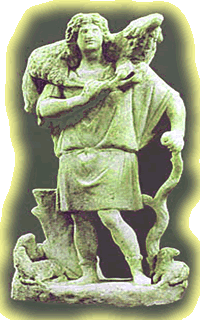
I find myself in an unusual situation this morning. I am a lay person, and I find myself speaking to a chapel full of people who are either mostly clergy, or who are studying to some day be clergy. On most Sundays I find the situation reversed. You are the ones that Peter addresses in his epistle as “elders.” The Greek here is presbyteros, sometime translated as pastor or priest. And the English word pastor comes from the Latin word pastor which means “Shepherd.” You are or will be the shepherds, the ones whom Peter exhorts to “shepherd the flock of God.” And, apart from Christ, Peter is the New Testament’s prime example of a Christian Shepherd. In John’s gospel, the risen Christ commands Peter, “Feed my sheep.” Regardless of our theology of the episcopate or the primacy of the pope, we know who Peter’s successors are. You are, or you will be. You are the shepherds, and your job is, as Peter says, “to shepherd the flock of God,” and “to be examples to your flock.” (more…)


December 25, 2007

The One Who Is to Come: An Advent Sermon

Filed under: Sermons — William Witt @ 6:04 am

Third Advent 2007
Isaiah 35: 1-10
Psalm 146
Matthew 11: 2-11

John the Baptist

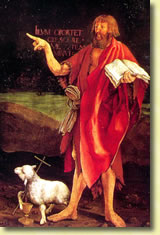
The gospel passage that we read this morning has caused a great deal of trouble in the history of interpretation. Biblical interpreters from the earliest times to the present have not known quite how to deal with it. It is not that what the text says is hard to understand. That is fairly straightforward. John the Baptist is in prison and he sends some of his disciples to ask Jesus a question: “Are you the one who is to come, or shall we look for another?” The problem is that we already know who John the Baptist is. Phil Harrold did a great job last week of laying out the territory. John has one job. John is the one wearing the camel’s hair bathrobe in all those great Medieval paintings who is pointing to Jesus. That is what John does. He points to Jesus. Now it seems John has forgotten his job description.

The Church Fathers did not know quite what to do with this. John Chrysostom raises all the obvious questions: “He that knew Jesus before His miracles, he that had learned it of the Spirit, he that heard it of the Father, he who had proclaimed him before all; does he now send to learn of him, whether he is himself or not?” Chrysostom points out to John that his reputation is at stake: “If you did not know that Jesus was surely the one,” he asks rhetorically, “how could you have any credibility? If you are going to bear witness to others, you first need to have some credit yourself.” Chrysostom imaginatively grills John: “Didn’t you say that you were not worthy to untie his shoes? Didn’t you say that he sent you to baptize? Didn’t you see the Spirit descend, and hear the voice that said ‘This is my beloved Son?’ Didn’t you leap in the womb when you were a baby?” Chrysostom is having none of this “Are you the one who is to come or should we expect another?” business. (more…)

July 24, 2007

Is it Necessary to be in Communion With Canterbury in Order to be Anglican?

Filed under: Anglicanism — William Witt @ 6:13 pm

One could read any number of classical works that talk about what it means to be Anglican and find virtually no references to the "See of Canterbury." For example, I’m not sure that the word "Canterbury" appears once in John Jewell’s Apology of the Church of England. If one reads those who articulated the historic understanding of what it means to be Anglican—Thomas Cranmer, John Jewel, Richard Hooker, George Herbert, John Donne, the 39 Articles et al—what one finds is a collection of doctrines and practices: (1) an affirmation of the primacy, sufficiency, and clarity of Scripture, an affirmation of the historic creeds as summarizing the heart of Scripture, an understanding of the church as expressing a kind of continuity with the primitive Catholic Church, and a critique of late Medieval and Tridentine Roman Catholicism as a deviation from patristic Catholicism; (2) certain practices of worship and devotion rooted in Prayer Book worship and the daily office. And, of course, views on the relation between grace and morality, all flowing from and connected to the above. Also, while not a central concern (as it was not a matter of dispute at the time) there are very clear statements about Christian sexual ethics—sometimes in odd contexts, e.g., Jewel’s defending the C of E from accusations of antinominianism, or Hooker’s discussions of why wedding rings are adiaphora but sexual fidelity in marriage is not.

For historical reasons, those who wrote these things were in communion with the see of Canterbury.

But, of course, Anglican doctrines and practices can exist without necessarily being in communion with Canterbury. After 1776, the new American Episcopal Church found it necessary to receive its orders through Scotland. When the Church of South India was formed by the merger of Anglican and Protestant Churches, it was necessary to break communion with Canterbury. And they did so with Canterbury’s blessing.

(more…)

May 22, 2007

Christological Subversion: A Sermon

Filed under: Sermons — William Witt @ 9:16 am

7th Sunday of Easter, 2007
Ps. 68
Acts 16: 16-34
Rev. 22:12-14,16-17,20
John 17:20-26

This morning’s gospel reading is one of a series of readings from Jesus’ farewell discourse in John’s gospel we have had the last few Sundays that will conclude with the reading for Trinity Sunday. This morning’s reading is actually the conclusion of the discourse in John’s gospel, and has been referred to since the sixteenth century as Christ’s “High Priestly Prayer.” Unfortunately, as the lectionary editors sometimes do, they have rather arbitrarily cut the reading in a way that misses the main point of the chapter, so I’m going to preach as if the reading included the entire chapter. So much the worse for the lectionary editors.

In this chapter, John summarizes three central themes in his gospel, themes that run like a red thread from beginning to end. At the same time, John introduces an interpretive principle when he expounds these themes that I call Christological subversion. This interpretive principle is not unique to John. It appears in numerous places in the New Testament, but John uses it throughout his gospel, and we will largely misunderstand the New Testament if we don’t understand the principle.

(more…)

March 21, 2007

My Letter to Bishop Smith: Drew and Me, Part 1

Filed under: The Episcopal Church — William Witt @ 6:56 pm

I do not pretend to have a gift of prophecy. In fact, I often get things quite wrong. However, the response of the House of Bishops today to the Tanzania Communique immediately brought back to me the words I wrote to Bishop Andrew Smith almost four years ago now, which now seem amazingly prescient. Of course, I could not have known when I wrote this letter that only two years later Bishop Smith and an entourage would invade our parish of St. John’s, Bristol, change the locks on our building, hack into the confidential files on the parish computer, impose a priest-in-charge who was a leading officer in Affirming Catholicism and who would then fire those of us who were the legally elected vestry, and, finally, that Smith would depose our rector, the Rev. Dr. Mark Hansen from the priesthood of the Episcopal Church. And I certainly could not have foreseen that I would be one of several dozen who would sign a presentment against our bishop that would be completely ignored, while Bishop Smith, still under charges, would be assigned as a judge in the trial of Bishop Cox for crossing diocesan boundaries. The ironies of my letter are rich, it seems.

Pay special attention to what I wrote about the oath of obedience. In the last several years it has become quite clear how TEC interprets that oath. And note what the HOB said today about the “sufficiency of Scripture.”

September 7, 2003
The Right Reverend Andrew D. Smith, Bishop
The Episcopal Diocese of Connecticut
1335 Asylum Avenue
Hartford, CT 06105-2295

Dear Bishop Smith:

It is with deep regret that I write to inform you that I am withdrawing my request to be considered for ordination to the priesthood in the Episcopal diocese of Connecticut.

I want to thank you for the courtesy extended to me on my visit to Diocesan House on June 10, and for your willingness to allow me to continue with the discernment process.

Unfortunately, in light of the recent events of this summer’s General Convention, I can not in good conscience continue with the ordination process, at least not in the diocese of Connecticut.

Please let me explain why I believe this to be so.

(more…)

January 27, 2007

Thank You

Filed under: Prayer Request — William Witt @ 4:22 am

To all who have expressed condolences for my father’s passing, Thank you. My family and I appreciate your prayers

One of the sad things about moving my blog from coldfusion to WordPress was losing the dozens and dozens of comments that people left. Some of them were theological in nature, but many were personal. I especially missed the kind words that people left after my father died. So to the many who expressed your condolences, thanks once again. Two years later (I post this on February 4, 2009), it still means a lot.

Bill Witt

January 23, 2007

Some Basic Theological Principles

Filed under: Theology — William Witt @ 7:02 am

1) The starting point of theology is faith seeking understanding, not understanding seeking faith.

2) Current theological disagreements must be addressed theologically, not in terms of alien criteria, whether those criteria be philosophical, political or sociological.

3) In the current theological crisis, the fundamental theological division has to do with the doctrine of the atonement. Specifically, is the person and work of Jesus Christ constitutive of a salvation that can be found nowhere else, and, accordingly, are the Scriptures as the authoritative witness to that salvation constitutive for our understanding of that salvation, or, conversely, are the person and work of Jesus Christ illustrative of a salvation that can be found elsewhere (or perhaps everywhere) as well, and the Scriptures accordingly illustrative of such a generally available salvation, and thus correctable in the light of it?

(more…)

Requiem Aeternam dona ei, Domine, et lux perpetua luceat ei

Filed under: Prayer Request — William Witt @ 4:18 am

Please pray for the repose of the soul of my father, Leon Dwight Witt, who passed away this evening after an unexpected heart attack last night. He was a man of faith, and a beacon of Christ’s love to all he met.

He suffered a debilitating stroke Thanksgiving a year ago, and I spent much of the last year in Arizona with my mother as we brought him home from a nursing facility, and watched him struggle mightily to recover. My wife Jennie and I fly to Arizona tomorrow to be with my mother and sisters.

« Newer PostsOlder Posts »

Non Sermoni Res — William G. Witt is proudly powered by WordPress