William G. Witt

October 26, 2008

A Reply to the Questioning Christian

Filed under: Scripture — William Witt @ 6:12 am

D.C. Toedt (aka The Questioning Christian) is one of the regular contrarians who hangs out at TitusOneNine, Kendall Harmon’s blog. D.C is a lawyer who regularly raises doubts about the historical reliability of the New Testament–especially when it comes to either miracles or the historic doctrines of the church. In a recent discussion over at TitusOneNine, D.C. raised the following objection:

If we’re to believe Acts, it’s abundantly clear that the apostles regarded Jesus as a mortal. They thought he was a special mortal, to be sure: in their minds, his resurrection proved that he had been designated by God to return Real Soon Now as Israel’s liberator. [Evidently they were wrong about that.] But there’s nothing in their reported early preaching that even hints they thought Jesus was God Incarnate. The standard orthodox response is that it took the church awhile to come to that conclusion. OK, fine: then the conclusion is far from self-evident — and it’s not at all unreasonable for others to conclude otherwise.)

I responded rather hastily, “Sorry, D. C., you’re wrong.” This resulted in a few interchanges at the end of which D.C. left this challenge:

Many of you think the apostles always believed a high christology, but Acts clearly suggests otherwise — which raises interesting questions that William Witt and others seem afraid to confront.

Not one to back down from a challenge, I promised D.C. to get back to him, but when I finally finished my response, I realized it was way too long to post as a blog comment, so I’m putting it as a post on my own blog in hopes that some find it valuable.

One of the causes for frustration in the current discussions between the orthodox and revisionists in the mainline churches these days (especially on the blogs) is that so often the debates are between an uncritical orthodoxy and an uncritical revisionism. (more…)

September 24, 2008

Is the Lord Among Us or Not? A Sermon on the Hiddenness of God

Filed under: Sermons — William Witt @ 5:52 am

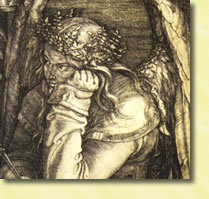
Melancholy“Is the LORD among us or not?” That is the question that the people of Israel asked Moses, according to this morning’s Old Testament reading. The God of Moses had delivered the Israelites from bondage in Egypt; he had rescued them from the hotly pursuing armies of Pharoah as they crossed the Red Sea; he then entered into a legal contract with them at Mount Sinai, a contract in which God promised the people that if they would keep his commandments, he would take care of them. That is the background to this morning’s reading from the Book of Exodus. But between the rescue at the Red Sea and the Sinai story are sandwiched a series of other stories that are almost comical if you read them one right after another, and this morning’s story is one of them. The first thing that happens is that the water tastes bad, so the people complain. Moses calls on God, and God fixes the water. Then there is nothing to eat. So the people complain again: “In Egypt, we were slaves, but at least we had three square meals a day.” So that night, a huge flock of quails arrive, and everyone has poultry for dinner. In the morning, God provides a special kind of bread, called manna, and he provides it every morning in the desert for the next forty years. So the people never go hungry again.

Then comes this morning’s story, and we know what is going to happen. The Israelites move to a new camp, there is no water, and the people complain: “Did you bring us here so that we and our children and our cattle could die of thirst?” Moses prays to the LORD, Moses strikes a rock with his rod, and God gives the people water. It is not too difficult too appreciate the perspective that the Psalmist provides in those last few verses from the Venite that we do not usually read: “Harden not your hearts, as your ancestors did in the wilderness. . . forty years long I detested that generation . . .” I do not have God’s patience, but before I came to teach at Trinity, one of the many jobs I worked at was IT support. The first question I always asked was “Did you check to make sure it’s plugged in?” We had a special term for a certain kind of problem – a PEBKAC. PEBKAC stood for: Problem Exists Between Keyboard and Chair. I can appreciate a perspective that asks: “When will these people ever learn?”

On the other hand, the concerns of the people of Israel are not unlike our own, and one can appreciate their dilemma. After all, if a God can not at least provide the basic necessities of life for one’s children and one’s cattle, then what good is he? Where is he? (more…)

August 28, 2008

A Sermon on St. Augustine

Filed under: Sermons,Theology — William Witt @ 4:42 pm

In the Church Calendar that you can find at the beginning of your copy of the Book of Common Prayer, you will note that today is the feast day of Augustine of Hippo. I believe strongly in expository preaching, and it is my usual practice to preach on the lectionary readings for the day. However, I am now officially a member of the faculty here at Trinity, and, as one of the first exercises of the freedom and authority granted me by my new position, I am going to depart from the liturgically correct position, and preach a topical sermon. I have decided to disregard the lectionary readings entirely and preach on St. Augustine instead. Please do not try this in your homiletics class.

Augustine, as I’m sure you all know, is perhaps the most important theologian in the Western Church. He is claimed as an authority by both Catholics and Protestants – although both sides would claim that the other side had misunderstood him. Augustine has certainly been important for Anglicans. You may have noticed that his portrait is on the Trinity iconostasis on the wall outside the library. There’s a gap of about a thousand years between Augustine’s picture and Wycliffe’s, but I have always assumed that was because Trinity ran out of money or space before they could finish adding the portraits on the left side of the wall.

Augustine was very important in my own theological development. I grew up in a free church Evangelical denomination, where it was more or less assumed that the Holy Spirit disappeared between the death of the apostle John (who died shortly after writing the book of Revelation) and the Reformation. If you look at the Trinity wall, you know better. The Spirit came back for Augustine. I read Augustine’s Confessions as an undergraduate, and my eyes were opened. He led me into the world of theology and church history. I can safely say that I am standing here now because I read Augustine as an undergraduate.

(more…)

August 26, 2008

Using Caesar’s Sword to Promote Christian Marriage

Filed under: Christianity and Politics,Ethics — William Witt @ 6:57 am

There has been a discussion at TitusOneNine about the movement among Christians and other groups in California — including Hindus and Muslims — to organization in opposition to same-sex marriage. At least one individual who claims to be an orthodox Christian is opposed to this because it means Christians are "manipulating Caesar to force Christian sacraments on the empire. . . . Conservative christianity cannot be salt and light by means of Caesar’s sword."

This is my response.

In the history of Christian social thought, there have been at least the following models of the relation between church and state:

1) Separatist–the model of radical Anabaptism. The most vivid contemporary example might be the Amish, who, as much as possible, live separately from the rest of the culture, do not participate in politics, do not bear arms, live in their own communities.

2) Government as corrective of sin–Augustinian/Lutheran. In a fallen world, the primary responsibility of government is to punish evildoers and provide a safe space for the Church to preach the gospel and administer the sacraments. Luther’s "two swords" analogy illustrates the distinction. There are some things the state does that the church does not do, and vice versa. The state enforces law and executes punishment on criminals; the church does not.

3) Promotion of the Common Good–Thomist/Aristotelian/Hooker’s Anglicanism. "It is not good for the man to be alone." God created human beings to be social animals. For humans to live together, there needs to be government to enable cooperation to promote human flourishing. The state not only punishes wrong-doers, but also takes positive steps to enhance human community and preserve the orders of creation. For example, anyone who uses the internet or drives an automobile on public streets is benefiting from a state that takes positive measures to promote the common good.

4) Transformationist–Calvinist. Inasmuch as possible, the state should work to transform society to promote Christian values, and anticipate the Kingdom of God. Martin Luther King, Jr.’s "I have a dream" speech is a prime example. As I was watching the speeches at the Democratic convention last night, and I heard Ted Kennedy preach "Health care is a right, not a privilege!," I was aware of just how much this Calvinist vision is alive in American culture.

5) Catholic subsidiarity/Reformed sphere sovereignty. (David Koyzis discusses this in his Political Visions and Illusions (InterVarsity, 2003)). There are numerous groups and cultures within a given society–churches, government, businesses, voluntary organizations, clubs, guilds, schools, etc. Each has its own realm of integrity and problems happen when groups trespass their bounds. The realms of the family or the schools, for example, are not the realms of either the state or the church; they have a genuine integrity of their own that both state and church need to respect.

6) Secularist separatism. Religion is a private matter of individuals and voluntary organizations. The realm of government is the realm of the public. The government should respect the right of religions to keep their own rules within their private environs, but the churches have no right to impose their private morality on the state or culture as a whole, and, if necessary, the state can pass laws that affect public matters that private voluntary organizations like churches must respect. So, for example, a Christian wedding photographer can be fined for refusing to photograph same-sex blessings. Catholic adoption agencies cannot discriminate against unmarried or gay couples.

There are, of course, other models.

Of the above six models, only 1) and 6) would suggest that the church has no business pushing against same-sex marriage. In any society of which Christians are citizens, Christians have the same privilege and duty to act in the public square as do other citizens. My own leanings are toward models 3) and 5). (more…)


August 19, 2008

On the Development of Doctrine

Filed under: Development of Doctrine,Theology — William Witt @ 7:47 am

On a blog post awhile back entitled “Some Basic Theological Principles (to be discussed later)” I had stated:

On the question of doctrinal development, the fundamental choice is between Newman’s and Barth’s understanding of the doctrine of the Trinity. The issue of continuity between (1) God’s revelation in the history of Israel, Christ, the apostolic Church: (2) the canonical Scriptures; and (3) the post-apostolic Church, must be decided theologically, in terms of the inherent intelligibility of the subject matter of revelation, not by alien philosophical criteria rooted in such historical conundrums as the relation between the one and the many, or problems of epistemological scepticism.

There have been a few inquires about what I meant by the “fundamental choice . . . between Newman’s and Barth’s understanding of the doctrine of the Trinity.” I haven’t answered that question yet. (My life has changed considerably since becoming a theology professor. Ironically, I have less time to do theology blogging.) However, I got an email today from someone (a Roman Catholic) who had read my post on “Why Not Leave?,” and asked me if I had changed my mind. This is my answer, and it relates to the question of development of doctrine: (more…)

Questions to Make Pastors Squirm

Filed under: Theology — William Witt @ 4:05 am

A friend of mine who is on the search committee for a new rector asked me for a list of questions that might help sort out a potential candidate’s theology, what was their churchmanship, whether they were Calvinist, Arminian, Evangelical or Anglo-Catholic.  I thought the following might be interesting questions to address to interviewees.  I wish my parish had asked some of these of a couple of “stealth” candidates who surprised the congregation with their real theology only after they had been called.

1.  Who is Jesus?  What does it mean to say “Jesus saves”?  How do you interpret John 14:6?

2.  Why is it important to believe in the doctrine of the Trinity?  Why is it important that Jesus rose from the dead?  If the bones of Jesus were found in a grave in Palestine, would that make any difference to Christian faith?

3. What is the central message of the gospel?

4. What is justification? Sanctification?  How are they related?

5. What does God contribute to salvation, and what do we contribute?  How are they related?

6. How do you understand divine sovereignty and providence?  Can anything happen outside God’s will?  Can human beings thwart God’s will?

7. Why do Christians pray if God already knows everything that will happen and exercises divine providence over the world?
(more…)

June 18, 2008

Buried With Him in Baptism: A Sermon

Filed under: Sermons — William Witt @ 7:16 am

Gen. 21:8-21
Rom. 6:1b-11
Matt. 10:24-39

River Baptism

What does it mean when a preacher finds himself facing the same kinds of lectionary readings over and over again? I am one of the three new faculty at Trinity this year, and I have now preached a number of times. In the last two sermons I preached, the issue of moral transformation and Christian discipleship was a key theme in the lectionary readings. In terms of Reformation theology, this is a topic that sometimes falls under a category called the “third use of the law.” This is an area that was somewhat controversial on this campus last year – the year before I arrived. So, as a new faculty member, I was understandably reluctant to preach on the topic. But there it was in the readings. So I preached on the readings.

I turn to the readings for this morning, and what do I find? In the gospel reading for this morning, we hear: “Whoever does not take his cross and follow me is not worthy of me. Whoever finds his life will lose it, and whoever loses his life for my sake will find it.” (Matt. 10: 38-39) Turning to the epistle, we find the central discussion of baptism in Paul’s letters. The reading begins with the question: “Are we to continue to sin that grace may abound?” (Rom. 6: 1) So there it is again. Moral imperatives! The third use of the law! I am quite tempted to preach on the OT lesson about Hagar and Ishmael. But perhaps, in God’s providence, the readings are there for a reason. Perhaps we at Trinity need to hear this message again. It is just as likely I think that I need to hear it, for I can hardly claim that I’m even close to getting a handle on this Christian discipleship thing.

(more…)

May 7, 2008

Blaming the Reformation

Filed under: Theology — William Witt @ 6:23 am

Cardinal Walter Kasper recently stated that Anglicans needed to choose between the sixteenth century and the first millennium. To the contrary, historic Anglicanism–as represented by Thomas Cranmer, John Jewel, and Richard Hooker–argued that they were choosing the church of the first millennium, over against the departures from Catholicity of the late Medieval Roman Church.

Bringing up the tired old polemics of the Reformation is a constant temptation in the crisis of un-faith that is affecting all churches today–not only the churches of the Reformation, but certainly Rome. But blaming the Reformation (or conversely, blaming Trent) will not help the church today because it does not address the real crisis the church is in.

Yesterday my students and I finished an entire semester of studying Contemporary Theology. We began with Schleiermacher and Barth, then covered everyone from Brunner, Bonhoeffer, the Niebuhrs, the Catholic Resourcement movement (DeLubac, Congar, Danielou), Orthodoxy (Bulgakof, Schmemann, Lossky), post-Vatican II theology (Rahner, Lonergan, von Balthasar), theology of hope/revelation history (Moltmann, Pannenberg) post-Liberalism (Lindbeck, Hauerwas), Evangelicals (Packer, Henry), (post-conservative) Evangelicals (N.T. Wright, Vanhoozer), “Scientific” theology (T. F. Torrance, Alister McGrath). We finished with Anglican theology–Ramsey and Sykes. All of these fairly clearly lined up with Barth. On the other side, we studied Bultmann, Tillich, process theology, feminist theology, liberation theology. All of these fairly clearly lined up on the other side–with Schleiermacher. (more…)

April 23, 2008

Abiding in the Vine: A Sermon

Filed under: Sermons — William Witt @ 3:24 am

John 15:1-8

The great Anglican biblical scholar Sir Edwin Hoskyns wrote of Jesus’ Last Supper Discourse in his Commentary on John’s gospel: “The whole scene is an epitome of the Christian religion.”(1) If that is true of chapters 14-17 as a whole, then I think it could also be argued that the eight verses at the beginning of John chapter 15 are such an epitome in miniature, for in just these few short verses, John includes all of the major themes of his version of the Christian gospel, all tightly woven together.

What are those themes? What is the passage about?

The first theme has to do with the John’s understanding of the church. The passage is about ecclesiology. Jesus’ statement “I am the true vine and my Father is the vinedresser” echoes numerous Old Testament passages. These passages all contain a message of judgment. In each of these passages, Israel is the vine, and God is the vineyard owner or planter. So in Isaiah 5, the prophet speaks of a vineyard owner who plants a vineyard that yields wild grapes – a vineyard that will be trampled down and made a waste. “For,” says Isaiah, “the vineyard of the Lord of hosts is the house of Israel.”

John echoes these passages, but with a Christological twist. For John, Jesus is now the true Israel. He is the true vine, and his Father is the vineyard dresser. Where the previous vineyard had been declared a waste, Jesus – the True Vine – produces fruit. There is still a message of judgment, however. The church is not the vine, but the branches that dwell in the vine. The vineyard dresser prune the vine, and the branches that do not yield fruit are cast into the fire. If the church, or at least members of the church, fail in their mission to dwell in the vine, they will suffer the same judgment as Israel. So the passage is about John’s understanding of church – and we’ll get back to that in a few minutes. (more…)

March 15, 2008

Ministers of a New Covenant: A Sermon for Potential Seminarians

Filed under: Sermons — William Witt @ 6:02 am

2 Corinthians 3: 7-18

The chapters in 2 Corinthians that begin with this evening’s lectionary reading have always been one of my favorite selections from Scripture. 2 Corinthians 3-6 contain some of the most beautiful writing in all the Bible. You are no doubt familiar with some of the verses: "The God who said, ‘Let light shine out of darkness,’ has shone in our hearts to give the light of the knowledge of the glory of God in the face of Jesus Christ." Or, "For this momentary affliction is preparing for us an eternal weight of glory beyond all comparison, as we look not to the things that are seen but to the things that are unseen." Or again, "For we walk by faith, not by sight." There is also"If anyone is in Christ, he is a new creation. The old has passed away; behold, the new has come."

This selection of Scripture is also particularly relevant this evening as I address a chapel full of seminarians and potential seminarians. Why? The context of the entire letter of 2 Corinthians is one long sustained argument that Paul is having with the Corinthians in which he defends his ministry. We know from Paul’s first letter to the Corinthians that Paul did not get along well with this church, and that there were those who challenged his ministerial credentials. Under similar circumstances, we ourselves might well be tempted to respond with an outburst of temper: "Because I’m the apostle, and you’re not! That’s why!" There is a little of that toward the end of the letter when Paul warns them: "What we say by letter when absent, we do when present." (2 Cor. 10:11) So, the Daddy apostle is coming home, and boy are you going to get it!

But, Paul is, after all, Paul. And Paul is nothing if not a theologian. So before Paul warns them at the end of the letter that if they don’t straighten up, they will be sorry, Paul does what Paul does. He theologizes. And for this we can be grateful, because Paul defends his ministry by a theological reflection on ministry that contains these wonderful three chapters from chapter three though chapter six. In this selection, Paul provides some of his most profound insights on the meaning of redemption and Christian life. The heart of Paul’s defense of his ministry is that as an apostle, he is a minister of God’s new covenant in Christ Jesus, a covenant written not in the stone letters of the ten commandments, but in letters of love written by the Holy Spirit on human hearts. (more…)

« Newer PostsOlder Posts »

Non Sermoni Res — William G. Witt is proudly powered by WordPress