
1554 Born at Heavitree near Exeter
1577 Becomes fellow at Corpus Christi, Oxford (with Jewel’s help)
1579 Appointed Deputy Professor of Hebrew
1578 Ordained
1584 Appointed Rector of Drayton Beauchamp
1585 Appointed Master of the Temple (conflicts with Walter Travers, the Reader, and a Puritan)
1585/86 A Learned Discourse on Justification (sermon)
1588 Marries Jean Churchman
1591 Rector of Boscombe, Wilts
1593-1595 Publication of Books 1-4 of Laws of Ecclesiastical Polity
1595 Rector of Bishopsbourne, near Canterbury
1597 Publication of Book 5 of Laws
1648 Publication of Books 6 & 8
1662 Publication of Book 7
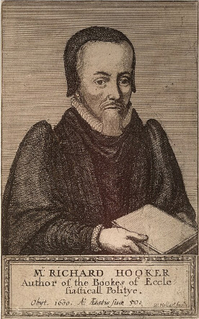
Richard Hooker is perhaps the most important theologian in the history of Anglicanism. His Laws of Ecclesiastical Polity provided the theological justification for the Prayer Book worship and polity of the Church of England during the Elizabethan settlement. At the same time, Hooker’s contribution is controversial. Partisan divisions within Anglicanism have contributed to his mixed assessment. Anglo-Catholics have tried to claim Hooker as one of their own, while Evangelical Anglicans who look to Thomas Cranmer as their source of inspiration have at the least neglected Hooker, perhaps fearing that he prepared the way for what they perceive as a falling away from Reformation principles in the following generation of the Caroline Divines. Paradoxically, a renewal of interest in Hooker’s theology over the last several decades has been led by Reformed scholars who have claimed Hooker as a Reformed theologian. What follows will recognize Hooker’s unique contributions to Anglican identity. At the same time, I think it mistaken to view Hooker as in discontinuity with the English Reformation that preceded him. On my reading, Hooker is in continuity with but also the logical conclusion of an Evangelical Catholic approach to Anglican theology that originated with Thomas Cranmer, was succeeded by John Jewel, and then passed on and developed in Hooker.
Hooker lived from approximately 1554 to 1600. It is believed that he was born in 1554 at Heavitree near Exeter. In 1577, Hooker became a fellow at Corpus Christi, Oxford, with the assistance of John Jewel. While Jewel was a protege of Cranmer, Richard Hooker was a protege of Jewel. In 1579, Hooker was appointed Deputy Professor of Hebrew. Hooker was ordained August 14, 1579 by Edwin Sandys, Bishop of London. In 1584, Hooker was appointed Rector at Drayton Beauchamp. In 1585, Hooker was appointed Master of the Temple in London, where he began having conflicts with Walter Travers, a Reader and a Puritan. Hooker would preach in the morning and Travers would preach in the afternoon, contradicting what Hooker had just preached. The controversy ended when Travers was silenced by Archbishop Whitgift in 1586.
Hooker’s Learned Discourse on Justification (published either in 1585 or 1586) was a sermon challenging the Roman Catholic position, but was nonetheless controversial among the Puritans for suggesting that Roman Catholics could still be saved. In 1588, Hooker married Jean Churchman. Hooker became the Rector of Boscombe, Wilts in 1591, and began writing the Laws of Ecclesiastical Polity. Books One to Four were published from 1593 to 1594. In 1595, Hooker became the rector of Bishopsbourne near Canterbury. In 1597, Book Five of the Laws was published. Hooker died in 1600. In 1648, Books Six and Eight were published, long after Hooker’s death. The publication of Book Seven did not take place until 1662.
The influences on Richard Hooker were primarily Thomas Aquinas, from whom he derived his understanding of law, the church fathers Irenaeus, Athanasius, and Cyril of Alexandria, whom he cites in his discussion of Christology, and John Jewel, when he discusses Anglican identity. Finally, Hooker was influenced by John Calvin for his understanding of the relationship between justification and sanctification as well as his Eucharistic theology.
As already noted, there has recently been a renewed interest in Hooker’s theology, primarily among Reformed theologians. This is ironic, as historically Hooker has been more admired by Anglo-Catholics, but the new interpreters are correct that although Hooker rejected Puritanism, he was nonetheless at least in conversation with a more moderate Reformed theology. I would suggest however that a better parallel would be provided by the conversation Jewel had with the Roman Catholic church. Although Jewel disagreed with Rome, he still wanted to argue that the Church of England was Catholic. Although Hooker disagreed with the Puritans, he did not simply reject the Reformation. As was the case with Jewel, I would suggest that Hooker’s own approach is Evangelical Catholic, a Reformed (in the sense of Reformation) or Evangelical (but not Calvinist) Catholicism. In particular, Hooker was in conversation with an earlier pre-Reformation Catholic tradition. Hooker especially engaged with the church fathers and the Christology and Trinitarian theology of the ecumenical councils. Hooker was also influenced significantly by the theology of the medieval Catholic theologian Thomas Aquinas.
The Puritans
Richard Hooker was the second great Anglican apologist. John Jewel was the English Reformation’s primary apologist in response to Roman Catholic attacks on Anglicanism. In the following generation, the Puritans had largely replaced Roman Catholics as the great challenge to the Elizabethan church. The Puritans were English Protestants who opposed the Elizabethan settlement because they thought the Church of England had not gone far enough in its reformation. When Jewel fled to the continent during the reign of Queen Mary, he met fellow English refugees who had discovered the Reformation as it was being practiced under the influence of John Calvin in Geneva, Switzerland, and whose goal was to reform the Church of England along Genevan lines.
The Puritans complained that the English Reformation under Thomas Cranmer during the reign of Edward VI, and later under Queen Elizabeth, retained too much of what they believed resembled Roman Catholicism, which they referred to as “popery.” Key to the Puritan demands was the hermeneutical practice of the Regulative Principle: whatever Scripture does not explicitly command is forbidden. In line with this, the Puritans demanded explicit Scriptural support for all aspects of public worship.1
The Puritans rejected Prayer Book worship as a violation of the Regulative Principle: the Bible does not command written prayers. They also rejected church ornaments and the wearing of vestments, including surplices. They rejected using the sign of the cross in baptism. They insisted on referring to communion tables rather than altars.
The Puritans emphasized preaching, which they believed was the most important feature of the Sunday service. They also emphasized Sabbath observance, by which they meant strict observance of Sunday as the sabbath, on which no work was to be done.
They also tended to reject episcopacy and advocated Presbyterian polity on the grounds that the New Testament does not make a clear distinction between presbyters and bishops. They pointed out correctly that the Pastoral Epistles that contain the chief passages in the New Testament referring to the roles of bishops and presbyters more or less identify the offices of episkopos and presbyteros with one another. A clear distinction between presbyters and bishops first appears in second-century writers like Ignatius of Antioch, a development the Puritans rejected as illegitimate.2
The Puritans especially opposed ecclesiastical courts because they disagreed that either the government (Parliament) or bishops should be able to hold people accountable for holding positions that the Puritans thought were legitimate theological alternatives to Prayer Book worship. The Puritans believed that the ecclesiastical courts did not not fairly represent their views, and they thought (probably correctly) that they were being persecuted by the courts.
Finally, in terms of the political realities of the English Reformation, it is significant that Queen Elizabeth opposed the Puritans. Since English monarchs played important roles not only in the first few decades but in the first couple of centuries of the English Reformation, to be opposed by the monarch was to place oneself in opposition to the established church.
Scripture and Tradition
Consistent with Reformation theology, and like Jewel and Cranmer before him, Hooker affirmed the priority and sufficiency of Scripture (Sola Scriptura), not as containing all knowledge, but as containing all things necessary for salvation:
Often times it hath been in very solemn manner disputed, whether all things necessary unto salvation be necessarily set down in the Holy Scriptures or no. If we define that necessary unto salvation, whereby the way to salvation is in any sort made more plain, apparent, and easy to be known; then is there no part of true philosophy, no art of account, no kind of science rightly so called, but the Scripture must contain it.3
A common but mistaken modern claim is that Hooker advocated a “three-legged stool” of Scripture, tradition, and reason – understood as three mutual sources of authority in the church. It is sometimes incorrectly stated (especially by liberal Protestant interpreters) that Hooker believed that all three legs of the stool were equal, and it might even be possible for reason to contradict or correct Scripture.4 To the contrary, Hooker did not advocate a three-legged stool because his three sources do not actually make a stool. A better analogy would be that Hooker’s “stool” is more like a unicycle. Scripture is central, and tradition and reason are something like the pedals that we use to interpret Scripture.
Hooker’s concern in distinguishing between Scripture, reason, and tradition was first and foremost hermeneutical. Hooker did not disagree with the Puritans about the priority and sufficiency of Scripture (Sola Scriptura). His concern was rather to address the question: how does the church interpret Scripture and apply its teaching in a different historical setting from the time in which the Scriptures were written? Which areas of Scripture are permanently binding for the church, which can be modified, and on what grounds? The assumption is that there are some aspects of Scripture that are not permanently binding for the later church, and reason and tradition help to clarify those distinctions.
As an example of something in Scripture that is not permanently binding, it is common for Christians to eat shrimp or pork chops although the Old Testament specifically prohibits the eating of crustaceans and pork. There are other Old Testament passages that Christians conveniently ignore, for example, the Old Testament commandment that specifies the placing of fences on roofs.
The New Testament itself addresses the sacrificial and food laws of the Old Testament and the practice of male circumcision as no longer binding for Gentile Christians. Common sense explains why there are laws about fences on roofs in the Old Testament. In spite of the Christmas carol, it was not the bleak midwinter when Jesus was born, and there was no snow on the ground. In hot Mediterranean climates, flat roofs are gathering and cooling off places, and there is always a danger of falling off the roof. Thus, some laws in Scripture address cultural and historical conditions that would not apply everywhere and at all times.
In devising his hermeneutic, Hooker made a crucial distinction between what he called doctrine and morals. Hooker stated that matters of doctrine and morals are unchangeable. When Scripture specifically refers to a matter of doctrine, for example, that Jesus Christ died for our sins, this does not change. The later church could not dispense with the doctrine of the atonement. Similarly with morals, Hooker believed that the Ten Commandments are absolutely binding at all times. The church could not decide that adultery or theft or murder are now permissible.
On the other hand, according to Hooker, matters of church order and polity are changeable, and this is crucial to understand his position. To suggest that a written liturgy or episcopal polity are permissible for the church even though neither is specifically commanded in Scripture would not be the theological equivalent of embracing Arian theology or advocating a libertine ethic. Following is the crucial passage from The Laws of Ecclesiastical Polity:
The Church hath authority to establish that for an order at one time, which at another time it may abolish, and in both it may do well. But that which in doctrine the Church doth now deliver rightly as a truth, no man will say that it may hereafter recall, and as rightly avouch the contrary. Laws touching matter of order are changeable by the power of the Church. Articles concerning doctrine, not so. (Laws V.8.2)
This appears just before the frequently cited passage about the “three-legged stool,” and is the key to its interpretation:
Be it in matter of the one kind or of the other, that is doctrine or order, what Scripture doth plainly deliver, to that the first place, both to credit and obedience is due. The next whereunto is whatsoever any man can necessarily conclude by force of reason. After these, the voice of the church succeedeth. (Ibid)
In line with the Protestant Reformers, Hooker claimed that Scripture is the church’s primary authority. However, not everything in Scripture is permanently binding. Matters of theology, doctrine, and morals are always binding. There will be other cases, however, where Scripture is not necessarily binding, specifically in matters of polity and worship, which are Hooker’s chief concerns, and the heart of his disagreement with the Puritans.
The order of authority is as follows. On matters of doctrine and morals, the church has no authority whatsoever to make any changes from the plain teaching of Scripture. In matters of church order and ceremony, the church may change its structures. When Scripture does not speak clearly, reason and tradition may weigh in.
For Hooker, reason is not the modern autonomous individualism that traces its origins to the French rationalist philosopher René Descartes (1596-1650), but is understood in the sense of “faith seeking understanding” (fides quaerens intellectum) that derives from both Augustine of Hippo and Anselm of Canterbury. Hooker refers to reason within the context of the church as a worshiping community in order to understand and apply the teaching of Scripture. Reason’s function is one of hermeneutics.
Hooker distinguishes between Scripture and reason because Scripture does not interpret itself. The Puritans tended toward a kind of straightforward reading of the Bible. If one wanted to to know what one needed to do, one simply read the Bible for oneself. Whatever the Bible commands us to do, we do. Whatever the Bible does not specifically command is forbidden.
Hooker was aware that things are not that simple. In order to understand and apply the teaching of Scripture, we have to compare texts with one another. We have to understand where a particular text occurs in what we might call the history of redemption or salvation. We have to look at the relationship between the Old Testament and the New Testament. We have to ask whether a particular passage in Scripture is a matter of morals and doctrine or whether it concerns matters that might not necessarily be permanently binding.
Hooker responds to Puritan objections against the use of reason at length. Against Puritan appeals to St. Paul concerning the inability of natural reason to receive the things of God (1 Cor. 2:14), Hooker responds that Paul himself claims that “natural” human beings know of both God and his law (Rom. 1:21, 32), and echoes Thomas Aquinas that“nature hath need of grace,” and “grace hath use of nature.”5 In response to Puritan appeals to Paul’s warnings against philosophy (Col. 2:8), Hooker distinguishes between sound reasoning and deceitful reasoning that makes the unreasonable seem reasonable. Against claims that heretics rely on reason, Hooker responds that the proper response to a heretical “counterfeit “reason is to use the “light of reason” as the principal instrument to refute heresy. To the claim that because Scripture is a perfect “two-edged sword,” we do not need to add to it the weapon of reason, Hooker responds that Scripture is perfect for the end for which God intends it; however, reason is not a “supplement” to the use of Scripture, but rather a “necessary instrument” for its interpretation. “To go from the books of Scripture to the sense and meaning thereof,” reason is necessary: “Exclude the use of natural reasoning about the sense of Holy Scripture concerning the articles of our faith, and then that the Scripture doth concern the articles of our faith who can assures us? . . . [B]etween true and false construction, the difference reason must show” (Laws III.8.2-16).
How does Hooker address the category of “experience,” which has been a major focus in modern theology since the beginning of liberal Protestantism with Friedrich Schleiermacher (1768-1834)? Hooker is critical of an understanding of experience that is sometimes associated with the leading of the Holy Spirit. He disparages the notion that the Spirit can give new revelations that would go beyond the content of Scripture, and is critical of those who claim that the Spirit gives them a special ability to interpret Scripture apart from the plain meaning of the text. In the Preface to the Laws, Hooker writes:
If the Spirit by such revelation have discovered unto them the secrets out of Scripture, they must profess themselves to be all prophets. It is not therefore the fervent earnestness of their persuasion, but the soundness of those reasons whereupon the same is built, which must declare their opinions in these things to have been brought by the Holy Ghost and not by the fraud of what evil spirit, which is even in his allusions strong. (Laws, Preface, 3.11)
Hooker is not saying that in interpreting Scripture, the Holy Spirit plays no role. However, key to the interpretation of Scripture is that God has given us minds so that we can read the Scriptures and understand them. The proper way to interpret Scripture is through sound exegesis. It is foolish to assume that we can open the Bible and pray, after which the Holy Spirit will give us the correct interpretation of a passage. In this light, Hooker would be critical of the modern liberal Protestant appeal to “experience” to claim that the Holy Spirit is now leading the church in new directions that are contrary to the plain sense meaning of Scripture.
Hooker on Law
For Hooker, law is the hermeneutical key to the interpretation and application of Scripture. Hooker follows the understanding of law in Thomas Aquinas fairly closely.6
One of the characteristic themes that arose at the time of the Reformation because of the discussion of law particularly in the apostle Paul’s letters to the Galatians and Romans has to do with the relationship between what is called Law and Gospel. Paul is clear that the law does not justify; only faith justifies. One of the consequences of the Reformers’ reading of Paul is that the Reformers, particularly Luther more than Calvin, sometimes have a negative understanding of law – the law always kills. In this respect, Luther is referring particularly to obeying biblical commandments as a means of justification – “works of the law.”7
Hooker also refers to law as commandment, which he designates as “positive law,” but borrowing from Aquinas, Hooker primarily writes about law in the sense of general principles by which God runs the world (exercises providence over creation) – not specific commandments. Hooker’s notion of law is something like the law of gravity. The law of gravity is not a written or oral command, but if a person walks off the edge of a cliff, he or she soon discover what it means to obey the law.
Hooker’s understanding of law thus goes beyond the notion of “positive law” (law as command “for us”) to address the ontological foundations of law in both the nature of God and of creation.8 Primarily, Hooker understands law in the sense of principles by which God has created and exercises providence over the universe. God has indeed given commands (positive law) in Scripture – biblical laws – but these must accord with God’s own character, the nature of creation, and the way that God intends for the world to run. Specifically, Hooker makes the move from law understood as volitional – an order or command expressed – to the structures of reality that underlie law as command. The move is from what might be called “common sense” realism to “critical realism,” from an understanding of realities as they “relate to me” (pro me) to what they must be in themselves (in se), from phenomena to ontology.9 Hooker distinguishes between different kinds of laws in order to explain how this move toward ontology plays out.
An important ontological distinction in Hooker’s discussion of both law (in Books I-IV) and Christology (in Book V) is the distinction between God and creation.10 As will be noted later, in the late medieval period, there began a “voluntarist” tendency to describe the relation between God and creation in terms of sheer will: God is the absolute all-powerful will that brought creation into being. In consequence, relations between God and creatures come to be understood in terms of competing wills – either in a (Semi)Pelagian or determinist manner. That is, divine and human wills either compete at the same level of being (William of Ockham and Gabriel Biel) or, to the contrary, God’s all-powerful will overrides human wills so that only God has free will (Thomas Bradwardine and Gregory of Rimini).
Hooker rather articulates the distinction in terms of ontological categories that echo patristic trinitarian and christological distinctions as well as Thomas Aquinas’s own discussion of the relation between God and creatures. God is distinguished from creatures in the following ways:
(1) Potency/act distinction: Because God’s existence is fully actualized, God can have no capacity toward further existence or perfection. In Aquinas’s terminology, God is the “pure act of existence” (purus actus essendi). In contrast, all creatures are in “potency” toward further actualization of existence and perfection. Hooker echoes this distinction: “God alone excepted, who, actually and everlastingly is whatsoever he may be, and which cannot hereafter be that which now he is not; all other things besides are somewhat in possibility, which as yet they are not in act” (Laws I.5.1).
(2) Infinite/finite distinction: God alone has infinite necessary existence. All creatures possess limited, finite, and contingent existence:
All things are in such sort divided into finite and infinite, that no one substance, nature, or quality, can be possibly capable of both. The world and all things in the world . . . all the powers and abilities whereby they work, whatsoever they do, whatsoever they may and whatsoever they are, is limited. . . . Impossible it is that God should withdraw his presence from anything, because the very substance of God is infinite. (Laws V.55.2-3)
(4) Perfection/participation: The distinction between God’s full (infinite) perfection of existence and the limited perfection of creatures is crucial to the transition of creatures from potency to act. To be a creature is to strive for a further actualized perfection of being that is a “participation” in divine perfection: “[Since] there can be no goodness which proceedeth from God himself, as from the supreme cause of all things; and every effect doth after a sort contain, at leastwise resemble, the cause from which it proceedeth; all things in the world are said in some sort to seek the highest, and to covet more or less the participation of God himself” (Laws I.5.2).
(3) Immutability/mutability: God’s immutability is a correlation of the fullness and perfection of his existence. Insofar as creatures move from potency to act – from incomplete existence to further actualized existence – they strive to imitate God’s goodness and excellence through the “continuance of their being,” through “constancy and excellence of their operations.” They strive to imitate the “immutability of God” through working for the most part in a consistent manner (ibid).
The distinction between God and creatures is thus essential for Hooker’s understanding of the notion of creaturely “participation” in divine perfection, and, accordingly, for Hooker’s understanding of various kinds of law.
First is the eternal law. What Hooker means by the eternal law is simply God’s own nature, the very Being of God himself (in se) as expressed in God’s decision to create the universe. Hooker so identifies eternal law as an expression of God’s own nature that he grounds it in God’s nature as Trinity. God’s unity is that of the Trinitarian processions of the generation of the Son and the procession of the Spirit, which are essential and necessary to God’s very being. God’s external actions are “from the Father, by the Son,” and “through the Spirit.” Unlike the necessary processions of the trinitarian persons, God’s external operations are “voluntary,” the expression of an “eternal decree . . . which we term an eternal law” (Laws I.2.2).
For Hooker, God’s law and God’s will are identified with the good, meaning that the end or teleological purpose of God’s work is the exercise of God’s own virtue (Laws I.2.4). According to Hooker, God is good, God is necessarily and completely good, and God could not but be good.11 Eternal law is then simply identical with God’s own good nature and character as expressed in creation.
There were those in the late medieval period who disagreed with this understanding of law. The Franciscan Duns Scotus claimed that if God had wanted to, he could have dispensed with the Second Table of the Ten Commandments, and if God had so willed, God could have created a different “possible world” in which murder or adultery were permissible. Nonetheless, God has decided to create the “possible world” in which we live, one in which murder and adultery are forbidden.12 The nominalist William of Ockham went beyond Scotus to claim that God could have created a world in which even the First Table of the Ten Commandments was dispensable. If God so willed, God could command us to hate him, and we would show that we loved God by hating him.13
Theologians and philosophers refer to this notion of unconstrained divine will as voluntarism. Key to voluntarism is the notion that the will is an “unmoved mover.” Its choices are not necessarily moved by or oriented toward any good, and free choice is understood as a matter of choosing between opposites with no inherent relation to a known good. There were both libertarian and determinist versions of voluntarism in the late medieval and Reformation periods. William of Ockham and Gabriel Biel were libertarian voluntarists who believed that both the human and divine wills were entirely free and could always choose between opposites. It is generally agreed that their theology of grace was at least semi-Pelagian. If the human being by free will alone did what he or she was able to do (quod facere in se est) to love God for God’s own sake, God would reward the pilgrim with grace.14
In opposition to the voluntarist theology of Ockham and Biel, determinist voluntarists like Thomas Bradwardine and Gregory of Rimini claimed to be following Augustine. Paradoxically, they nonetheless affirmed the voluntarist notion of will in respect to God, but rather denied it in respect to human beings – claiming that human beings had no free will at all but simply did whatever God had determined them to do.15 There were Puritans, for example, William Perkins, who were simultaneously voluntarist and determinist in this sense. Perkins claimed that whatever existed existed because God had decreed it to happen exactly as it happened, and that God’s determinist will was the cause of both good and evil. Perkins claimed that evil existed because God had decreed that it was good for evil to exist.16
Hooker emphatically rejected the voluntarist notion that good and evil are simply identified with whatever God wills. He wrote: “They err therefore who think that of the will of God to this or that there is no reason besides his will.” According to Hooker, God’s will is good because God’s nature, which is identical with his own being, is inherently good, and God cannot will other than good. In that light, all of God’s actions have reason and are done with counsel or wise resolution (Laws I.2.5). The eternal law is then the law of God’s own wisdom. The eternal law does not in any way constrain God’s freedom to act or not act, to create or not to create, but it does mean that if God decides to create or to act, whatever God does, God will act in a manner that is good and in accord with his own nature as good (Laws I.2.6).
The second type of law, according to Hooker, is natural law. Natural law is the law by which creatures follow God’s intentions for their order. All creatures seek the good, but do so in different ways. Non-rational creatures obey natural law necessarily by seeking a general perfection and design consistent with the continuation of their own being. Hooker writes: “Whereas therefore things natural, which are not in the number of voluntary agents . . . do so necessarily observe their certain laws, that as long as they keep those forms which give them their being, they cannot possibly be apt or inclinable to do otherwise than they do” (Laws I.3.2-4). In the words of the song, “fish gotta swim, birds gotta fly.” If one is a fish or a duck, the way that one obeys God’s law (the natural law) is doing what God has created one to do. Ducks obey God’s natural law by flying south for the winter.
There is also, according to Hooker, an aspect of the natural law that has to do with morality. Hooker refers to this as the law of reason (Laws I.3.2, 8.8-9). One of the ways in which rational creatures such as human beings are different from non-rational creatures is that they have a choice about obeying what Hooker calls the natural law or the moral law. This is one of the things that makes what Hooker calls “voluntary agents” (not only human beings but also angels) distinct from non-rational animals (Laws I.3.2, 7.2).
Hooker’s move to ontology echoes such church fathers as Irenaeus and Athanasius, but also Augustine and Aquinas by making clear that the doctrine of creation must precede the doctrine of the fall and redemption, and that a Christian anthropology must ontologically precede a doctrine of sin. We can only know what it means for human beings to be sinful if we first know what it means for God to have created human beings in the image of the triune God and made for union and communion with God.
In line with Hooker’s understanding of law is that Hooker’s account of morality and will is teleological, or goal-oriented (from the Greek word telos, meaning end or goal). Hooker’s understanding of morality is neither a deontological commandment ethic – “do this” or “do not do that” – nor is it consequentialist, focusing on the consequences or outcomes of moral actions, for example, the utilitarian “greatest happiness for the greatest number of people.” In Hooker’s thought, the morality of actions primarily has to do with the proper goal or purpose of those actions.
Teleology is fundamental to Hooker’s entire account of creation. All things work toward a preconceived end or goal (Laws I.2.1). Even God’s own being is a kind of law that works either toward God’s own perfection or the perfection of his acts. As noted above, all of God’s actions work toward the good (Laws I.2.2-3). All things, whether non-rational or rational, resemble God’s goodness first in seeking their own continued existence. Second, creatures resemble God’s goodness through the excellence of operations connected with their natures (Laws I.5.2).
Human beings pursue their own perfection (teleological end) through knowledge and will. Knowledge and will are related in the sense that the will has no option but to choose known goods. Passions (or affections) draw the will toward or repel the will away from known objects: “Reason is the director of man’s will by discovering in action what is good” (Law, 1.7.4). The affections and appetites are the will’s “solicitor[s]” beckoning or repelling the will from known goods or evils (Laws I.7.3). In order to choose an action or object, I have to desire something or I have to be repelled by it, and I have to recognize it as being good for me or threatening to me in some way.
Hooker also makes a distinction between what could be called “natural freedom” – the freedom to choose between options – and moral freedom, the freedom to choose rightly. “Choice” (for Hooker) is the natural ability to choose between options. When one wakes up in the morning, one can decide whether to wear the brown shoes or the black shoes. In contrast to “choice,” “will” is the ability to choose the good, which is not simply “free will,” but moral freedom – the freedom to act rightly: “To choose is to will one thing before another. And to will is to bend our souls to the having or doing of that which they see to be good” (Laws I.7.2). Reason directs human understanding to discover which actions are good. “Right reason” provides the “laws” of well-doing (Laws 1.7.4).
Hooker’s account is not only teleological, but also eudaemonistic. As the will is attracted to the good, our choices are oriented toward felicity or happiness.17 In all of our choices, the will seeks happiness and cannot do otherwise: “Our felicity therefore being the object and accomplishment of our desire, we cannot choose but wish and covet it” (Laws I.8.1). Happiness is attaining as far as possible the full possession of that which is desired simply for itself. However, such happiness is not possible in this life. Only union with God can bring true happiness because only God can be desired simply for himself, and God has made human hearts to desire him (Laws I.11.3-4).18
Hooker here anticipates a position that would later be associated with such theologians as the Roman Catholic Henri de Lubac and (rightly or wrongly) the mid-twentieth century Roman Catholic movements of nouvelle théologie and ressourcement.19 Hooker holds together two paradoxical positions found in the theology of Thomas Aquinas. On the one hand, he claims that human beings have a natural desire for an infinite happiness that cannot be satisfied by any created good; only an infinite good can be desired for its own sake (Laws I.11.1-2). At the same time, only God is infinite, and so only God can fulfill this desire. Moreover, such desire can be fulfilled only by union with God:
No good is infinite but only God; therefore He our felicity and bliss. Moreover, desire tendeth unto union with that it desireth. If then in him we be blessed, it is by force of participation and conjunction with Him. Again, it is not the possession of any good thing can make them happy which have it, unless they enjoy the thing wherewith they are possessed. Then are we happy therefore when fully we enjoy God, as an object wherein the powers of our souls are satisfied even with everlasting delight: so that although we be men, yet by being unto God united we live as it were the life of God. (Laws I.11.2)
The paradox arises because while Hooker (and Aquinas) describe this desire as “natural,” the fulfillment of the desire is not something that can be fulfilled through natural means, but only through supernatural grace. Hooker claims that no natural desire can fail to be fulfilled or it would be pointless: “And is it probable that God should frame the hearts of all men so desirous of that which no man may obtain? It is an axiom of Nature that natural desire cannot utterly be frustrate. This desire of ours being natural should be frustrate, if that which may satisfy the same were a thing impossible for man to aspire unto” (Laws I.11.4).
Hooker does not resolve the question that would become controversial in twentieth-century Roman Catholic theology of how a “natural desire” that demands fulfillment could still be received as a free divine gift; however, he is clear that the union with God that fulfills the desire is “supernatural” and beyond natural human capacities. Even if a human being were to possess in this life every imaginable beauty, wealth, knowledge, virtue and other imaginable perfections, something more would still be desired: “So that Nature even in this life doth plainly claim and call for a more divine perfection” (Laws I.11.4).
Up to this point, Hooker has been describing a kind of ideal account of human nature. Even unfallen sinless human beings would require supernatural grace to fulfill their created end. Hooker shifts the argument however to assess our actual situation – as fallen sinful human beings. Given human sinfulness, how much more are revelation and redemption necessary for humanity to attain its created goal!
Seeing then all flesh is guilty of that for which God hath threatened eternally to punish, what possibility is there this way to be saved? There resteth therefore either no way unto salvation, or if any, then surely a way which is supernatural, a way which could never have entered into the heart of man as much as once to conceive or imagine, if God himself had not revealed it extraordinarily. For which cause we term it the Mystery or secret way of salvation. (Laws I.11.5)
Hooker thus identifies attainment of the good identified with ultimate happiness as only realized in knowing and loving and being in union with God – since only such union can bring about the happiness for which we are made. This echoes the famous prayer at the beginning of Augustine’s Confessions, “You have made us for yourself, and our hearts are restless until they rest in you.” Even if humanity had never sinned, the ultimate happiness found in union with God would only be possible through supernatural grace. Given human sinfulness, only the redemption found in Christ can provide this happiness:
[B]ehold how the wisdom of God hath revealed a way mystical and supernatural, a way directing unto the same end of life by a course which groundeth itself upon the guiltiness of sin, and through sin desert of condemnation and death. For in this way the first thing is the tender compassion of God respecting us drowned and swallowed up in misery; the next is redemption out of the same by the precious death and merit of a mighty Saviour, which hath witnessed of himself, saying, “I am the way,” the way that leadeth us from misery into bliss. This supernatural way had God in himself prepared before all worlds. (Laws I.11.6)
Ultimate happiness found in a knowing and loving union with God provides the ontological and teleological basis for Hooker’s account of morality. In his analysis of moral choices, Hooker claims that all law is founded on the two great commandments to love God and neighbor – the first and second table of the Ten Commandment as summarized in the Gospels (Laws I.8.7). Although the two great commandments are revealed in Scripture, Hooker claims that they are also naturally known, in line with first principles of reason that are self-evident (Laws I.8.5). Human beings by nature know that there is a God and that all things depend on him, and that we owe him honor. Humans naturally see that it is our duty to love our fellow human beings. That I desire to be loved by others imposes on me a natural duty to love them in return (Laws I.8.7).
Although they should be naturally knowable, God has also given human beings written laws such as the Ten Commandments (Laws I.12). While the Ten Commandments include commands such as “do not murder,” “do not commit adultery,” it is also the case that in spite of God having given us such laws, human beings violate them. While birds obey natural law by flying and fish obey natural law by swimming, human beings do not love God with our whole heart and we do not love our neighbors as ourselves. As noted above, this distinction between the way that non-rational creatures necessarily obey natural law and the way in which rational creatures (angels and human beings) are necessarily attracted to known goods but are able to choose between one good and another is a key difference between the two kinds of living creatures. That human beings do not obey natural law in the same way as non-rational animals is our great dilemma.
When Hooker writes that human beings have choice to obey or disobey the rational or moral law, he is not ignoring the doctrine of the fall or what Luther referred to as the Bondage of the Will. What Hooker is doing is to provide a kind of corrective to Reformation tendencies to articulate the gospel as a simple dichotomy between sin and salvation.20 As noted above, this is an account of God’s intentions for creation and human nature as preliminary to a doctrine of sin and redemption.
Given what Hooker has said about all human choices being oriented toward the good, that we are destined for happiness, and that we cannot help but desire happiness, how would evil or sin even be possible? Hooker addresses this question by endorsing an Augustinian notion of evil as privation. (Hooker’s account is also reminiscent of Aquinas’s own account of intentionality and moral choices.) For Augustine (and Aquinas), evil does not exist in itself, but is always a privation or a perversion that is parasitic on the good – a choice of something that appears to be good, but is not actually good for us. The typical example would be the alcoholic, who continues to drink until he or she has ruined their health or the adulterer who justifies their behavior with the claim that they have finally met the person they should have married all along. One of the reasons that people can and do rationalize sin is that sin is in some way always connected with something that we perceive as in some way being good for us.
Hooker does not deny the existence of sin, or the problem of the fallen human will. However, Hooker’s teleological and eudaemonistic account of law provides the setting for his account of redemption and the supernatural virtues, and his understanding of sin fits within that context. According to Hooker, finding happiness through knowing and loving God as our true teleological goal is possible only through supernatural means. Given the fall into sin, because we are all sinners, true happiness is only possible through the redemption of Jesus Christ’s death and merit.
Human beings cannot attain the happiness that we desire because we are sinners. We cannot love God as we are now because we have fallen. It is only possible for us to know God and to have the true happiness for which we are created through the redemption that has taken place in Jesus Christ. The virtues of faith, hope, and charity unite us to Christ and are oriented toward union with God in the beatific vision. (Hooker’s ethic is also a “virtue ethic.)
Concerning Faith, the principal object whereof is that eternal Verity which hath discovered the treasures of hidden wisdom in Christ; concerning Hope, the highest object whereof is that everlasting Goodness which in Christ doth quicken the dead; concerning Charity, the final object whereof is that incomprehensible Beauty which shineth in the countenance of Christ the Son of the living God: concerning these virtues, the first of which beginning here with a weak apprehension of things not seen, endeth with the intuitive vision of God in the world to come; the second beginning here with a trembling expectation of things far removed and as yet but only heard of, endeth with real and actual fruition of that which no tongue can express; the third beginning here with a weak inclination of heart towards him unto whom we are not able to approach, endeth with endless union, the mystery whereof is higher than the reach of the thoughts of men; concerning that Faith, Hope, and Charity, without which there can be no salvation, was there ever any mention made saving only in that law which God himself hath from heaven revealed? (Laws I.11.6).
The three virtues of faith, hope and charity require the supernatural assistance of grace. We cannot have faith, hope, and charity to love God with all of our hearts and our neighbors as ourselves unless God gives us the grace to do so. Again, Hooker’s account echoes Aquinas, but also Augustine.
Hooker on the Incarnation and Union with Christ (as Participation)
If Hooker’s account of law provides the interpretative key to the reading of the first four books of the Laws of Ecclesiastical Polity, his account of Christology plays the same interpretive role in the fifth book, and repeats and completes key themes in his earlier account of law.21
The starting point of the discussion is the theme that had been central to the discussion of law: the union of God and humanity. The reality that makes this union possible is the incarnation of God in Jesus Christ as the mediator between God and humanity:
For as our natural life consisteth in the union of the body with the soul; so our life supernatural in the union of the soul with God. And forasmuch as there is no union of God with man without that mean between both which is both, it seemeth requisite that we first consider how God is in Christ, then how Christ is in us, and how the Sacraments make us partakers of Christ. (Laws V.50.4)
The Trinity
As in his discussion of Law, Hooker begins this section with a discussion of the doctrine of the Trinity. All three persons possess the one substance of God and are distinguished from one another by properties of origin. The Father is from no one; the Son or Word is consubstantial with and is of the Father; the Spirit proceeds from the Father and the Son. While each person has the “same substance” of God, “which is one,” each also has a unique “subsistence,” shared by no other, and distinguishing one person from another (Laws V, 51.1).
Hooker on the Incarnation
Salvation demands that the Savior should be both God (Creator of the world) and human.
It would be unfitting “that the world should honour any other as the Saviour but him whom it honoureth as the Creator of the world, and in the wisdom of God it hath not been thought convenient to admit any way of saving man but by man himself.” The world’s salvation would have been impossible without the incarnation, not “simply impossible,” but impossible given God’s will to save humanity by the death of his own Son: “Wherefore taking to himself our flesh, and by his incarnation making it his own flesh, he had now of his own although from us what to offer unto God for us.”22 The Son took on humanity that he might be capable of death, so that “he which without our nature could not on earth suffer for the sins of the world, doth now also by means thereof both make intercession to God for sinners and exercise dominion over all men with a true, a natural, and a sensible touch of mercy” (Laws V.51.3).
Hooker summarizes the history of Christological heresies to affirm the key themes of orthodox Christology. Throughout Hooker appeals to Athanasius, Basil of Caesarea, Gregory of Nyssa, Gregory Nazianzus, Cyril of Alexandria, Hilary of Poitiers, and John of Damascus. The incarnation is the assumption of human nature by a single divine person, not the assumption of a human nature by a divine nature nor the assumption of a human person by a divine person (Laws V.52.1-2).
Against Nestorianism, Hooker affirms the doctrines of communicatio idiomatum (characteristics of both divine and human natures are attributed to the single divine person), anhypostasis (because the incarnate Christ is a divine person, he has no human person), and enhypostasis (there is only one divine person in Christ to whom divine and human characteristics are predicated):23
[T]he Son of God did not assume a man’s person unto his own, but a man’s nature to his own Person . . . Christ hath no personal subsistence but one whereby we acknowledge him to have been eternally the Son of God, we must of necessity apply to the person of the Son of God even that which is spoken of Christ according to his human nature. (Laws V.52.3)
Jesus Christ is a divine person because he is personally the Son of God, human not because he is a human person, but because he shares the human nature common to humanity.
Against Eutychianism, Hooker claims that the two natures are inseparable, but also distinct. No property of one nature is transferred to the other: “whatsoever is natural to Deity the same remaineth in Christ uncommunicated unto his manhood, and whatsoever natural to manhood his Deity thereof is uncapable” (Laws V.52.4-53.1). There is cooperation and association between the two natures, but never a mutual participation, in which the properties of one are infused into the other (Laws V.53.3). When we refer to Jesus Christ as either deity or humanity, “we understand by the name of God and the name of Man neither the one nor the other nature, but the whole person of Christ, in whom both natures are” (Laws V.53.4). Against Nestorius and following Cyril, Hooker insists that in the crucifixion of Jesus, God suffered death – however in his human not divine nature. The name “God” in this context refers to “the person of Christ, who being verily God suffered death, but in the flesh, and not in that substance for which the name of God is given him” (Laws V.53.4).
Hooker uses the word “deification” in reference to the sanctification of Christ’s humanity through the “grace of unction” (anointing), not as a transformation of human nature into divine nature: “God hath deified our nature, though not by turning it into himself, yet by making it his his own inseparable habitation” (Laws V.54.5-6). The purpose of the Son of God’s taking on a human nature was to “change it,” to advance its condition, not however to abolish its substance, “nor to infuse into it the natural forces and properties of his Deity” (Laws V.54.4).
Hooker writes that Christ is by three degrees a receiver. First, as the Son of God by eternal generation, Christ receives the divine substance from the Father. Second, Christ’s human nature is in union with the deity given to the divine person through eternal generation. In the incarnation, Jesus Christ’s human nature is united to the person of the only begotten Son. Third, the incarnate Jesus Christ receives the graces that flow from effects of the Son’s deity into the human nature joined to it. The incarnation produces no change in God; rather, the hypostatic union adds perfection to the human nature, not the divine: “God from us can receive nothing, we by him have obtained much” (Laws V.54.1-5).
Through the “grace of unction” (anointing) the human soul and body of Christ receive the influence of deity: “the Deity of Christ hath enabled that nature which it took of man to do more than man in this world hath power to comprehend; forasmuch as (the bare essential properties of Deity excepted) he hath imparted unto it all things, he hath replenished it with all such perfections as the same is any way apt to receive, at the least according to the exigence of that economy or service for which it pleased him in love and mercy to be made man” (Laws V.54.6).
Four things make Jesus Christ who he is: his deity, his humanity, the conjunction of both, and the distinction of one from the other. Four heresies denied or compromised each: Arianism (denial of Christ’s deity); Apollinarianism (denial of Christ’s humanity); Nestorianism (division of Christ into two persons); Eutychianism (confounding of the human and divine natures). Four General Councils addressed each heresy: Nicea (Arianism); Constantinople (Apollinarianism); Ephesus (Nestorianism); Chalcedon (Eutychianism). The four councils provide four adjectives to describe the incarnate Son of God: Jesus Christ is “truly” God; “perfectly” human; “indivisibly” both God and human; “distinctly” preserving the integrity of both natures (Laws V.54.10).
Having summarized the essentials of Christology, Hooker lays out the significance of the incarnation for soteriology and sacramental theology through what he calls “participation”:
Having thus proceedeth in speech concerning the person of Jesus Christ, his two natures, their conjunctions, that which he either is or doth in respect of both, and that which the one receiveth from the other; sith God in Christ is generally the medicine which doth cure the world, and Christ in us is that receipt of the same medicine, whereby we are every one particularly cured, inasmuch as Christ’s incarnation and passion can be available to no man’s good which is not made partaker of Christ, neither can we participate him without his presence, we are briefly to consider how Christ is present, to the end it may thereby better appear how we are made partakers of Christ both otherwise and in the Sacraments themselves. (Laws V.55.1).
Key to Hooker’s understanding of the doctrine of grace and the sacraments is the permanent humanity of Jesus Christ and union with the risen Christ in not only his deity but also his humanity. The doctrine of the ascension makes clear that in rising from the dead, Jesus Christ did not leave his body behind. Jesus continues to be a human being now and for eternity. Through faith, Christians are united with the humanity of the risen Christ, and through that union we share in Christ’s very resurrection life.
At the heart of Hooker’s theology of grace and the sacraments is the notion of what he calls “participation,” which means participation in the humanity of the risen and ascended Jesus Christ. Yet while Christ’s deity is universally present (since the divine nature is infinite), his humanity is not, and this distinction between the omnipresence of the divine nature and the finite limited locality of the risen Christ’s humanity created notorious problems and disagreements especially for Reformation-era sacramental theology.
Hooker asks whether Christ’s “glorious body” in heaven has the power to be in all places and to be present everywhere. To the contrary, Christ’s body remains “consubstantial” with our bodies, and has the same nature and measure it had on earth (Laws V.54.9). A crucial distinction between God and creatures is that between infinity and finitude. It would be impossible for God to not be present to every created thing because his very substance is infinite. Insofar as Christ shares his deity with the Father and the Holy Spirit, he is present everywhere in his divine nature; however, “nothing of Christ which is limited, . . . nothing created, . . . neither the soul nor the body of Christ, and consequently not Christ as man or Christ according to his human nature can possibly be everywhere present . . .” Christ is present everywhere as God, but he is not present everywhere as human (Laws V.55.4).
The properties of Christ’s two natures are imparted to the single divine person, but neither nature is changed into the other. The supernatural endowments of Christ as human (the grace of unction) make Christ more excellent than other human beings but they do not take his human nature from him nor cause his soul or body to be other than human. The substance of Christ’s human body has only a local presence. Even after the resurrection, Christ’s “majestic body” cannot be in substance in many places simultaneously. Hooker writes: “we hold it . . . a most infallible truth that Christ as man is not every where present” (Laws V.55.6-7). (The target here is clearly both Roman Catholic transubstantiation and Lutheran ubiquity).
The above would seem to place Hooker firmly within the Reformed camp, and possibly affirming even the Zwinglian position that Christ’s risen humanity has nothing to do with salvation. However, in several crucial paragraphs, Hooker qualifies his position in a manner that makes clear that he is rather affirming what some might think him to be denying. Hooker posits what can only be called a real presence of and union with the risen Christ not only in his deity but especially in his humanity – a presence and union which Hooker insists is not only necessary to but the whole point of salvation. He lays out the following three points:
1) Because Christ’s human substance is “inseparably joined” to the person of the Word which through the divine essence is present with all things, the human nature that cannot of itself have universal presence has it “after a sort” because it cannot be separated from the divine nature which is everywhere present. Wherever the Word is, he has his humanity. The humanity of Christ is present wherever the Word is by what Hooker designates as “conjunction.” Through conjunction with his divine person, the humanity of Christ is “in some sort” present everywhere:
For the Person of Christ is whole, perfect God and perfect Man wheresoever, although the parts of his manhood being finite and his Deity infinite, we cannot say that the whole of Christ is simply every where, as we may say that his Deity is, and that his Person is by force of Deity. For somewhat of the Person of Christ is not every where in that sort, namely his manhood, the only conjunction whereof with Deity is extended as far as Deity, the actual position restrained and tied to a certain place; yet presence by way of conjunction is in some sort presence. . . . [T]he manhood of Christ may after a sort be every where said to be present, because that Person is everywhere present, from whose divine substance manhood nowhere is severed. (Laws V.55.7-8)
2) The humanity of Christ is everywhere present with the deity of Christ through “cooperation.” Before the incarnation, the deity of Christ worked all things without his humanity. After the incarnation, Christ’s deity does nothing apart from his humanity: “Christ as Man hath all power both in heaven and earth given to him.” Christ’s ascension and session at God’s right hand is the “actual exercise of that agency and dominion wherein the manhood of Christ is joined and matched with the Deity of the Son of God.” The risen Christ exercises his power both as God and as human, “as God by essential presence with all things, as Man by co-operation with that which essentially is present.” Christ exercises this power through both his human understanding and will “so that by knowledge and assent the soul of Christ is present with all things which the Deity of Christ worketh” (Laws V.55.8).
3) Not only Christ’s human mind and will, but also his body has a kind of universal presence through “conjunction” with his divine nature:
And even the body of Christ itself [admits] in some sort a kind of infinite and unlimited presence likewise. For the body being a part of that nature which whole nature is presently joined unto Deity wheresoever Deity is, it followeth that his bodily substance hath everywhere a presence of true conjunction with Deity. (Laws V.55.9)
Because of the “conjunction” of Christ’s body with the person of the Son of God, Christ’s body has been given “a presence of force and efficacy” throughout all human generations. Although only God can be infinite in substance, as every number is infinite by addition and every line can have infinite extension, there can be no limit set to the value or merit of the sacrificed body of Christ; its efficacy is “infinite in possibility of application” (Laws V.55.9).
Participation and Mystical Union
As noted above, the distinction between God and creation is fundamental for Hooker’s understanding of law (understood as the context of creation and providence) and Christology (the incarnate Jesus Christ as the mediator between God and humanity). “Participation” is the term Hooker uses to describe the manner in which the presence of Jesus Christ in his divine and human natures enables fallen and redeemed human beings to share in the divine life while still remaining creatures: “Participation is that mutual inward hold which Christ hath of us and we of him, in such sort that each possesseth other by way of special interest, property, and inherent copulation.” Participation is based on two principles: (1) every original cause imparts itself unto things that come from it; (2) whatever receives its being from another is in some manner “in” that which gives it being. Participation is thus “being in” through causal origin (Laws V.56.1).
Hooker identifies what could be called five “modes” of participation.
(1) Participation through perichoresis or circumcessio24: Once again, Hooker begins with the Trinity. Because of their unity of substance, the Trinitarian persons are necessarily “within” one another, while being distinct without separation. The persons are not three particular substances with a general common nature, but rather one particular substance in which all have personal distinction: The Father is in the Son as the source of light in the light it causes; the Son in the Father as light that flows out without separation; the Father is in the Son, the Son in the Father, and the Spirit in both. As the only begotten, the Son is necessarily the only loved-beloved of the Father (Laws V.56.2-3).
(2) Participation through incarnation: The incarnation causes Jesus Christ as human to be in the Father and the Father in him:
For in that he is man, he receiveth life from the Father as from the fountain of that ever living Deity, which in the Person of the Word hath combined itself with manhood, and doth thereunto impart such life as no other creature besides him is communicated. In which consideration likewise the love of the Father toward him is more than it can be toward any other, neither can any attain unto that perfection of love which he beareth toward his heavenly Father. (Laws V.56.4)
(3) Participation as creation: All created things have their being in God and God is in them. Because their substance is totally other than that of God, the communion of creatures with God differs from that of the Trinitarian persons with one another. While God exists necessarily, without God’s continuing influence and support, creatures would cease to exist. Creatures are “partakers of God” as God’s personal wisdom is the cause of their existence and preservation. Wherever God works, the “hands of all three Persons” are “in “ them: “The Father as Goodness, the Son as Wisdom, the Holy Ghost as Power do all concur in every particular outwardly issuing from that one only glorious Deity which they all are.” All creatures are “in” God as effects of the highest cause; God is “in” all creatures as the assistance and influence of deity is their life (Laws V.56.5).
(4) Participation through redemption and grace: Although all human beings are by nature “sons of Adam,” not all are “sons of God.” The “sons of God” have God’s natural Son as their second Adam: “These were in God as in their Saviour, and not as in their Creator only” (Laws V.56.6).
Hooker draws on several biblical images. Those who have Christ as their Savior are sons of God through “vocation” and “adoption.” They receive “participation of divine nature” (2 Pet. 1:4) through “the grace of our Lord Jesus Christ, the love of God, and the fellowship of the Holy Spirit” (2 Cor. 13:13). We are in Christ through “adoption into the body of the true Church, and the fellowship of his children.” The church is in Christ by “actual incorporation” into the society of which Christ is the head (Col. 2:10). Through “mystical conjunction,” we are in Christ “as though our very flesh and bones should be made continuate with his” (Eph. 5:30). Christ is the vine and we are the branches (John 15:5-6): “We are therefore adopted sons of God to eternal life by participation of the only begotten Son of God, whose life is the well-spring and cause of ours” (Laws V.56.7).
In contrast to Zwingli’s understanding of grace, Hooker’s notion of participation is not a matter of the direct presence of the Holy Spirit to the exclusion of an ontological union with the risen Christ; nor is it a matter of the risen Christ’s presence only in his divine nature. As noted above, the permanent humanity of the risen and ascended Christ is at the heart of Hooker’s notion of participation as grace. Hooker claims that Christ “frameth [the church] out of the very flesh, the very wounded and bleeding side of the Son of man. . . . So that in him even according to his manhood we according to our heavenly being are as branches in that root out of which they grow” (Laws V.56.7). Following Cyril of Alexandria, Hooker rejects the notion that it is only Christ’s deity that is the vine of which the church is the branches: “[E]ven from the flesh of Christ our very bodies do receive that life which shall make them glorious at the latter day, and for which they are already accounted parts of his blessed body.” Hooker concludes: “Christ is therefore both as God and as man the true vine whereof we both spiritually and corporally are branches” (Laws V.56.9).
(To be Continued)
1 Contemporary examples of the Regulative Principle would include churches that do not allow the use of musical instruments in worship. Some Presbyterian denominations still base their worship singing exclusively on the Psalter, not singing hymns because they contain lyrics not found in the Bible.
2 In contrast, John Calvin in The Institutes of Christian Religion found the development of episcopacy in the patristic church to have been acceptable. Although he was opposed to the papacy, he did not reject episcopacy as such; Institutes of the Christian Religion 4.4-4.5
3 Richard Hooker, Of the Laws of Ecclesiastical Polity (London: J. M. Dent & Sons, 1907), (I.14.1); 2 vols.
4 The authors of my old copy of The Episcopal Church’s Lesser Feast and Fasts, which has descriptions of various historical figures in church history, go so as far as to add the fourth leg of “experience” in their description of Hooker. They have turned the three-legged stool into perhaps a couch or a bench. Experience is not one of the three legs in the stool. Lesser Feasts and Fasts (New York: Church Hymnal Corporation, 1980), 3rd edition, 367.
5 Cf. Thomas Aquinas, Summa Theologiae I.1, art. 8, ad 2.
6 For Aquinas on Christian virtue ethics, law, beatitude and right reason, see Jean Porter, “Right Reason and the Love of God: The Paremeters of Aquinas’ Moral Theology,” The Theology of Thomas Aquinas, Rik van Nieuwenhove and Joseph Warykow, eds. (Notre Dame, IN: University of Notre Dame Press, 2005), 167-192; Thomas Aquinas, Summa Theologiae I.II – II.II.
7 Luther’s Law/Gospel hermeneutic appears especially in his “Heidelberg Disputation” (1518), Commentary on Galatians (1535), and “Preface to the New Testament” (1522, 1546). Accessible English translations can be found in Martin Luther’s Basic Theological Writings, Timothy F. Lull, ed. (Minneapolis, MN: Fortress, 1989)and Martin Luther: Selections from his Writings, John Dillenberger, ed. (New York: Doubleday, 1961); Paul Althaus, The Theology of Martin Luther, Robert C. Schultz, ed. (Philadelphia: Fortress, 1966), 251-273.
8 This move marks a return to a connection between ontology and creation that was largely lost in the late medieval period, and began with Bishop of Paris Étienne Tempier’s “Condemnation of 219 Propositions” in 1277, and continued in the Protestant Reformation. (“The Condemnation of 1277,” Philosophy in the Middle Ages, Arthur Hyman and James J. Wash, eds. (Indianapolis, IN: Hackett 1973), 540-549. Lutheran theologian Philip Melanchthon rejected scholastic discussion of topics such as “God,” “The Unity and Trinity of God,” “The Mystery of Creation,” and “The Manner of the Incarnation.” as “altogether incomprehensible,” “foolish” and “stupid.” Melanchthon famously wrote, “[T]o know Christ is to know his benefits and not as they teach, to reflect upon his natures and the modes of his incarnation.” Philip Melanchthon, Loci Communes in Melanchton and Bucer, Wilhelm Pauck, ed. (Philadelphia: Westminster, 1969), 20-21. Reformed theologian John Calvin wrote of created nature as a “mirror” that produces a certain awareness of God, but claimed that what arises from this knowledge is only awareness of human sinfulness (John Calvin, Institutes of the Christian Religion, 1.2.1-1.3). The Anglican Thirty-Nine Articles contain no article on the doctrine of creation and the closest that the thirty-three sermons of the Book of Homilies come to discussing creation is a sermon for Rogation week.
9 Bernard Lonergan, “The Origins of Christian Realism,” A Second Collection, William F. J. Ryan and Bernard J. Tyrell, eds. (Philadelphia: Westminster, 1974), 239-261; Thomas F. Torrance, Reality and Evangelical Theology: The Realism of Christian Revelation (Downers Grove, IL: InterVarsity, 1982).
10 On the importance of this distinction, see especially Robert Sokolowski, The God of Faith and Reason: Foundations of Christian Theology (Notre Dame, IN: Notre Dame Press, 1982); David B. Burrell, “Distinguishing God From the World,” Faith and Freedom: An Interfaith Perspective (Malden, MA: Blackwell, 2004); Freedom and Creation in Three Traditions (Notre Dame: Notre Dame Press, 1993); Knowing the Unknowable God: IbnSina, Maimonides, Aquinas (Notre Dame: Notre Dame Press, 1986).
11 “God’s being of infinite goodness by nature, delighteth only in good things: neither is it possible that God should alter in himself this desire, becaust that without it he were not himself.” Hooker, “Of Predestination,” Appendix to Book V No. I: Fragments of an Answer to the Letter of certain English Protestants.
12 Duns Scotus, Ordinatio III, suppl, dist 37; Alan B. Wolter, trans. Duns Scotus on the Will and Morality (Washington, DC: Catholic University of America, 1986, 1997), 198-207.
13 William of Ockham, Quodlibet 3, q. 14; Reportatio 2, q. 15; Gordon Leff, William of Ockham: The Metamorphosis of Scholastic Discourse (Oxford: Manchester University Press, 1975), 496, 506.
14 Heiko Oberman, The Harvest of Medieval Theology: Gabriel Biel and Late Medieval Nominalism (Cambridge, MA: Harvard University Press, 1963), 176-177.
15 Gordon Leff, Bradwardine and the Pelagians (Cambridge: Cambridge University Press, 1957); Gregory of Rimini: Tradition and Innovation in Fourteenth-Century Thought (Manchester: Manchester University Press, 1961).
16 William Perkins, A Golden Chaine concerning the Order of the Causes of Salvation and Damnation, according to God’s Word (Cambridge, 1600), art. 6; “A Christian and Plaine Treatise of the Manner and Order of Predestination and the largeness of God’s Grace,” Perkins’ Collected Discourses (London,1631).
17 The Latin term would be beatitudo (beatitude), “happiness” understood not as pleasure, but as complete well-being. Hooker uses the terminology of either “felicity” or “happiness.”
18 John Calvin specifically denies this. Against the view of the “philosophers,” who teach that “all things seek good by a natural instinct,” Calvin insists that what human beings really seek is not a pursuit of moral goodness, but their own self-interest. The good they seek is nothing more than a “desire for well-being.” Inst. 2.2.26.
19 See John Milbank, “Henri de Lubac,” The Modern Theologians, David F. Ford with Rachel Muirs, eds. (Malden, MA: Blackwell, 2005), 76-91; Henri de Lubac, Augustinianism and Modern Theology, Lancelot Sheppard, trans. (New York: Crossroad, 2015); The Mystery of the Supernatural, Rosemary Sheeds, trans. (New York: Crossroad, 2016). For an earlier Anglican discussion of this issue, see Eric L. Mascall, “Grace and Nature in East and West,” The Openness of Being: Natural Theology Today (Philadelphia: Westminster, 1971), 217-250.
20 For example, Thomas Cranmer’s “Homily on Sin and Salvation” begins with the words “Because all men be sinners and offenders against God, and breakers of his law and commandments, therefore . . . . every man of necessity is constrained to seek for another righteousness or justification, to be received at God’s own hands, that is to say, the forgiveness of his sins and trespasses, in such things as he hath offended.”
21 Hooker’s account of Christology can be found in Book 5, 50-56 and provides the background to his discussion of the sacraments in 57-67.
22 The issue concerns whether the incarnation is “necessary” for humanity’s salvation or rather “fitting.” Again, Hooker seems to be following Aquinas, who claims that the incarnation was not absolutely necessary, nor the only possible way for God to redeem humanity, but the “most fitting.” Aquinas uses the Latin convenire and conveniens, translated as “fitting” or “fittingness” in English translations (Summa Theologiae III.46.2-3). Hooker uses the English “convenient.” See Adam J. Johnson, “A Fuller Account: The Role of ‘Fittingness’ in Thomas Aquinas’ Development of the Doctrine of Atonement,” International Journal of Systematic Theology 12 no. 3 (July 2010): 302-318.
23 These three correlated doctrines are often misunderstood. The communicatio idiomatum does not mean (as it is often interpreted) either that the properties of one nature are predicated of the other or that the characteristics of one nature share in the characteristics of the other. Rather, because the subject of the incarnation is the single divine person, characteristics of either nature can be predicated of the single divine person. “The Word became flesh” does not mean that the second person of the Trinity was somehow “transformed” into a human being (as in nineteenth century kenotic Christology), but that the second person assumed a human nature while remaining fully God. The virgin Mary is theotokos (God-bearer or “Mother of God”) not because she gave birth to the divine nature, but because the personal identity of her son Jesus is that of the second person of the Trinity, the Son of God.
Enhypostasia and enhypostasia do not mean that Jesus Christ is not a complete human being with a human intellect and will, but that the personal identity of Jesus Christ is that of the eternal Son of God. Jesus is one divine person (enhypostasis) (“who” Jesus is equals divine person) who has no human person (anhypostasis) who nonetheless lives as a human being with all that is necessary to being human (“what” Jesus is equals human “nature”).
On these distinctions, see espcially Thomas Weinandy, “Cyril and the Mystery of the Incarnation,” The Theology of St. Cyril of Alexandria: A Critical Appreciation, Thomas G. Weinandy and Daniel A. Keating, eds. (London: T & T Clark, 2003), 23-54; Does God Change? (Still River, MA: St. Bede’s Publications, 1985), 56-58, 62-66, 98-100; Does God Suffer? (Notre Dame, IN: Notre Dame Press, 2000), 174-206); “The Doctrinal Significance of the Councils of Nicaea, Ephesus, and Chalcedon,” The Oxford Handbook of Christology, Francesca Aran Murhy, ed. (Oxford: Oxford University Press, 2015), 549-567; Thomas F. Torrance, Incarnation: The Person and Life of Christ, Robert T. Walker, ed. (Downers Grove, IL: InterVarsity Academic, 2008), 207-211. Torrance does not get the communicatio idiomatum entirely correct. It does not mean that “human predicates are applied to the divine nature” (209), but that human predicates are applied to the divine person.
24 Perichoresis (Greek) or circumcessio (Latin) are terms that refer to the mutual coherent indwelling relations of the three persons of the Trinity; Thomas F. Torrance, The Christian Doctrine of God: One Being Three Persons (Edinburgh: T & T Clark, 1996), 168-169, 173-202; Giles Emery, The Trinitarian Theology of Thomas Aquinas, Francesca Aran Muraphy, trans. (Oxford: Oxford University Press, 2007), 300-310.

[…] beauty of creation. Certain periods in church history emphasize one thing or another. As noted in a previous essay on Richard Hooker, the Protestant Reformation focused primarily on issues of soteriology, on salvation, and […]
Pingback by Non Sermoni Res — June 10, 2026 @ 1:24 pm