
William G. Witt

August 1, 2025

Icons of Christ: A Sermon

Filed under: Sermons — William Witt @ 1:26 am

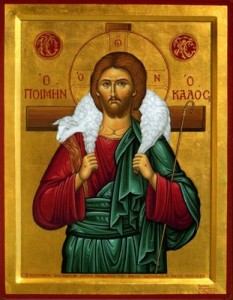
Sheperd IconBefore I begin I want to thank the graduating seniors for asking me to speak to them at what would normally be baccalaureate but because of the dedication of the Trophimus Center has been shifted to Wednesday chapel. Since I am retiring, this is a sermon to mark not only your own graduation from Trinity, but also in some sense mine. It has been a great honor to teach and to get to know hundreds of seminary students in these last eighteen years. It has been my great pleasure to get to know those of you who are graduating as well as those of you who will not graduate this year, but will be here awhile longer. I will miss you.

I also want to express my appreciation to my fellow faculty and to the staff. One of the wonderful things about teaching at Trinity has been the people who have dedicated themselves to what we do here. I especially want to express my appreciation to Don Collett, who arrived the same year I did, and to my fellow author Joel Scandrett for his collaboration on our book on the atonement. I just wish more people would buy it.

Two of the faculty, my dear friends the Rev. Drs. Martha Giltinan and Rod Whitacre, have now joined the celestial choir, where Rod no doubt plays ukelele, and Martha sings. By now I assume that they have resolved their disagreements about women’s ordination. Bishop Grant LeMarquand who was here when I arrived, and Dr. David Yeago, our first Lutheran theologian, have recently retired. Three of my dearest friends the Rev. Dr. Leander Harding, the Rev. Dr. Wes Hill, and the Rev. Tina Lockett are now serving the church elsewhere.

I also want to thank those who to me will always be the new faculty, Jack Gabig, David Ney, Brad Roderick, and Jacob Rodriguez. I cannot forget our Lutheran friends David Luy and Alex Pierce or our Presbyterian Rich Herbster. And of course, without our librarian Susanah Wilson, neither of my two books would have been written.

I have known four Dean Presidents and numerous Board Members, and there would be no seminary without them, so thank you to Dean Presidents and the Board. But the heart of seminary life is the faculty, the staff, and the students, and they are the ones I will remember with the greatest joy. Thomas Aquinas famously reinterpreted the virtue of charity as friendship, friendship with God and friendship with our fellow Christians. I am immensely grateful for the friends I have found at Trinity.

I am a layperson, which means that I am a sheep, not a shepherd. In what follows, I’d like to give some advice to those of you who as shepherds are about to be turned loose on the flock. The Anglican Divine George Herbert In The Country Parson defines your future role this way: “A Pastor is the Deputy of Christ for the reducing of Man to the Obedience of God.” Herbert goes on to say that, after Christ’s resurrection and ascension, “Christ being not to continue on earth, but after he had fulfilled the work of Reconciliation, to be received up into heaven, he constituted Deputies in his place, and these are Priests.” In typical Anglican fashion, Herbert gives us the titles of both “pastor” and “priest.” What is important for Herbert is not the title, whether “pastor” or “priest,” but what he means when he says that a pastor is a “deputy” of Christ.

Another way of saying that a pastor is a “deputy of Christ” is to compare the pastor to an icon of Christ. I preached an earlier version of this sermon at an ordination when I first came to Trinity, which was published in The Living Church. That sermon later led to my publishing a book about ordination. In both cases, it was the publishers who chose to give the sermon and the book the title Icons of Christ.

(more…)

July 6, 2025

Believing Thomas: A Sermon

Filed under: Sermons — William Witt @ 7:19 pm

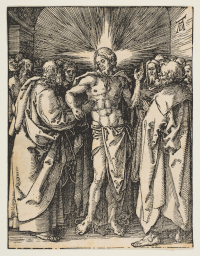
I gave the following sermon in chapel the Wednesday following the Second Sunday of Easter, where the Gospel reading is always the story of Jesus’ appearing to the apostle Thomas in John’s Gospel. Trinity Seminary also annually celebrates a “high church” service, with incense, bells, and chanting. Since Trinity is an “evangelical” seminary, some students would not be familiar with this kind of worship, usually associated with Anglo-Catholicism. I confess that I have spent my entire adult life since becoming Episcopalian/Anglican worshiping in “high church” congregations. I would identify as “Evangelical Catholic” or “Catholic Evangelical” rather than Anglo-Catholic.

John 20:19-31

Durer Thomas

The second Sunday of Easter is known as “Low Sunday.” I find myself with a bit of liturgical whiplash this morning as we celebrate our “High Church” service with the readings from “Low Sunday.” I thought about asking the experts at Nashotah House if this was okay, but I imagine they’d just respond “What’s a low Sunday”? No one knows quite why the second Sunday of Easter is called “Low Sunday,” although it is speculated that “Low Sunday” contrasts with the “High Sunday” of Easter itself. It is not called “Low Sunday” because of the low attendance in church the Sunday after Easter, although perhaps it should be. The Sunday is also known as “Thomas Sunday” because of the Gospel reading for the Second Sunday of Easter, which is the selection we heard this morning, the story of Jesus’ resurrection appearance to Thomas the apostle.

Poor Thomas has received a bit of a bad rap because of this familiar story. He is known as “Doubting Thomas,” although no one uses names like “Denying Peter” or “Overly Ambitious James and John.” Despite his bad nickname, there are sermons that turn Thomas into a kind of apology for our own questionings. “Do you sometimes have doubts about whether this Christianity thing is true or not? That’s okay. Jesus’ disciple Thomas had doubts too.”

I once heard a sermon on Easter Sunday (not Low Sunday) where the Episcopal priest reassured those of us who were attending: “If you’re here this morning, and you’re not sure whether you really believe in the Easter stories, don’t worry. Modern biblical scholars assure us that we do not really have to believe that Jesus rose bodily from the dead.” So that was the good news of Easter. We don’t have to believe that Jesus rose from the dead after all. That was the last Sunday I attended that church.

I am going to focus on the Gospel story for my sermon this morning, but I want to claim that it is a misreading of the story to assume that the story is a story about Thomas’s doubt or even about Thomas at all. First, the name “Doubting Thomas” is misleading because the English translations are misleading. In the NIV translation, Jesus says to Thomas “Stop doubting and believe” (John 20:27). The NRSV reads “Do not doubt but believe.” However, there is no Greek word for “doubt” in the text. The actual contrast is not between doubt and believing, but between believing and not believing. The ESV translation actually gets this right. When Jesus appears to Thomas, he does not say to him “Do not doubt,” but “Do not disbelieve, but believe.”

In addition, Thomas’s position is not all that different from the other disciples. In each case, the movement of the appearances is from not believing to seeing to believing. When Jesus appears to Mary Magdalene, she does not recognize him at first, but thinks he is the gardener. It is only after he speaks to her that she recognizes him. She then goes to the disciples and announces “I have seen the Lord” (John 20:11-18).

(more…)

July 4, 2025

Sermon for the Feast Day of George Herbert

Filed under: Anglicanism,Sermons,Spiritualty — William Witt @ 12:36 am

Preached on February 27, 2025

George Herbert

I

t is my normal policy when I preach to focus on the lectionary readings. I am going to make an exception today because this is the Feast Day for George Herbert, and I want to say a few things about Herbert. As a theologian, my favorite Anglican authors are from the period in which the Church of England began to settle into its identity following the English Reformation and the Elizabethan Settlement: Richard Hooker and his Laws of Ecclesastical Polity and the period of the Caroline Divines following Hooker: John Donne, Lancelot Andrewes, Thomas Traherne, and, of course, George Herbert. I have more than once used the period of Lent to read through some of John Donne’s sermons or Herbert’s poetry. As Lent begins, I might encourage you to spend some time doing the same.

Who was George Herbert? Herbert was an Anglican priest who was born in 1593 and died of tuberculosis in 1633 at the age of only thirty-nine. He is an example of how to live a meaningful Christian life in the midst of troubled times. Herbert spent his early years trying to pursue a career in politics, and he even served in Parliament for a time. However, with the death of King James, Herbert became disillusioned with politics, and he abandoned the world of public influence to serve in a small village church. Herbert spent the last three years of his life as the rector in the rural parish of St. Andrews, Bemerton, and it is these three years Herbert spent as a priest for which he is remembered four hundred years later. Izaak Walton summarized his life: “Thus he lived and thus he died like a saint, unspotted of the world, full of alms’ deeds, full of humility, and the examples of a virtuous life.”

If I were to summarize the chief characteristic of these Anglican writers known as the Caroline Divines, I would say that they brought together a combination of theology and spirituality. Herbert left us two writings: a guide for priests entitled The Country Parson, and a collection of poems titled The Temple. In a short sermon, I cannot do more than give you a brief introduction to the theology and spirituality of George Herbert, but I will mention what I will call four pillars of the spiritual life according to George Herbert.

The first two pillars are a combination of word and sacrament in contrast to a spirituality that centers only on Scripture – the Word without the sacrament – or only on worship – the sacrament without the Word. One of the characteristics of Anglican spirituality of this period was that it was a way of prayer and worship that was informed by two books – first, the English Bible that appeared as the Great Bible of Henry VIII 1539 and later the Authorized Version of King James translated under the leadership of Lancelot Andrewes published in 1611, and, second, the third Elizabethan edition of the Book of Common Prayer of 1559.

This two-book spirituality is found throughout Herbert’s prose and poetry. First, the Bible. Herbert writes in The Country Parson that the chief source of the pastor’s knowledge is the “book of books, the storehouse and magazine of life and comfort, the Holy Scriptures. There he sucks and lives” (The Country Parson, 4). The lights of Scripture shine not only individually, but form constellations of the one Christian story. In Herbert’s poem, “The Holy Scriptures,” he writes:

Oh that I knew how all thy lights combine,
And the configurations of their glory!
Seeing not only how each verse doth shine,
But all their constellations of the story (“The Holy Scriptures II”).

(more…)

May 16, 2025

Biographical Statement

Filed under: Personal,Theology,Trinity School for Ministry — William Witt @ 1:24 am

With my retirement, I thought it might be helpful to provide a short summary of who I am, my life in the church, how I became theologian, and my teaching career. If you find it interesting, enjoy! If not, that’s fine too.

ship

I cannot remember a time when I did not have faith in Jesus Christ. Evangelical (or fundamentalist) Christianity goes back several generations on both sides of my family, although the name we preferred was “born-again” Christian, or, simply, “Christian.” When I was five years old, I “asked Jesus to come into my heart” and forgive my sins. I was baptized at the age of seven. Luther used to say, “Remember your baptism!” I am glad that I can remember mine.

My family went to church Sunday mornings and evenings and to Wednesday night prayer meetings. There were occasional week-long revival meetings, and Vacation Bible School in the summers. I used to set up my toy box as a pulpit, and preach sermons to my younger sister and her dolls. I read the Bible constantly. I used to worry that my school-mates were not “saved,” and felt guilty that I did not “witness” to them, i.e., tell them about Jesus.

Aside from a certain amount of guilt, my Baptist upbringing gave me a spirituality focused on a personal relationship with Jesus Christ, a sense that Christians had to be different from other folks, a knowledge and love of the Scriptures, a regular practice of daily prayer, and a way of responding to certain types of worship. Hymns like “Amazing Grace” can still give me goose bumps.

At the age of sixteen, I attended a church camp retreat where I “came under conviction” (to use the revivalist terminology) that God was calling me to be a pastor. From this point on, I assumed as a matter of course (as did my family, friends, and pastor) that I was going to be a “preacher-boy.” This decision marked a definite transition in my Christian experience. I think it was the time at which I first affirmed an adult Christian faith.

Throughout my high school years, I was constantly involved in church activities. I was president of my church youth group. I shared tracts with people in the city park. I earned a reputation in high school for being a “Jesus Freak.” (This was at the height of the “Jesus Movement.”) I attended a Campus Crusade for Christ evangelism conference with 100,000 other teenagers in Dallas, TX called “Explo’ 72,” where I heard Billy Graham preach.

But I also began a gradual intellectual and spiritual awakening. I discovered the writings of C. S. Lewis and J. R. R. Tolkien, and their literary circle – George MacDonald, Charles Williams, Dorothy L. Sayers, G. K. Chesterton. During my senior year in high school, I somehow found time to read through Tolkien’s Lord of the Rings, and the central writings of Lewis’s literary corpus, both fiction and non-fiction.

During my college years, I attended a small evangelical liberal arts college. My sophomore year in college, I took a required introductory philosophy course, and discovered that I loved philosophy. I majored in philosophy, which led me to discover not only the classical pagan philosophical tradition (Aristotle, Plato), but also the western Catholic philosophical and theological tradition, especially Augustine and Thomas Aquinas. I read modern Thomists like Etienne Gilson, and Eric L. Mascall. I also discovered the twentieth century theological tradition, especially the critical orthodoxy of Karl Barth, Emil Brunner, Dietrich Bonhoeffer, and the Niebuhr brothers, but also Wolfhart Pannenberg (whom I especially liked at that time), and the “biblical theology” of figures like Walther Eichrodt, John Bright, Oscar Cullmann, and Joachim Jeremias. A small group of like-minded friends and I used to spend hours discussing philosophy and theology (along with a couple of influential faculty members), both inside and outside regular classroom hours.

(more…)

November 2, 2024

Justice, Truth, Reconciliation: A Sermon

Filed under: Sermons — William Witt @ 10:57 pm

Isaiah 59:9-20
Psalm 13
Hebrews 5:11-6:12
Mark 10:46-52

St. George

The Old Testament reading and the epistle reading this morning seem made to order to make both the preacher and the congregation uncomfortable. In the Old Testament passage, the prophet focuses on the problem of injustice and puts the blame squarely on his hearers: “For our transgressions are multiplied before you, and our sins testify against us; for our transgressions are with us, and we know our iniquities” (Is. 59:12).

The Hebrews passage threatens about the dangers of apostasy. The apostle warns that in the case of those who have fallen away “it is impossible to restore them to repentance . . . since they are crucifying once again the Son of God to their own harm and holding him up to contempt” (Heb. 6:4, 6). Should I preach a sermon to a chapel full of seminarians in which I accuse you of injustice whose “transgressions are multiplied” before God? Or rather should I go down the path of suggesting that you might be apostates who are guilty of crucifying the Son of God to your own harm? Best to stick to the Gospel story of Jesus giving sight to Blind Bartimaeus.

However, I think that both the Old Testament passage and the epistle are on target for where we find ourselves in contemporary culture. The problem of injustice is a concern that plagues not only the culture but the church. We approach a political election in a matter of days in the midst of what feels like the most politically divided period in my lifetime. And the rabid disagreements between both political parties are primarily moral. The resentment of both sides of the electorate against one another stems out of a kind of moral outrage that is rooted in mutual accusations of injustice.

And of course, the church itself has had to deal with issues of injustice in the past couple of decades, particularly connected to issues of clerical abuse, primarily sexual abuse but also leadership abuse that has led to the scandals of clergy being defrocked, but also disagreement about the nature of Christian morality that has led to denominational splits among the mainline churches.

Concerning apostasy, we are living in the midst of an abandonment of Christian faith in the last several decades that seems unprecedented. The brief religious revival of the Jesus Movement and the charismatic renewal of the 1970s was followed almost immediately by the rise of the New Age phenomena in the following decades, of the cultural popularity of the New Atheists in the early twenty-first century, and the recent phenomenon of Christian Deconstruction in the last decade.

If you are hoping that I will resolve any of these problems this morning, you are expecting far more than a seminary professor can offer in a chapel sermon. I am not going to tell you how to vote next week, how to resolve the disagreements that have divided the mainline churches in the last two decades, or how we can reverse the numbers of people who are leaving the church.

I do think however that the lectionary passages from Isaiah and Hebrews can tell us something about what the Bible has to offer concerning the issues of injustice and apostasy. (more…)

August 15, 2024

Follow the Bouncing Ball or Why We Disagree About Women’s Ordination (Part Two)

Filed under: Women's Ordination — William Witt @ 2:03 am

Angelus

Some Historical Background

I

did not write my book Icons of Christ with the intention of changing the minds of those opposed to women’s ordination, although from time to time I have heard from people who have told me that the book changed their minds Rather, I wrote for three different groups:

First, for those within my own tradition (Anglican/Episcopal) who were disappointed at what seemed to be an upsurge of those opposed to women’s ordination within theologically conservative Anglicanism. Women’s ordination had not been an issue of contention at the beginnings of the founding of the Anglican Church of North America in distinction from the Episcopal Church in the mid 2000s. Those of us who had been members of TEC before the split did not leave TEC over either WO or the 1979 BCP. Many of us were members of dioceses and congregations that supported WO before the split. I myself was confirmed as an Episcopalian on May 15, 1982 by Bishop William Frey of the Episcopal Diocese of Colorado. Bishop Frey supported women’s ordination as well as the 1979 BCP, and afterwards moved from Colorado to Ambridge, Pennsylvania, where he became the Dean President (1990-1996) of what was then Trinity Episcopal School for Ministry, where I have taught Systematic Theology and Christian Ethics since fall 2007.

Trinity School for Ministry/now Trinity Anglican Seminary has had a policy since its founding that there could be disagreement on the issue of women’s ordination. While there have always been members of the faculty who opposed WO (including my dear friend the late Rev. Dr. Rod Whitacre), since its beginnings the majority of the faculty have favored WO, and there have always been women serving on the faculty, including my dear friend the late Rev. Dr. Martha Giltinan. And, yes, despite their disagreements about women’s ordination, Rod and Martha were good friends, and Rod entirely supported Martha as a member of the faculty, although he did not receive communion if she presided at the Eucharist. Rod taught women who were seeking ordination, and he treated them no differently than he did his male students. Bob Duncan, the first archbishop of the ACNA, was the bishop of Pittsburgh, a diocese that supports the ordination of women. I myself have served on the Commission On Ministry in the Diocese of Pittsburgh, and we approved both men and women for ordination to the diaconate and the priesthood.

(more…)

July 31, 2024

Follow the Bouncing Ball or Why Christological Subversion is Central to the Gospel (Part One)

Filed under: Atonement,Theology,Women's Ordination — William Witt @ 2:20 am
Lamb of God

The negative review of my book Icons of Christ: A Biblical And Systematic Theology for Women’s Ordination continues at The North American Anglican. It is tempting to reply with a point by point response. However, a reading of the most recent criticism makes clear that where the author really disagrees with me concerns issues of basic theological methodology. In particular, the author objects first to my advocacy of a narrative interpretation of Scripture, and, second, to my use of the principle of what I call “Christological Subversion.” Before addressing these specific criticisms, I think it would be more helpful to explain how I do theology. I have published two recent books – the first in favor of women’s ordination1 and the second (with my colleague Joel Scandrett) about the history and doctrine of the atonement.2 Both books have been favorably reviewed by competent peers in the fields of biblical and systematic theology, and both follow the same basic methodology. Although it was published later, I began the atonement book first, so the principles of narrative interpretation and “Christological Subversion” were first developed in that book. And the atonement book itself developed out of one of the first essays I published over two decades ago.3

Narrative interpretation and Christological subversion are subordinate to a third principle, which is more basic, the principle of the priority of the object over the subject in theological methodology, what Karl Barth calls nachfolgen or “following after,” what in Thomas Aquinas is the principle of an a posteriori approach to theology, and a citation from Hilary of Poitiers that provides the motto for my blog: Non sermoni res, sed rei sermo subjectus est: “The word is subject to the reality, not the reality is subject to the word.” It is what I call in the title of this post “follow the bouncing ball.”

A major theme in both books is the problem of incommensurable theological systems. This is even more evident concerning the doctrine of the atonement than it is concerning women’s ordination. For women’s ordination, there are basically four options: Protestant complementarian (hierarchical) opposition; Catholic sacramental (non-hiererarchical) opposition; liberal Protestant/Catholic modernist affirmation; critically orthodox or evangelical catholic egalitarian affirmation. Gustaf Aulén’s book Christus Victor discussed three atonement models: satisfaction/substitution, exemplarism, Christus Victor. In the book on atonement I wrote with Joel Scandrett, we discuss eight historic models and finish with a comparison of contemporary discussion. Even then, for space reasons, we had to omit several other approaches. So there is actually more disagreement about atonement theology than there is about women’s ordination.

(more…)

July 16, 2024

Yet Another Review of a Book I Did Not Write Or Why Disagreements Concerning Women’s Orders Are Intractable

Filed under: Women's Ordination — William Witt @ 10:40 pm

Gargoyle


In a recent post, I looked back on the reception of my book Icons of Christ: A Biblical and Systematic Theology for Women’s Ordination three years after its publication. In that essay, I focused on why I had given the book its title:

The single argument that appears repeatedly in these several chapters is that Christians resemble (are “Icons” of) Jesus Christ not through physical likeness or through exercising hierarchical authority over one another, but in the same way that Paul makes clear in both Phillippians 2 and 2 Corinthians 2-4, first, by pointing away from ourselves and our own authority and accomplishments to the saving work of the crucified and risen Jesus Christ, and, second, by imitating Jesus Christ’s own kenotic cruciformity in service to one another.

However, I also noted:

My book received quite a few positive reviews, and the positive reviews consistently have recognized this key argument about what it means for Christians to resemble Christ. My book has received a fair amount of criticism as well, but almost none of this has acknowledged or addressed the central argument. Rather, the negative reviews have focused on defending the traditional arguments against women’s ordination – whether complementarian Protestant or Catholic sacramentalist.”

A recent reviewer claims to have read this essay: “Witt declares what he believes is the most important part of his book.” In that light I had thought that the author would address what I have claimed is the key issue of the book – how it is that all Christians (not just men) resemble Christ — through cruciform discipleship. He did not do that, however, but instead followed the predictable pattern – not at all addressing the key point of the book but rather (once again) offering a defense of the hierarchical complementarian position – beginning with an interpretation of the account of the creation of man and woman in Genesis 2.

(more…)

June 21, 2024

Deconstruction (and Reconstruction) on the Road to Emmaus

Filed under: Deconstruction,Sermons — William Witt @ 6:57 pm

Acts 3:1-10
Ps 105:1-8
Luke 24:13-35

DeconstructionI hope you will forgive me this morning if my topic is not exactly what you might expect for an Easter week sermon. As I understood until about a year ago, deconstruction is a kind of post-modern rejection of the notion that literary texts have any inherent meaning in themselves, but rather that meaning is imposed by readers. This was a philosophical movement associated with the French writer Jacques Derrida. However, in the last few years,“Deconstructing Christianity” has become a kind of movement among mostly former evangelical young people to describe their process of re-examining and usually abandoning their Christian faith. Just in the last couple of weeks, a book entitled Exvangelicals: Loving, Living, and Leaving the White Evangelical Church has become a runaway best-seller.

Some have suggested that a kind of reverse “Great Awakening” is taking place in American culture, and this movement is being compared in significance to the revival movements of the nineteenth century or the Jesus Movement of my own generation – except, again, in reverse. Given the sheer scope and influence of this movement, I think that it is something that Christians, especially those of you who are going to be ordained clergy, and seminary professors like myself, need to be aware of. To ignore it would be like a missionary setting out for India who knew nothing about Hinduism or Islam or Sikhism.

What I know about deconstruction at this point is sketchy, and largely derived from YouTube videos supplied by young people – former evangelicals – who have deconstructed their faith. There seems to be a pattern: they are young (usually in their twenties or early thirties), they describe growing up within the culture of American Evangelicalism. They were members of youth groups; they were home schooled; they went on mission trips. The churches they describe seem to be mostly Baptistic or Pentecostal, and the theology they left seems conservative or traditionalist to the point of being Fundamentalist. They understand Christian faith to be in conflict with modern science, with modern historical method, and with modern psychology.

And they regularly describe a conflict between faith and reason, in which Christian faith seems to be opposed to rationality rather than the traditional Christian understanding of theology as faith seeking understanding. They seem largely ignorant of historic Christian theology or serious contemporary biblical scholarship. I have yet to come across one of these young people who claimed that they deconstructed their faith because they had read Augustine or the Cappadocians, Aquinas, Luther or Calvin, Karl Barth or Dietrich Bonhoeffer, N. T. Wright or Brevard Childs.

We might be tempted to dismiss deconstruction as a cultural movement specific to North American revivalism and pietism that has nothing to do with the kind of historic Reformation Christianity represented here at Trinity: Anglicanism, Lutheranism, Presbyterianism. We may call ourselves Evangelicals, but we’re not that kind of Evangelical! I think that would be a mistake. (more…)

March 8, 2024

Concerning Women’s Ordination: What About 1 Timothy 2:12?

Filed under: Women's Ordination — William Witt @ 2:38 am

AngelusI have addressed and responded to several criticisms of and challenges to my book Icons of Christ and its arguments in favor or women’s ordination and women’s equality through several essays on my blog. However, there is one crucial passage that I have not yet addressed at length – Paul’s assertion in 1 Timothy 2:12: “I do not permit a woman to teach or to exercise authority over a man; rather, she is to remain quiet” (ESV). I have made occasional references to this passage, particularly in addressing hermeneutical issues, but I have not discussed it in detail. So with apologies for a lengthy delay, I now turn to this passage.

Preliminary Reflections

Before examining the passage, some initial issues need to be addressed.

First, the disagreements about this passage are not primarily about exegesis, but about hermeneutics. I had addressed this in previous essays. For example, in a previous essay, I made a crucial distinction between “master passages” or “master stories” and “paradigms.” A “master passage” is a passage of Scripture that is crucial for one’s own understanding of an issue, and a “paradigm” is the interpretive key to the interpretation of the “master passage.” My previous essay to this makes clear the master passages that are central to my understanding of what Scripture teaches about what it means for not only men but also women to resemble Jesus Christ, and the corresponding “paradigm” is one of cruciformity, mutual service, and mutual submission.

(more…)

« Newer PostsOlder Posts »

Non Sermoni Res — William G. Witt is proudly powered by WordPress