William G. Witt

November 9, 2009

Where is Jesus Now and What is He up to? A Sermon

Filed under: Sermons — William Witt @ 7:50 am

1 Kings 17: 8-16
Hebrews 9:24-28
Mark 12:38-44

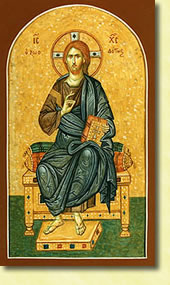
Christ EnthronedWhen I was a child I already showed signs that I was going to be a theologian when I grew up. I used to wonder about things like this: If Jesus is everywhere, then is Jesus sitting in this chair? If I sit down in the chair, will I sit on Jesus? If Jesus is in my heart, how did he get small enough to fit there? If Jesus is in other people’s hearts too, does that mean that there are lots of little Jesus’s, with each person having their own Jesus living in their heart?

Of course, such speculation is nothing new. The Medieval theologian William of Ockham (not one of my favorites by the way) once speculated that in God’s absolute power God could make it possible for the eye of Christ in one part of the eucharistic host to see another part of the body of Christ in another part of the host. And, of course, those who have taken my Anglican way of theology class or other courses at Trinity in church history or sacramental theology should know that a central cause of disagreement at the time of the Reformation had to do with the problem of how we relate the risen body of Christ to the consecrated elements of bread and wine in the Eucharist, with the Lutherans insisting that because Christ’s body is everywhere, there is no problem with him also being present in the bread and wine, while the Reformed insisted that, since Christ’s body is at the right hand of God the Father, he cannot be physically present in the bread and wine, so he must be spiritually present—whatever that means.

As I read the epistle for this morning, I could not help but be reminded of my old childhood questions, and of all these controversies in church history. There is a sense in which the writer of Hebrews is addressing the central issue that lay behind my childhood questions, and behind the Reformation controversies about Eucharistic theology. He situates the issue by laying out a timeline with a beginning point and an end point. The beginning point is the earthly mission of Jesus, in which through his incarnation, life, death, and resurrection Jesus has, says the author, “appeared once for all, at the end of the ages to put away sin by the sacrifice of himself.” The end point will be Jesus’ return: “So Christ, having been offered once to bear the sins of many, will appear a second time, not to deal with sin but to save those who are eagerly awaiting him.” (Heb. 9:28). If the beginning point of the timeline is Jesus’ life, death, and resurrection in which he put away sin, and the end point is his returning to bring salvation to those whose sins he has put away, the question that comes to mind is: “Where is Jesus now, and what is he up to?” The writer of the epistle to the Hebrews answers the question this way: “For Christ has entered not into holy places made with hands, which are copies of of the true things, but into heaven itself, now to appear in the presence of God on our behalf.” (Heb. 9:24.) (more…)

September 28, 2009

The Wisdom From Above: A Sermon for New Seminarians

Filed under: Sermons,Trinity School for Ministry — William Witt @ 5:26 am

Morning Prayer
Psalm 37
1 Kings 11:1-13
James 3:13-4:12

When I looked at the passage about King Solomon from 1 Kings this morning, I was very tempted to preach a very short sermon with some concrete applications. So, first, for those of you who are men, and who are beginning your studies here at Trinity School for Ministry—if you can manage to get through seminary with no more than one wife, and no more than one god, you’ll be better off in the long run. For the women, if the guy you’re interested in already has 700 wives, he’s probably not that into you.

On a more serious note, there really does seem to be a common theme uniting all three of the passages we’re read from the Daily Office lectionary this morning. All three passages have something to do with Wisdom.

So, beginning with King Solomon. Solomon is an ambiguous figure in the biblical canon. On the one hand, he is associated with Wisdom. At the beginning of Solomon’s reign as King, God appears to him in a dream, and gives Solomon the option to “Ask what I shall give to you.” In response, Solomon asks for an “understanding mind to govern your people, that I may discern between good and evil.” (1 Kings 3:5,9) Then follow several stories in which Solomon’s great wisdom is demonstrated. There is the story of the two women with one dead child and one living one who ask Solomon to decide which of them is the mother of which. There is the story of Solomon building the temple, and the prayer in which Solomon prays: “O Lord, God of Israel, there is no God like you in heaven above or one earth beneath, keeping covenant and showing steadfast love to your servants who walk before you with all their heart.” There is the story of the covenant that God makes with Solomon, promising to establish his royal throne forever. There is the story of the Queen of Sheba who visits Solomon and tells him: “Your wisdom and prosperity surpass the report that I heard.” (1 Kings 3-10)

Canonically, Solomon has historically been associated with three Wisdom books in the Old Testament canon – Proverbs, Song of Songs, Ecclesiastes. So Solomon is associated with Wisdom the way that Moses is associated with Law or David with Kingship.

And then there is this morning’s passage, where we are told that Solomon “loved many foreign women,” and had 700 wives, and 300 concubines, that his wives “turned away his heart after other gods,” that he sacrificed to Chemosh and Molech. This is a far cry from the Solomon who prayed at the dedication of the temple, “ there is no God like you in heaven above or on earth beneath.” (1 Kings 8:23) This is very different from the advice we find in Proverbs, where the young man is told to “rejoice in the wife of your youth.” (Proverbs 5:18) So the reading about Solomon raises the question, “What is wisdom?”

In the Psalm and in James, we also find ourselves asking the question, “What is wisdom?” The Psalm gives a practical definition of wisdom: “Trust in the Lord, and do good, dwell in the land and befriend faithfulness. Delight yourself in the Lord, and he will give you the desires of your heart.” (Psalm 37: 3-4)

James asks the question right off the bat: “Who is wise and understanding among you? By his good life let him show his works in the meekness of wisdom.” (James 3:13) So, there is a common theme this morning, that of wisdom. What is it? How do we find it? And, in only the few minutes I’m allowed for a sermon this morning, how does that apply to students who are beginning their studies in seminary? (more…)

August 24, 2009

The God Who Can Be Rejected: A Sermon

Filed under: Sermons — William Witt @ 9:27 pm
12th Sunday After Pentecost
Joshua 24: 1-2,14-25
Ephesians 5:15-20
John 6:60-69

CrossWe find something rather odd when we look at the passage from Joshua in this morning’s lectionary readings. In this passage, Joshua has gathered all the tribes together at a place called Shechem, and Joshua is renewing the covenant that God made with Israel at Mount Sinai, when Moses had led Israel out of Egypt into the desert. At the beginning of the passage (much of which we did not read this morning), Joshua recounts the story of God’s dealings with Israel’s ancestors—Abraham, Isaac, and Jacob. He tells of Moses and the deliverance from slavery in Egypt, and he tells of how God has given Israel a new land to dwell in. Joshua then commands the people: “Now therefore fear the Lord and serve him in sincerity and in faithfulness. Put away the gods that your fathers served beyond the River and in Egypt, and serve the Lord.” (Joshua 24:14)

Now here comes the strange part. Joshua gives the people a choice. “And if it is evil in your eyes to serve the Lord, choose this day whom you will serve, whether the gods your fathers served in the region beyond the River, or the gods of the Amorites in whose land you dwell. But as for me and my house, we will serve the Lord.” (v. 15) Israel is given a choice between serving the gods of the land in which they used to live or the gods of the new land in which they now live. Or they can serve the Lord.

In ancient societies, gods tended to be attached to the land in which they were worshiped. So the gods worshiped in Egypt are the gods of Egypt. The gods of the Amorites are the gods of the new land in which Israel dwells. But the biblical God is not a God bound to a particular place or land. He gives Israel a land, but he is not a God associated with a land, but with a history. He is the God who made a covenant with Israel’s ancestors, and who delivered Israel from slavery before they had a land. This is a God who makes covenants with his people, and a covenant involves a choice. One actually has to make a decision to worship such a God. And so, here is the odd part. Israel’s God is a God who can be rejected.

(more…)

July 21, 2009

Announcement

Filed under: Announcements — William Witt @ 4:34 pm

For the last two months, I have been in the middle of moving to a new house. During this time, I have been short on time, but also (for a whole month) without internet–except when I am in my office. This means I have not been able to respond to your comments or add new posts. There are a lot of you who have been waiting to hear from you. I also have a new email address. If you need it, please ask for it in the “Contact Me” page.

June 22, 2009

The Perils of Bootstrapping or What is Christian Ethics? A Sermon

Filed under: Ethics,Sermons,The North American Anglican Province — William Witt @ 7:34 am

This is the first sermon I preached right after The Episcopal Church’s General Convention 2003. At the time, I was an aspirant for Holy Orders in the Episcopal Diocese of Connecticut. Within a month I had withdrawn from the ordination process. Two years later, on July 13, 2005, Bishop Andrew Smith invaded St. John’s Episcopal Church, changed the locks and deposed Mark Hansen, our priest, and imposed a priest-in-charge, who later removed those of us on the vestry for “numerous offenses” (unspecified).

I now live in the Anglican Diocese of Pittsburgh, and Archbishop Robert Duncan is my bishop. With the inaugural meeting of the new Anglican Church of North America this week, of which I am a member, I thought it appropriate to repost this sermon.


Psalm 147
Eph. 5: 15-20
John 6:53-59

AtlasAt General Convention 2003, the Episcopal Church made two decisions that have put the Anglican communion in an uproar. They decided to ordain an Episcopal priest who had divorced his wife, and has been living in an ongoing homosexual relationship with another man, and they decided to allow individual dioceses to provide rites of blessing for homosexual relationships, at the discretion of the local bishop. The issue of controversy in the Episcopal Church today has to do with a disagreement about ethics or morality. So I have decided to talk a little this morning about Christian ethics.

The first thing that I think needs to be said is that it is quite difficult today to think about ethics from a Christian perspective, even for those inside the Church. The reason for this is that there is a competing ethic in our culture that has nothing to do with Christianity, but which we can hardly avoid. This is an ethic that has so permeated our culture that even Christians fall into its ways of thinking. I am going to refer to this as the “do-it-yourself” ethic. “Doing-it-yourself” is the idea that morality is about doing the best you can—pulling yourself up by your boot straps. If you do the best you can, you’ll be all right.

This “do-it-yourself” ethic comes in two varieties, a conservative variety and a liberal variety. The conservative variety aims for perfection. The conservative “do-it-yourselfer” does not allow for any failures, and tolerates no half-hearted efforts. Sometimes this view is called moralism or Puritanism. The liberal “do-it-your-selfer” is more tolerant. He realizes that not everybody is perfect, so he thinks that God grades on a curve. As long as you try, you get an A for effort.

(more…)

June 10, 2009

The Practical Doctrine of the Trinity: A Trinity Sunday Sermon

Filed under: Sermons,Theology — William Witt @ 8:03 am

TrinityThe Easter season begins with the celebration of the resurrection of Jesus from the grave, and it ends with Trinity Sunday. The resurrection is concrete and specific, something that even children can relate to and understand. Easter eggs and baby chicks speak of new life. We celebrate Easter with the singing of exuberant hymns—“Up from the grave He arose!”—and churches decorated with lilies. However, in contrast to the resurrection, the doctrine of the Trinity is abstract, impossible to understand we fear, and something best left to theologians who like to speculate about things such as how 1 + 1 + 1 add up to 1, something about as practical as the question of how many angels can dance on the head of a pin. Besides “Holy, Holy, Holy,” how many hymns about the Trinity can the average churchgoer bring to mind?

I would suggest rather that the resurrection and the Trinity are the two most important doctrines of the Christian faith, both belong together, and both are imminently practical. Without either one of them, Christianity would collapse. If Jesus had not risen from the dead on the first Easter Sunday, there would have been no people called Christians. If God were not Trinity, Jesus would not have risen from the dead. The resurrection is about what God has done. The Trinity is about who God is. We know who God is from what he has done. We understand the meaning of what God has done when we understand who God is. (more…)

April 21, 2009

More on the Development of Doctrine: The Choice is not between “Protestantism” and the “Older Traditions.”

Filed under: Development of Doctrine,Theology — William Witt @ 2:05 am

HeronMichael Liccione has continued the discussion on the Development of Doctrine over at Perrennis Philosophia.

This is the first part of what I hope will be a series of responses.

1) Dr. Liccone begins with a misleading summary of the issue of disagreement. He suggests that when it comes to the question of the Development of Doctrine there are three hermeneutical circles (HC), characteristic of Roman Catholicism, Orthodoxy, and Protestantism. The purpose of the HC is to identify an “authority [his emphasis] of ultimate appeal for distinguishing between true and false doctrine.”
2) The fundamental choice really boils down to two, between the Protestant HC on the one hand and the Catholic and Orthodox HC on the other, which he refers to as “the older traditions.” The main difference is “how they relate belief about the nature and authority of the confessing community itself to the deposit of divine faith.”
3) Liccione believes that the question of authentic authority has to be settled prior to the question of whether there are legitimate developments of doctrine.
4) Nonetheless, there is a criterion that can help one settle which prior explanation one should endorse—abduction, by which he means “inference to the best explanation.”

Liccione’s identification of the choice in assessing the question of doctrinal development between what he calls the Protestant HC and the “older traditions” is inherently misleading because there is no “older tradition” of doctrinal development. Doctrinal development is a modern phenomenon. (more…)

April 2, 2009

A Palm Sunday Sermon

Filed under: Sermons — William Witt @ 4:27 pm

Psalm 31: 9-16
Philippians 2:5-11
Mark 15: 1-47

Exactly ten years ago I was visiting an Episcopal Church on Palm Sunday. The service had begun with the Procession of the Palms and the readings of Jesus’ triumphal procession into Jerusalem, and the readings had concluded with a reading of the Passion Account of Jesus’ crucifixion. The priest then went to the pulpit and began his sermon with these words: “The idea that Jesus died for our sins has caused more suffering and evil than any other idea in the history of the world!” He then proceeded to preach a sermon in which he outlined every horrible event in the history of the church—I think he talked about the Crusades, the Spanish Inquisition, the religious wars between Catholics and Protestants, Antisemitism; I’m fairly certain he mentioned the Nazi holocaust—and he stated repeatedly throughout the sermon that all these horrible events could be traced to a single idea—that Jesus had died for the sins of the world. We then stood and said the Creed.

Without commenting on this priest’s orthodoxy—which was certainly lacking—one might ask what could possibly motivate someone to make such an outrageous claim? From the pulpit no less? Well, if the priest was intending not to comment on the church’s teaching but on its practice, he might well have had a point. We need to be honest that there have been plenty of times in church history when Christians have just got it wrong. (more…)

March 15, 2009

Eulogy For My Father

Filed under: Sermons — William Witt @ 3:58 am

I was privileged to preach the eulogy at my father’s funeral on January 29, 2007. I needed to take some time before I could share this.

What can I say about my father, Leon Witt?

First, my father was a fighter.

They say that into every life a little rain must fall, and Dad certainly had his share of hard times. He was born in 1930, one year after the stock market crashed. His mother, his father, and his three brothers lived as migrant farmers in the Dust Bowl years of the Great Depression. I have heard him describe being in a tent with the wind blowing, and the dust so thick that during the middle of the day you needed a Coleman lantern to see to the other side of the tent. His father died of a heart attack by the side of the road next to the family Model A when my father was only ten. From then on, Dad’s mother raised four boys by herself in New Mexico, and Dad became the family cook at ten years old. (more…)

March 12, 2009

Is God Our Judge? A Sermon

Filed under: Sermons — William Witt @ 8:09 am

With Holy Week soon upon us, I thought this an appropriate sermon to repost.

The Judge JudgedIn the epistle which we read this morning, St. Paul introduces the metaphor or image of “justification” to describe what God has done for us in Jesus Christ. “Since we are justified by faith,” he says, “we have peace with God through our Lord Jesus Christ.” (Rom. 5:1). The doctrine of “justification by faith” utilizes legal language and draws upon the metaphor of God as our “Judge.” This language appears throughout Paul’s Epistle to the Romans, which is in many respects one long meditation on the meaning of the justice of God and of God’s role as Judge of sinful humanity.

This metaphor of God as Judge is perhaps one that has left an unfortunate legacy to the Western church. (The Eastern churches have largely focused on other metaphors, like that of re-creation.) This juridical language, combined with the Western heritage of Roman law, has left us with an overly legal understanding of what it means to say that God has saved us in Jesus Christ. We Western Christians have too often interpreted God’s work in Jesus Christ as a juridical process in which we sinners deserved the punishment of eternal damnation, but God let us off by punishing his innocent Son Jesus instead. I remember that as a child I liked Jesus very much, but I wasn’t too sure about God the Father. He was a bit too rigid, I thought.

(more…)

« Newer PostsOlder Posts »

Non Sermoni Res — William G. Witt is proudly powered by WordPress