
William G. Witt

August 18, 2010

It’s My Fault that Leander Harding is not a Bishop

Filed under: The Episcopal Church — William Witt @ 6:58 am

We all have hobbies. My friend and colleague Leander Harding seems to like to run in episcopal elections. I don’t know how many times he has run, but he likely holds some kind of a record, and he has never won. Actually, he does not seem to run, so much as people keep nominating him. In the last few months, he was nominated in both the Episcopal Diocese of the Rio Grande (New Mexico) and the Episcopal Diocese of Springfield (Illinois). In both cases, the clergy and laity chose candidates who were (speaking strictly objectively) both pastorally and academically less qualified than Leander to be a bishop. I speculate as to why this is the case, but have been convinced that the problem is that he is too orthodox, and too smart. The elected bishop in Rio Grande (formerly an orthodox Episcopal diocese) is a revisionist, and I expect this means the end of orthodoxy in that diocese, as orthodox parishes will either leave for the ACNA or will die.

Over at Virtueononline, David Virtue noticed this anomaly, and posted a piece on his blog asking about why it is that in the Episcopal election at Springfield, not only Leander, but other far more qualified candidates, like Robert Munday, Dean of Nashotah House, were passed by. The very first comment to appear was by the Rev. Tom Woodward of Santa Fe, NM, a retired Liberal Protestant priest who lives in the Diocese of Rio Grande. Tom and I had met before online. Tom wrote to respond to Virtue’s column about Springfield, but in passing offered some interesting information about why Leander Harding was not elected in Rio Grande. (more…)

August 12, 2010

Does God Change His Mind?

Filed under: Metaphysics — William Witt @ 5:11 am

The following appeared in the comments section on a blog in answer to the question of whether prayer “changes God’s mind.”

If God could change His mind, then He would be learning from and therefore be dependent upon His own creation.  He would be growing from good to better, from wise to wiser.  He would in short be deprived of some of the essential characteristics of Deity – His Omniscience and Timelessness.

The writer was a Calvinist, but I have heard Thomists (of which I am one) make similar kinds of statements. While I do not believe that creatures can make God “change his mind,” I have always been troubled by the more sophisticated metaphysical assertion that really lies behind the claim — that God in no way responds to creatures, and that contingent actions of creatures do not make any difference to God’s knowledge. If they did, God would depend on creatures for that knowledge, and God’s would change, either for the better or the worst, etc. While this position is common among Calvinists and Banezian Thomists, I do not believe it is Thomas’s own position, and I find it problematic because it inevitably leads to determinism–a position Thomas rejects.

I replied as follows: (more…)

July 19, 2010

The Divine Guest: A Sermon

Filed under: Sermons — William Witt @ 2:25 am

Genesis 18: 1-14
Colossians 1: 21-29
Luke 10: 38-42

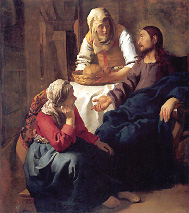
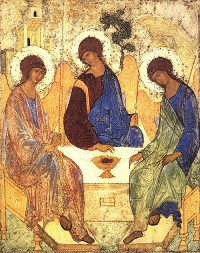
christ_in_the_house_of_martha_and_maryThere are two stories of divine hospitality in this morning’s readings. The first is the story of the three mysterious visitors to Abraham, one of whom is designated as “The LORD.” There is an Orthodox icon of this event where the three visitors are portrayed as angels; the alternate name for the icon is “The Old Testament Trinity,” and each one of the three figures of the icon is identified as one of the members of the Trinity – the Father, the Son, and the Holy Spirit. That the doctrine of the Trinity was on the mind of the author of Genesis is unlikely, but the point is the same. These three visitors are not just ordinary visitors. This is a personal visit from God to Abraham. God is, as it were, Abraham’s guest.

The second reading is the gospel reading, and it has a similar structure. Jesus visits the home of Mary and Martha, where Martha serves, and Mary sits at Jesus’ feet and listens. This story also has enjoyed a traditional interpretation in the history of the church. Martha has been perceived as an example of the active life, the life of those who must do physical work for a living; and Mary has been portrayed as the example of the contemplative life, that is, of those religious orders who gave themselves over to prayer and contemplation rather than to active service. So Christians have managed to find a way to take a biblical story that challenged Martha’s one-up-manship of Mary, and turn it into a way where they could identify with Mary to encourage one-up-manship over those whom they identified with Martha.

But I do not think that the story is primarily about Mary and Martha, who are the hosts, but about Jesus, who is the Guest. What is God like when God comes to visit us? This side of the resurrection we know the identity of the Divine Guest. Jesus is not just any visitor to Mary and Martha. He is the Son of God, God come among us as a human being. So, once again, God is, as it were, a Guest. This time, God, the Son of God, is the Guest of Mary and Martha. (more…)

June 26, 2010

Second Readings: A Sermon

Filed under: Scripture,Sermons — William Witt @ 10:26 pm

Feast Day of St. John the Baptist
Isaiah 40: 1-11
Acts 13:14b-26
Luke 1:57-80

Old Testament Trinity
In what follows, I am going to depart from the usual way in which responsible expository preachers are supposed to preach sermons. I am not going to focus primarily on the meaning of the biblical texts themselves. Rather, I am going to look at the slightly different question of how it is that we as Christians make sense of the texts, how it is that the church has read these particular texts, and particularly the text in Isaiah. Because, frankly, there is a bit of a problem.

Let me explain what I mean by referring to an icon called The Hospitality of Abraham, that shows three angels sitting around a table. (For backround, see Solrunn Ness, The Mystical Language of Icons, (Grand Rapids: Eerdmans, 2005), pp.36-37) It is based on the story from Genesis 18 in which three men appear to Abraham, and Abraham offers the men hospitality. There are some odd details about the story. The narrative begins by stating that The LORD appeared to Abraham by the oaks of Mamre, and throughout the narrative Abraham speaks to one of the visitors, who promises Abraham that he will have a son, and later he and Abraham have a long discussion about whether or not Sodom is going to be destroyed. Throughout the narrative, this visitor who speaks with Abraham is referred to as the LORD.

The icon has a second name. It is also called “The Old Testament Trinity,” and the Eastern Church in particular has identified these three visitors with the divine Trinity. John of Damascus says: “Abraham did not see the divine nature, for no one has ever seen God, but he saw an image of God and fell down and worshiped.” (See John of Damascus, On Holy Images, part 3, ch. 4.) In the icon, the figure on the left is identified with the Father; the figure on the middle is identified with the pre-existent Word or Logos. The one on the right is identified with the Holy Spirit. (more…)

April 24, 2010

My Sheep Hear My Voice — A Sermon About Election

Filed under: Sermons — William Witt @ 7:24 pm

Psalm 23
Rev. 7:13-17
John 10:22-30

The Good Shepherd
Not that kind of Shepherd!

I want to dissuade you from a certain misreading of this morning’s gospel passage. You can easily find examples of what I mean if you Google “images” and look for “Good Shepherd.”  We are all familiar with those images from the walls of countless Sunday School classrooms, and Children’s Bible Story books.  These are the pictures of a very gentle looking Jesus, holding in one arm an innocent looking little lamb, and a shepherd’s crook in the other.  He is also often accompanied by a flock of grown up sheep, who look up at him adoringly.  This Jesus’ hair is perfectly coiffed, and he is, for some reason, bare footed.  Those who know better might correct me, but I would imagine that there are good reasons why most shepherds wear shoes, preferably boots.  At any rate, it is clear from this morning’s reading that Jesus is not that kind of shepherd.

This morning’s readings are not about Jesus gently holding cuddly lambs in his arms, but about disagreement and division.  John 10:22-30 is the second of two Shepherd parables in this chapter, and takes place two months after the first one, at the Feast of the Dedication of the Temple, what we know as Hanukkah.  The Feast of the Dedication is the celebration of the Maccabees’ re-dedication of the temple after the defeat of the Seleucid King Antiochus Ephiphanes, who had desecrated the temple by offering pagan sacrifice there.  (It’s all in the Apocrypha.)  Symbolically, Jesus accomplishes in person what the Maccabees tried to do.  He is the new temple. (more…)

March 29, 2010

The Hidden King — A Palm Sunday Sermon

Filed under: Sermons — William Witt @ 5:00 am

Luke 19:29-40; 22:39-23:56

Palm SundayThe story of the Hidden King is one that we are familiar with from many fairy tales and other stories—stories like The Prince and the Pauper, King Arthur, The Lord of the Rings, and the Frog Prince. It is the story of a king whose identity is unknown by those around him. The whole point of the story is that although the king is the king no one except the king knows who he really is. Of course, the king does not have to be a king—as we know from Cinderella–but it is usually a king.

A central irony of the story is that the king does not look like or act like a king is supposed to act. A king is not supposed to be a frog. The girl who cleans the ashes out of the fire place is not supposed to marry the prince. At some point in the story there is usually a trial—a time when those who do not believe that the king who does not look like a king is a king is challenged to prove that he is the king. At the time of the trial, the king stands alone because only he knows whether he is the true king, and it is only the outcome of the trial that can reveal the true king. And there are often pretenders to the throne. How do we decide which one is the real king? (more…)

February 7, 2010

Whatever It Is, I’m (Not Necessarily) Against It!

I used to be a regular participant at the two most frequented “conservative” Episcopal/Anglican blogs. I refuse to comment at one at all any more, and do no more than make the occasional comment at the other.

Why? While I consider myself an orthodox Anglican, I do not in any sense of the word consider myself a “conservative.” I reject the term “conservative” when applied to orthodox Christianity because, first, it is a meaningless term. “Conservative” only makes sense as an adjective. “Conservative” as to what? What do I think it worthwhile to “conserve”? Furthermore, “conservative” only makes sense in a spectrum from “conservative” to “moderate” to “progressive,” a spectrum in which both ends and middle constantly shift. A generation ago, I would have been considered a “moderate” in the Episcopal Church. Without having moved, the same positions I held then, are now considered “conservative” or even “fundamentalist.” Finally, “conservative” too often confuses the realms of politics and religion. To embrace any political ideology, whether it calls itself “conservative” or “progressive” is a betrayal of the gospel. If Jesus Christ is Lord, he stands in judgment on all political positions.

However, “conservative” can also mean “reactionary,” and this is more and more what the term means on the two most widely read “conservative” Episcopal/Anglican blogs. A “reactionary” is someone whose position can be summarized in the lines from Groucho Marx’s song from the movie Horsefeathers:

“I don’t know what they have to say
It makes no difference anyway;
Whatever it is, I’m against it!”
(more…)

January 25, 2010

Newman’s Incoherence

Filed under: Anglicanism,Development of Doctrine,Theology — William Witt @ 4:43 am

In a previous blog post in which I listed a number of theological principles I hoped someday to discuss further, I had written the following:

On the question of doctrinal development, the fundamental choice is between Newman’s and Barth’s understanding of the doctrine of the Trinity. The issue of continuity between (1) God’s revelation in the history of Israel, Christ, the apostolic Church: (2) the canonical Scriptures; and (3) the post-apostolic Church, must be decided theologically, in terms of the inherent intelligibility of the subject matter of revelation, not by alien philosophical criteria rooted in such historical conundrums as the relation between the one and the many, or problems of epistemological skepticism.

At some point I hope to come back to this discussion, especially as it touches on Barth. In the meanwhile, this is an ongoing contribution to a series of discussions on doctrinal development, and, particularly on John Henry Newman’s own contribution. (For previous discussion, see here, here, here, and here.) In what follows I intend to focus on Newman’s shorter essay entitled “Faith and Private Judgment,” to which I find contemporary Roman Catholic apologists regularly appeal, to show how it casts doubt on the coherency of the claims Newman makes about development in his Essay on the Development of Doctrine. (John Henry Newman, “Faith and Private Judgement,” Discourses Addressed to Mixed Congregations (London: Longmans, Green & Co., 1897), pp. 192-213; An Essay on the Development of Christian Doctrine (London: Longmans, Green & Co., 1920).)

My argument in what follows is that Newman’s approach is philosophical, primarily having to do with a concern for epistemological certainty, rather than a properly theological argument based on the nature of revelation, and the continuity between God’s revelation in Christ, the canonical Scriptures, and the post-apostolic church. Moreover, as a philosophical argument, Newman’s position is incoherent. (more…)

January 13, 2010

Presence and Estrangement: A Mystery Sermon

Filed under: Sermons — William Witt @ 12:42 am

Exodus 17: 1-7
Colossians 1: 15-23

This morning’s lectionary readings have to do with a mystery—not a theological mystery, but a mystery in the sense of a detective novel. In a mystery, there are a number of clues, but how they tie together, and how they provide the solution to the problem is not given until everything is wrapped up at the very end of the story. Our Old Testament reading sets the stage for the mystery, by providing us the clues. The epistle reading takes the very same clues and ties them all together to answer the question raised by the Old Testament reading.

If we compare the Exodus reading with the epistle reading from Colossians this morning we will find that both touch on a similar theme, identified by the question the people of Israel ask in the last verse of this morning’s reading: “Is the Lord among us or not?” The question raised has to do with the presence of God, and how we know whether or not God really is present with us. This, then, is the mystery: how is God present with his people? Or is he? (more…)

December 3, 2009

Austin Farrer: Anglican Philosophical Theologian

Filed under: Theology — William Witt @ 7:30 am

Austin Farrer was one of a group of critically orthodox (mostly) Anglican Christians associated with Oxford University during the mid-twentieth century. A smaller literary group connected with this circle—C. .S. Lewis, J. R. R. Tolkien, and, to a lesser extent, Dorothy Sayers and Charles Williams—is more well-known because of the continuing popularity of their (mostly fictional) writings. Farrer was friends with this group (he was Lewis’s confessor and a friend of Lewis and his wife Joy) but belongs more with a lesser-known group of academic theologians and philosophers who also knew and supported each other’s work: the Anglican theologians E.L. Mascall, Basil Mitchell, Michael Ramsey, the (non-Christian) philosopher Iris Murdoch.

There is a need for an accessible introduction to Farrer’s thought for at least two reasons. First, Farrer was a polymath—his published writings include dense philosophical theology, biblical studies, sermons, and popular apologetic expositions of basic Christian faith. He wrote no single systematic theology or one-volume summary that might place his views neatly before the reader in one place. To discover his views on a topic like sin or salvation one has to snatch a passage here or there from a sermon or popular apologetic piece. For example, when Anglican theologian Brian Hebblethwaite wrote an article on Farrer’s doctrine of the incarnation in response to the 1976 essay collection The Myth of God Incarnate (SCM, 1976, John Hick, ed.), he turned to Farrer’s The Glass of Vision (a biblical commentary), Saving Belief (a popular exposition of Christian doctrine), and to some of his sermons.(See “The doctrine of incarnation in the thought of Austin Farrer,” The Incarnation: Collected Essays in Christology (Cambridge: Cambridge University Press, 1987), 112-125.)

Second, Farrer’s readings are not always accessible. His philosophical theology is demanding and requires considerable intellectual effort to penetrate. His biblical exposition is unlike standard academic fare either of his own or the current generation. So the uninitiated reader benefits from help, first, to grasp Farrer’s overall vision. How do the biblical commentaries fit with the philosophical speculations, if at all? Is there a coherent theological vision that lies behind and is reflected in the sermons and the popular writing? Second, those who lack Farrer’s intellectual acumen can use some help to penetrate the depths of his sometimes demanding arguments. (more…)

« Newer PostsOlder Posts »

Non Sermoni Res — William G. Witt is proudly powered by WordPress