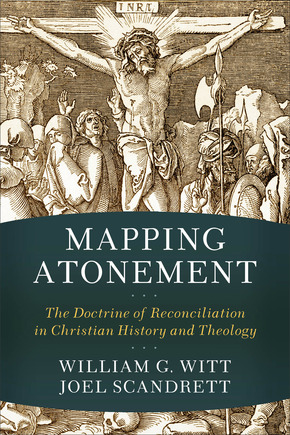
My second book, written with my colleague Joel Scandrett, is now available at the usual outlets: Barnes and Noble, Amazon, Christian Book Distributors.
This has been a lengthy project. I am grateful to my fellow author, Joel Scandrett, not only for his own contribution, but also for editing my lengthy prose to a reasonable length, and to Bob Hosack of Baker, who was patient with a project that took several years to write.
From the Publisher
What do we mean when we say that “Jesus saves”? Unlike the doctrines of the Trinity and Christology, there is no ecumenical consensus regarding the Christian doctrine of the atonement. Instead, there are a number of divergent atonement theologies found in various streams of the Christian theological tradition.
This introduction maps the biblical, historical, and theological terrain of the doctrine of the atonement. Beginning with the early Christian era, the book traces the origins, development, and divergent streams of atonement theology throughout the Christian tradition and proposes key criteria by which we can assess their value. The authors introduce essential biblical terms, texts, and concepts of atonement; identify significant historical figures, texts, and topics; and show how various atonement paradigms are expressed in their respective church traditions. The book also surveys current “hot topics” in evangelical atonement theology and evaluates strengths and weaknesses of competing understandings of atonement.
Contents
Introduction: What Is Atonement?
1. Atonement as Incarnation: Irenaeus and Athanasius
2. Atonement as Christus Victor: Church Fathers and Gustaf Aulén
3. Atonement as Satisfaction: Anselm of Canterbury
4. Atonement as Divine Love: Peter Abelard and the Wesleys
5. Atonement as Fittingness: Thomas Aquinas
6. Atonement as Penal Substitution: John Calvin and Charles Hodge
7. Atonement as Moral Example: Hastings Rashdall
8. Atonement as Reconciliation: Karl Barth
9. Atonement Today
Index
Endorsements
“Christians are united in proclaiming that ‘Jesus saves,’ but the Christian tradition and Scripture offer different narratives, symbols, and metaphors to understand what that means. Witt and Scandrett are wise, charitable, brilliant, and passionate guides to the scriptural, theological, and historical questions that compose atonement theology. This approachable introduction will help everyone who wants a deeper understanding of what we mean when we confess that Christ lived, died, rose again, and ascended into heaven ‘for us and for our salvation.'”
Tish Harrison Warren, Anglican priest and author of Liturgy of the Ordinary and Prayer in the Night
“Thoughtful Christians looking for guidance on the doctrine of the atonement are flooded with almost too much information. Witt and Scandrett’s Mapping Atonement brings wonderful clarity to the field. Their choice of figures for discussion is excellent, and their constructive approach to the topic is theologically balanced and insightful. I look forward to using this book in my own teaching.”
Joseph Mangina, professor of theology, Wycliffe College, University of Toronto
“Mapping Atonement is a major theological accomplishment. It offers a remarkably comprehensive overview of the history of atonement theology. With attention to detail and generosity of interpretation, Witt and Scandrett faithfully map the doctrine of atonement. Rightly arguing that Christ’s mission doesn’t just illustrate but in fact constitutes atonement, Witt and Scandrett carefully chart their own theological path. This is the textbook on Christ’s salvific work that many have been waiting for.”
Hans Boersma, Saint Benedict Servants of Christ Chair in Ascetical Theology, Nashotah House Theological Seminary
“Mapping Atonement serves admirably both as a contribution to theology and as an introduction for students. It expands the vista offered to earlier generations by Aulén, even as it offers a grammar, rooted in Scripture and composed of history and ontology, to evaluate all proposals. Throughout, and especially in the conclusion (culminating in an ‘critical realist’ account of T. F. Torrance), Witt and Scandrett understand the urgency of atonement’s retrieval in our confused time. I highly recommend it to a wide audience.”
The Right Rev. George Sumner, Bishop of the Episcopal Diocese of Dallas
“With the lucidity and penetration characteristic of their teaching and writing, Witt and Scandrett have provided us a superb survey of atonement theology. Written from a classical perspective that is respectful of the variety of views on the topic, yet responsibly critical in the application of scriptural and metaphysical demands on the material, the book covers a broad range of reflection on the atonement from the early church to the present, culminating in a careful commendation of T. F. Torrance’s work. The volume wears its scholarship lightly but is informed by a mastery of the tradition. This will prove an essential introduction to the topic.”
Ephraim Radner, professor of historical theology, Wycliffe College, University of Toronto

 Occasionally, I get mail. The following are a couple of questions sent to me on behalf of someone asking about the historical reliability of Scripture. I am a systematic theologian, and not primarily a biblical scholar or a historian, and people trained in these areas could no doubt address these issues with more sophistication. At the same time, one of the things that theologians do is to try to address the questions that ordinary people ask, and this notion that the Bible is historically unreliable, closer to “fairy tales” than history, seems to be common in contemporary secular culture these days.