
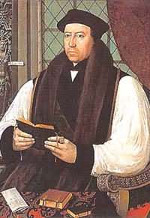
Today is the Feast Day of Thomas Cranmer, who placed his hand in the fire when he died at the stake on this day 470 years ago. I thought it a fitting day to post this essay on his sacramental theology.
A previous essay focused on Thomas Cranmer’s Reformation theology, specifically the way in which Cranmer embraced but also gave his own interpretation to the three Reformation principles of Sola Scriptura (the normative authority of Scripture alone), Sola Gratia (justification by grace alone), and Sola Fide (through faith alone). Cranmer affirmed the primacy and sufficiency of Scripture over all church tradition, while nonetheless also affirming the significance of tradition as the proper context for the interpretation of Scripture. He also affirmed both the reading of Scripture translated into the common language along with a focus on the reading of Scripture as a means of edification (the “priesthood of all believers”). Cranmer interpreted justification by faith alone to mean justification by Christ alone, with faith understood as the “lively faith” that embraced the crucified and risen Christ’s righteousness in contrast to what he called “dead faith.”
This essay will address the two other areas where Cranmer contributed most to the history of Anglican theology: his doctrine of the sacraments, particularly the Eucharist, and his contribution as author of the 1549 and 1552 versions of The Book of Common Prayer, focusing specifically on the eucharistic rites in the two books.
Reformation Eucharistic Theologies
If there was a general consensus among Reformation churches concerning the primacy and normativity of Scripture as well as justification by grace alone through faith alone, no such agreement existed for sacramental theology, style of worship, or church polity. The Reformers disagreed as much among themselves as they did with the Roman Catholic church concerning their theology of the sacraments, liturgical worship, and church orders (ordination). Concerning the sacraments, areas of disagreement concerned whether sacraments are means of grace, whether the risen Christ is present in the Eucharist, and, if so, in what manner, whether infants should be baptized, and whether baptism regenerates. Concerning worship, whether the church should retain or discard the historic liturgical worship of the church (the Catholic “mass”), and if retained, to what extent should the liturgy be preserved or modified. Concerning orders, whether the church should retain episcopacy, and, if not, whether the church should be governed by elders (presbyterian) or democratically (congregational).
Concerning the sacraments, there has been a history of disagreements in the Western church about the Eucharist – of how it is that the consecrated elements become the body and blood of Christ or how they unite the believer to Christ – that precedes the split between the Eastern and Western church. This has not been so much a concern in Eastern theology, and it may well have something to do with the Western understanding of how Christ makes himself immediately present in the Eucharist rather than the Eastern understanding that Christ is mediately present through the invocation of the Holy Spirit in the epiclesis.1 This fundamental difference between West and East concerning what can be designated as two separate “models” of Eucharistic presence has not been sufficiently recognized in discussions of Eucharistic theology, but is arguably as fundamental for understanding the Reformation-era disagreements as the disagreements themselves.2
The standard Western model of the Eucharist has a Christocentric emphasis. In the Western understanding, Jesus Christ as the risen and ascended Son of God acts directly and immediately to make himself present in the sacraments. During the Eucharistic prayer, the celebrant (or priest) represents the risen Jesus Christ. In Latin, the expression in persona Christi (in the person of Christ) means that the celebrant acts as a visible representation of the invisible risen Christ. When the celebrant pronounces the “Words of Institution” – “This is my body” and “This is my blood” – the physical elements of bread and wine are transformed to “become” (or make present) the body and blood of Christ.
The role of the Holy Spirit tends to be minimized. Insofar as the Spirit is present, the Spirit is present in either of two ways. First, by “appropriation.” That is, the Holy Spirit is present along with the risen Christ in the same manner in which the one God as the undivided divine nature acts throughout creation but specific divine acts are “appropriated” to a particular person because of a special fittingness. The phrase “all acts of the Trinity ad extra are one” (Opera Trinitatis ad extra indivisa sunt) means that all acts of the triune God outside God’s own nature (ad extra) are common to all three persons as to a single principle of action with the exception of acts specific to the mission of a specific person.
For example, although all three persons act indivisibly in the act of creation, creation is “appropriated” to the Father in the Creed – “[T]he Father Almighty, Creator of heaven and earth” – because as the originating source of all three persons (the monarchy of the Father), the Father is the person to whom creation is especially appropriate. While all three persons act in redemption, redemption is attributed especially to the Son because the Son’s unique mission is that of the incarnation. Although sanctifying grace is an act common to all three persons, sanctification is “appropriated” to the Holy Spirit as the one person associated most closely with holiness and love.
Alternatively, Western theologians sometimes speak of the Holy Spirit as mediately present through the Son in the sense either that the Spirit is sent by the Son or, alternatively, that the Spirit becomes present along with the Son as the Son (the risen Christ) makes himself immediately present. The Son thus brings the Spirit with him as the Son makes himself present in the Eucharist.
Eastern Models of the Eucharist
In contrast, Eastern models of the Eucharist have a Trinitarian rather than Christocentric emphasis. In Eastern theology, the Holy Spirit has a distinct mission after the risen Christ’s ascension to the right hand of the Father rather than being present by appropriation. In the Eastern model, the celebrant represents the worshiping community in praying the Eucharistic prayer. In Latin, this is expressed as in persona ecclesiae (in the person of the church) in that, when the celebrant (or priest) prays, he is praying on behalf of the church as the gathered worshiping community. The celebrant (presiding minister) is not representing the risen Christ directly in saying the “Words of Institution,” nor is the priest playing the part of Jesus as if the Eucharistic Prayer were an act in a play.
In the Eastern model, the Son becomes mediately present. That is, the risen Christ does not make himself present when the priest recites the “Words of Institution,” but the Son becomes present through the invocation of the Holy Spirit in the epiclesis, a prayer that is present in Eastern eucharistic prayers but historically absent from the Western canon (eucharistic prayer). Thus, the Holy Spirit has a distinct mission, and the Spirit descends on both the gifts of bread and wine as well as on the people in order to sanctify the elements of bread and wine to become the body and blood of Christ and to sanctify the gathered worshiping congregation as a community.
Transubstantiation
During the Reformation period, there were not simply one or two different understandings of how the risen Christ is present in the Eucharist, but several different positions, and these disagreements have continued not only between the Roman Catholic church and Reformation churches, but between the Reformation churches themselves.
The Roman Catholic theory of transubstantiation or presence by substantial change has its origin in the medieval period, and was an attempt to explain how the risen Christ is present in the sanctified elements of bread and wine using the Aristotelian categories of substance and accidents combined with a distinction between substantial and accidental change.3
According to Aristotle, a “substance” is the very nature of a thing, “what it is.” Fundamental to the theory of transubstantiation is the notion of predication. In Aristotelian philosophy, “substance” is the subject of predication. In the sentence, “This is a cow,” “this” refers to the individual substance of a particular cow, and is the subject of the predicate. For example, in the sentence “The cow is a herbivore,” “cow” is the subject, and thus the “substance.” The notion of “substance” can also be distinguished from “essence.” A substance is a particular instance (an individual) of an essence shared by many. For example, Bessie is a cow (substance), but Bessie is only one particular example of the essence of “bovinehood” or “cowness” that is a common property of many different cows, of which Bessie is a particular one.
An “accident” is a characteristic that can be attributed to an individual substance, but is not itself necessary to maintaining the identity of the individual substance as a member of its species or essence. In the sentence “The cow is white,” “white” is an accident. There are many different cows, some of whom might be white, while others are black or spotted, yet all remain cows. Accidental change occurs when something about an individual substance is modified, yet the individual still preserves its identity. When Bessie was first born, she was a calf of a specific size. As Bessie grew older, she also grew larger. She engages in various activities: standing, lying down, running, sleeping, eating. All of these activities are examples of “accidental change,” yet Bessie is still the same cow (substance) throughout all of these changes.
Substantial change occurs when a change is not merely accidental, but affects the very identity of a thing. For example, when Bessie eats grass, the grass undergoes substantial change in that what used to be grass becomes cow. At the same time, if Bessie herself ends up at the butcher, she might well become a hamburger which could be consumed by you or me. In that case, there would be multiple examples of substantial change: Grass becomes cow when cow eats grass. Cow becomes human when human eats beef.
In the theory of transubstantiation, the understanding is that the risen Christ makes himself present by a miraculous substantial change that is not like the substantial change of grass becoming a cow. Prior to the reciting of the “Words of Institution,” “this” refers to the substance of the elements of bread and wine. However, after the presiding celebrant recites the “Words of Institution” – “This is my body” “This is my blood” – “this” now refers to the very substance of the risen Christ, who becomes present in the sacrament by changing the substance of the bread and wine – the very nature of what bread and wine are – into the substance of his body and blood, more specifically, into himself – the substance of the “whole Christ,” body and soul, humanity and divinity.
Before the recitation of the “Words of Institution,” “this” refers to the substance of bread and wine. After the recitation, “this” refers literally and truthfully to the substance of the body and blood of Christ. However, unlike the grass that becomes cow, the now consecrated elements of what before had been but are no longer bread and wine retain their appearance and physical properties, that is, their “accidents.” They have the same color, they have the same taste. However, their identity is no longer that of bread and wine, but that of the body and blood of Christ.
Transubstantiation is thus very different from ordinary substantial change. In substantial change, accidents change because the substantial reality changes, and the accidents change along with the substance. When Bessie eats grace, the grass literally becomes cow. According to the theory of transubstantiation, when bread and wine become the body and blood of Christ, they literally become Christ, yet they retain their original accidental qualities. Although they are no longer bread and wine, but the body and blood of Christ, they still look like and taste like bread and wine.
Reformation Eucharistic Theologies
While the Reformers differed among themselves in their own eucharistic theologies, they nonetheless agreed in rejecting transubstantiation, and specifically the notion of substantial transformation – that what had previously been bread and wine was no longer bread and wine because it was now the substance of the body and blood of Christ. The Reformers agreed that whatever else took place in the celebration of the Eucharist, the consecrated elements retained their initial substantial properties. Bread and wine were still what they appeared to be – bread and wine.
Among the Reformers, the Lutheran position remained closest to the Roman Catholic position in that the risen Christ is genuinely and truly present, and that the bread and wine truly become the body and blood of Christ. Where the Lutheran position differs from transubstantiation is that it posits a dual rather than a single eucharistic identity. Before consecration, “this” refers to the elements of bread and wine. After consecration, “this” still refers to bread and wine, but “this” also refers to the substance of the body and blood of Christ. Bread and wine are still bread and wine, but after consecration, they are also truly the body and blood of Christ. This position has sometimes been designated as “consubstantiation,” although Lutherans prefer to say that Christ is present “in,” “with,” and “under” the elements of bread and wine.4
Insofar as Luther had a theory, he expressed his position through his unique understanding of the relation between the two natures of Christ. To Ulrich Zwingli’s objection that Christ could not be corporally present in the elements because his body is ascended to heaven at the right hand of God, Luther replied that God’s “right hand” was a metaphor for wherever God exercises his omnipotent power. Luther also made the unusual move of postulating that the communicatio idiomatum was not merely a manner of speaking, that is, it is not merely that characteristics of either the divine or human nature can be predicated of the single divine person who assumed human nature, but rather that, as a result of the incarnation, the human nature literally shares in the characteristics of the divine nature.5
For Luther, the risen Christ is present because Christ’s humanity shares in the omnipresence of his deity. Wherever Christ’s deity is present, his humanity is present as well. This is sometimes referred to as the theory of ubiquity.6 In the Eucharist, Christ’s omnipresent humanity is present not in the Roman Catholic sense that the bread and wine cease to be bread and wine and now become the body and blood of Christ, but in the sense that Christ’s humanity is present in, with, and under the bread and wine. The bread and wine are truly the body and blood of Christ, but they are also truly bread and wine.7
The third Reformation position is associated with the Swiss theologian Ulrich (Huldrych) Zwingli.8 Against Luther’s ubiquity, Zwingli insisted that because bodies are characterized by limited physicality, and Christ’s risen humanity is present exclusively at the right hand of the Father, Christ’s body cannot be simultaneously present in more than one place. If the risen Jesus is in heaven, he cannot simultaneously be present in the bread and wine of the Eucharist.9
Zwingli also claimed that the bread and wine are only symbols of the body and blood of the risen Christ. – the position of “memoralism.”10 Zwingli combined his insistence that Christ’s physical body exists locally in heaven with a dualist understanding of spirit and matter. Zwingli interpreted John 6:36, in which Jesus says, “The spirit gives life, the flesh is of no avail” (RSV), to mean that physical elements have nothing whatsoever to do with human salvation. It is only through the Holy Spirit that God communicates his grace. While physical elements (like bread and wine) can function as symbolic pointers to remind us of the past work of Christ’s crucifixion in salvation – “Do this in memory of me” – the bread and wine are not changed or transformed in any way, and they are not in themselves instruments of grace.11 Zwingli posits the distinction between signs and the thing signified as exclusive alternatives: “the word sacrament means a sign and nothing more . . . . Now the sign and the thing signified cannot be one and the same. Therefore the sacrament of the body of Christ cannot be the body itself.”
The fourth Reformation-era position is the Reformed position associated with the theology of John Calvin.12 Modern Reformation scholars agree that Calvin did not posit a merely metaphorical (Zwinglian) notion of real presence. Calvin wrote: “[T]here are some who define the eating of Christ’s flesh and drinking of his blood, as, in one word, nothing but to believe in Christ. But it seems to me that Christ meant to teach something more definite, and more elevated, in that noble discourse in which he commends to us the eating of his flesh.” The reference is to John 6, and it is significant that Calvin read the text as referring to the Eucharist in a manner that both Luther and Zwingli (and later Cranmer) denied. They insisted that John 6 was referring to an “eating” that takes place by faith and has nothing to do with the Eucharist.
Calvin rejected Zwingli’s notion that in the Eucharist, we partake of the Spirit only, “omitting mention of flesh and blood.” To the contrary, “the flesh of Christ is like a rich and inexhaustible fountain that pours into us the life springing forth from the Godhead itself . . . . our souls are fed by the flesh and blood of Christ in the same way that bread and wine keep and sustain physical life.”
Calvin agreed with Zwingli that the humanity of the risen Christ is exclusively physically present in heaven at the right hand of the Father, but Calvin also claimed that the Holy Spirit unites the worshiping church to the risen Christ when we “lift up our hearts” to feed on Christ. This has sometimes been called a sursum corda eucharistic theology from the words that began the eucharistic acclamation in the Latin mass: “Lift up your hearts” (Sursum corda).
Calvin’s understanding has affinities to the Eastern Orthodox epicletic theology of Eucharistic presence in that in addition to his sursum corda language (which is really a metaphor), Calvin writes about a union with the risen Christ that takes place through the action of the Holy Spirit.
Even though it seems incredible that Christ’s flesh, separated from us by such a great distance, penetrates to us, so that it becomes our food, let us remember how far the secret power of the Holy Spirit towers above all our senses. . . . The Spirit truly unites things separated in space. . . . [T]he Lord bestows this benefit upon us through his Spirit, so that we may be made one in body, spirit, and soul with him. The bond of this connection is therefore the Spirit of Christ, with whom we are joined in unity, and is like the channel through which all that Christ himself is and has is conveyed to us.
Calvin’s language of a presence through the Spirit is unique in the Western church at this time in that no other contemporary Western theologian – Roman Catholic or Protestant – uses this language of the risen Christ being made present through the Holy Spirit. Perhaps if disputants had paid more attention to Calvin in this regard, some of the Reformation disagreements might not have been so fierce.
Cranmer on the Sacraments
Thomas Cranmer’s theology of the sacraments must be understood within the historical context of these various positions of the late medieval and Reformation period. The first question to be asked might well be “Why would Cranmer need a theology of the sacraments at all?” After all, Cranmer had insisted that in justification we are justified by Christ’s alien righteousness, and Cranmer’s theology of the atonement suggests that Christ’s crucifixion and resurrection has dealt with our sins once and for all. Why then do we need the sacraments?
As pointed out above, Zwingli did not seem to think the sacraments are strictly necessary in that they function exclusively as a memorial of Christ’s saving death. Early in the 20th century, Anglo-Catholic Dom Gregory Dix claimed in The Shape of the Liturgy that Cranmer was a Zwinglian.13 Cranmer does share some themes with Zwingli’s eucharistic theology. Against Lutheran ubiquity, Cranmer claimed that Christ’s risen body cannot be physically present in the host because it is locally present at the right hand of God. Cranmer also emphasized the importance of the sacraments as “visible symbols” of what they proclaim. However, Cranmer went beyond Zwingli’s emphasis on visible symbolism as should be evident by his combining the imagery of symbolism with references to regeneration and spiritual nourishment.
Augustine of Hippo defined a sacrament as a visible sign of an invisible grace. Cranmer included both elements in his understanding of the sacraments. Both baptism and Eucharist are external visible signs:
And for this consideration our Saviour Christ hath not only set forth these things most plainly in his holy word, that we may hear them with our ears, but he hath also ordained one visible sacrament of spiritual regeneration in water, and another visible sacrament of spiritual nourishment in bread and wine, to the intent, that as much as is possible for man, we may see Christ with our eyes, smell him at our nose, taste him with our mouths, grope him with our hands, and perceive him with all our senses. For as the word of God preached putteth Christ into our ears, so likewise these elements of water, bread, and wine, joined to God’s word, do after a sacramental manner put Christ into our eyes, mouths, hands, and all our senses.14
Cranmer went beyond Zwingli by claiming that sacraments are not only external visible symbols of but are also efficacious means of grace. Cranmer refers to baptism and the Eucharist not only as “visible sacraments” in the above quote, but of baptism as a “visible sacrament of spiritual regeneration in water” and the Eucharist as a “visible sacrament of spiritual nourishment.”
Cranmer draws a close parallel between baptism and the Eucharist in his sacramental theology. Baptism is the sacrament by which spiritual rebirth (regeneration) takes place. Cranmer draws a connection between visible sign, presence of the risen Christ, and effective grace in his theology of baptism:
And for this cause Christ ordained baptism in water, that as surely as we see, feel, and touch water with our bodies, and be washed with water, so assuredly ought we to believe, when we be baptized, that Christ is verily present with us, and that by him we be newly born again spiritually, and washed from our sins, and grafted in the stock of Christ’s own body, and be apparelled, clothed, and harnessed with him, in such wise, that as the devil hath no power against Christ, so hath he none against us, so long as we remain grafted in that stock, and be clothed with that apparel, and harnessed with that armour. (PS I, 41)
Parallel to the manner in which the Christian life begins with baptism, it continues with the Eucharist. The Eucharist is a sacrament by means of which the spiritual life that begins in baptism is continued and nourished. Through the Eucharist, our spiritual life is fed, nourished, and preserved by the body and blood of Christ. Cranmer writes:
And in like manner Christ ordained the sacrament of his body and blood in bread and wine, to preach unto us, that as our bodies be fed, nourished, and preserved with meat and drink, so as touching our spiritual life towards God we be fed, nourished, and preserved by the body and blood of our Saviour Christ; and also that he is such a preservation unto us, that neither the devils of hell, nor eternal death, nor sin, can be able to prevail against us, so long as by true and constant faith we be fed and nourished with that meat and drink. And for this cause Christ ordained this sacrament in bread and wine (which we eat and drink, and be chief nutriments of our body), to the intent that as surely as we see the bread and wine with our eyes, smell them with our noses, and touch them with our hands, and taste them with our mouths, so assuredly ought we to believe that Christ is a spiritual life and sustenance of our souls, like as the said bread and wine is the food and sustenance of our bodies. (PS I, 41).
The sacraments provide a spiritual nourishment that satisfies spiritual hunger.
For as meat and drink do comfort the hungry body, so doth the death of Christ’s body and the shedding of his blood comfort the soul, when she is after her sort hungry. What thing is it that comforteth and nourisheth the body? Forsooth, meat and drink. By what names then shall we call the body and blood of our Saviour Christ (which do comfort and nourish the hungry soul) but by the names of meat and drink? . . . And as every man is carnally fed and nourished in his body by meat and drink, even so is every good Christian man spiritually fed and nourished in his soul by the flesh and blood of our Saviour Christ. (PS I, 40)
The correlation between the risen Christ’s physical body and the church as the body of Christ also points to the unity of the church as the gathered community of those who have faith. Cranmer echoes a metaphor from The Didache, one of the earliest of post-New Testament writings, to correlate the unity of the consecrated loaf and the one cup with the unity of the church as the body of Christ:
[T]hat bread and wine do most lively represent unto us the spiritual union and knot of all faithful people, as well unto Christ, as also among themselves. For like as bread is made of a great number of grains of corn, ground, baken, and so joined together, that thereof is made one loaf; and an infinite number of grapes be pressed together in one vessel, and thereof is made wine; likewise is the whole multitude of true Christian people spiritually joined, first to Christ, and then among themselves together in one faith, one baptism, one Holy Spirit, one knot and bond of love. (PS I, 42)
As the bread and wine that we consume are transformed into our own flesh and blood, so through partaking of the bread and wine of the Eucharist, Christians are joined to the risen Christ and the church is transformed to become the body of Christ.
[A]s the bread and wine which we do eat be turned into our flesh and blood, and be made our very flesh and very blood, and so be joined and mixed with our flesh and blood, that they be made one whole body together; even so be all faithful Christians spiritually turned into the body of Christ, and so be joined unto Christ, and also together among themselves, that they do make but one mystical body of Christ, as St Paul saith: “We be one bread and one body, as many as be partakers of one bread and one cup.” And as one loaf is given among many men, so that every one is partaker of the same loaf; and likewise one cup of wine is distributed unto many persons, whereof every one is partaker; even so our Saviour Christ (whose flesh and blood be represented by the mystical bread and wine in the Lord’s supper) doth give himself unto all his true members, spiritually to feed them, nourish them, and to give them continual life by him. (PS I, 40)
This theme of a eucharistic unity between the sacrament and the church fits well with the theme of reconciliation with other Christians. This is an area where Cranmer’s theology anticipates themes of the “New Perspective” on Paul:
Wherefore, whose heart soever this holy sacrament, communion, and supper of Christ will not kindle with love unto his neighbours, and cause him to put out of his heart all envy, hatred, and malice, and to grave in the same all amity, friendship, and concord, he deceiveth himself, if he think that he hath the Spirit of Christ dwelling within him. (PS I, 43)
Cranmer’s theology of salvation includes not only a forensic account (imputation) of how it is that our sins are forgiven; salvation also communicates a transformation in which we are not only declared, but made to be holy. Justification includes not only an alien righteousness, but produces a real change.
Scripture makes clear that the way in which salvation is communicated is through union with the risen Christ. The apostle Paul writes, “I have been crucified with Christ; it is no longer I who live, but Christ who lives in me; and the life I now live in the flesh I live by faith in the Son of God, who loved me and gave himself for me” (Gal. 2:20, RSV).
For Cranmer, union with Christ is not merely a legal declaration, but a real (one might say ontological) union. Sacraments are necessary because of the way in which Jesus Christ’s risen life is communicated to us. Sacraments are the means by which the church is united to the risen Christ, and through which union we come to share in the very life of the triune God: Father, Son, and Holy Spirit. (As will be seen in a later essay, the Anglican Divine Richard Hooker used the language of “participation” to describe this union.)
As noted in the previous essay, Cranmer does not make the explicit verbal distinction between justification and sanctification that only appears later with theologians like John Calvin and Richard Hooker, Rather, Cranmer makes the same distinction using the language of “lively faith.” Baptism and Eucharist would seem to belong to Cranmer’s notion of “lively faith” as the equivalent of sanctification language. Baptism begins the Christian life through regeneration. The Eucharist continues the Christian life by nourishing the baptized with Christ’s body and blood.
Having laid down the minimum of what Cranmer writes about the sacraments as both external visible symbols and signs of inward effective grace, it is necessary to recognize that scholars have not agreed about what Cranmer’s sacramental theology amounts to for the reason that he is difficult to interpret. As noted above, Dom Gregory Dix claimed that Cranmer was a Zwinglian. More recently, there have been scholars who have argued that Cranmer believed that Christ was present in his deity but not in his humanity.15
Both interpretations seem to be misreadings – as is evident from Cranmer’s own words. First, Cranmer specifically rejects a theology of memorialism (Zwinglianism), the notion that the sacraments are merely symbolic: “And therefore, I never said of the whole supper that it is but a signification, or a bare memory of Christ’s death. But I teach that it is a spiritual refreshing, wherein our soul be fed and nourished with Christ’s very flesh and blood to eternal life” (PS I, 148, emphasis added).
As noted above, Cranmer draws a close connection between baptism and the Eucharist, and he seems to understand the risen Christ to act in the same manner in both sacraments. In response to his opponent Stephen Gardner, Cranmer stated: “And when you say that in baptism we receive the Spirit of Christ, and in the sacrament of his body and blood, we receive his very flesh and blood, this here saying is no small derogation to baptism, wherein we receive not only the Spirit of Christ, but also Christ himself, whole body and soul, manhood and Godhead unto everlasting life, as well as in the Holy Communion” (PS, I, 25). Cranmer insisted that we receive the “whole Christ” (as well as the Holy Spirit) in every part of the baptismal water and in every part of the bread broken in the Lord’s table, yet not “corporally” or “naturally” (PS I, 64).
Quoting the apostle Paul, Cranmer writes: “As many as be baptized in Christ, put Christ upon them. Nevertheless, this is due in divers or in different respects. In baptism it is done in respect of regeneration, and in the Holy Communion in respect of nourishment and augmentation” (PS I, 25). Cranmer provides some clarification, which unfortunately is not much clarification at all. Cranmer distinguishes between corporal, spiritual, and sacramental presence. Cranmer agrees with Zwingli and Calvin that Christ’s body is physically present in heaven, so it cannot be physically present here. At the same time, Cranmer writes that the risen Christ is “sacramentally” and “spiritually” present here: “And although Christ in his human nature, substantially, really, corporally, naturally, and sensibly, be present with the Father in heaven, yet sacramentally and spiritually, he is here present” (PS I, 47).
Cranmer went so far as to agree with Gardiner concerning “spiritual” presence. He insisted against Gardiner that his disagreement with Rome was not about whether Christ’s body is present, but the manner in which it is present:
For we be agreed, as me seemeth, that Christ’s body is present, and the same body that suffered: and we be agreed also of the manner of his presence. For you say that the body of Christ is not present but after a spiritual manner, and so say I also. And if there be any difference between us two, it is but a little and in this point only: that I say that Christ is but spiritually in the ministration of the sacrament, and you say that he is but after a spiritual manner in the sacrament. And yet you say that he is corporally in the sacrament, as who should say that there were a difference between spiritually, and a spiritual manner; and that it were not all one, to say that Christ is there only after a spiritual manner, and not only spiritually. (PS I, 91)
Cranmer never clearly explained what he meant by “spiritual” presence. There is a parallel between spiritual presence and sacramental presence. Cranmer is also clear that faith is essential: Christ is spiritually present only to those who have faith, and here Cranmer disagrees with both Roman Catholic and Lutheran theology, both of which claim that the wicked receive Christ in the sacrament, but it does them no good. To the contrary, Cranmer insists that the wicked do not receive Christ in the sacrament; only those who have faith receive Christ (PS I, 203, 214-223, 225).
A fundamental disagreement concerns how to interpret Jesus’ discourse in John 6, in which Jesus uses the language of “eating my flesh and drinking my blood.” Cranmer claims that John 6 is not about the Eucharist, but is rather referring to a spiritual presence through faith that is not a sacramental presence (PS I, 25). As noted above, Cranmer agreed with Luther on this. Also as noted above, Calvin claimed that John 6 is indeed about the Eucharist, and here Calvin agrees with the position of perhaps the majority of modern biblical interpreters.
Yet Cranmer does not simply identify sacramental presence with spiritual presence. What Cranmer seems to be saying is that in the Eucharist, the risen Christ is present “dynamically” through the act of eating and drinking (“in the ministration of the sacrament,” PS I, 91), not physically in the elements of bread and wine, but rather in the hearts of those who believe. In Cranmer’s own words, “They say that Christ is received in the mouth and entereth in the bread and wine; we say that he is received in the heart and entereth in by faith” (PS I, 57).
In conclusion, Cranmer seems to be saying that Christ is present not (locally) in the physical elements of bread and wine, but in what he calls the “ministration” of the sacrament. That is, the entire sacramental celebration, and not simply the physical bread and wine, is an occasion or an event in which the risen Christ becomes present to and unites himself to the worshiping community, the church, which thus becomes the mystical body of Christ. In the whole celebration, the risen Christ nourishes the church “spiritually” through not only his deity, but his humanity (his “body and blood”).
Cranmer’s theology has been designated as “virtualism,” in that through the reception of the sacraments, we receive the virtue or strength of Christ’s presence, and “receptionism,” that is, we receive Christ when we receive the consecrated elements of bread and wine with worthy faith: “[M]y meaning is, that the force, the grace, the virtue and benefit of Christ’s body that was crucified for us, and of his blood that was shed for us, be really and effectually present with all them that duly receive the sacraments: but all this I understand of his spiritual presence” (PS I, 3). Cranmer contrasts a local corporal presence in the consecrated elements and what might be called an instrumental presence through the use (usus) of the elements:
For I mean not that Christ is spiritually either in the table, or in the bread and wine that be set upon the table; but I mean that he is present in the ministration and receiving of that holy supper, according to his own institution and ordinance: like as in baptism, Christ and the Holy Ghost be not in the water, or font, but be given in the ministration, or to them that be truly baptized in the water. (PS I, 148)
Regardless of the specific mechanics, Cranmer insisted that the risen Christ is truly present both in baptism and in the celebration of the Lord’s Supper, not simply in his deity, but (as Cranmer wrote to Gardiner) we receive “Christ himself, whole body and soul, manhood and Godhead unto everlasting life.” In this sense, Cranmer was as emphatic about the real presence of Christ as is the Roman Catholic theory of transubstantiation, but Cranmer did not want to associate the presence of Christ specifically with the transformation of the elements of bread and wine.
Cranmer made much of the distinction between the sign of a sacrament and the thing signified by the sacrament. The sacrament is not to be confused with the thing it symbolizes – the error of transubstantiation. It is appropriate to call the sacrament by the name of thing signified. However, bread and wine are not literally the body and blood of Christ – only “sacramentally.” The sacraments are “only significations and figures, yet doth Almighty God effectually work, in them that duly receive his sacraments, those divine and celestial operations which he hath promised, and by the sacraments be signified” (PS I, 148).
The danger in making this distinction too radical is that an absolute dichotomy will be placed between the sacrament and its effect and the sacrament will become a “mere symbol,” as in Zwingli. Geoffrey Bromiley is concerned about a Nestorian tendency in Cranmer’s sacramental theology: “In his anxiety to avoid an ex opere operato view, [Cranmer] does not quite do justice to the real unity of sign and the thing signified.”16
The next point has to do with what Cranmer meant by “spiritual” presence. As noted above, some have interpreted spiritual presence to mean that Cranmer thought that Christ was present only in his deity, or only in a non-material manner because Christ’s physical body is in heaven.17 However, Cranmer’s language made clear that he really did believe that the risen Christ (the “whole Christ”) is truly present in humanity and deity, body and soul, in the “ministration” of the Eucharist.
Others have suggested that Cranmer was referring to a presence through the action of the Holy Spirit. Church historian and missionary Stephen Neill makes this claim in his book Anglicanism, as does Bromiley.18 This would make Cranmer’s position similar to that of Calvin, or to the Orthodox position. Unfortunately, this seems mistaken. Cranmer could have and perhaps should have spoken in this way, but he did not. Rather, Cranmer seems to have believed not that the risen Christ becomes present through the Holy Spirit, but rather that the Spirit is present along with Christ in the ministration of the sacrament.
Cranmer wrote: “In the due ministration of the sacraments, according to Christ’s ordinance and institution, Christ and his Holy Spirit be truly and indeed present by their mighty and sanctifying power, virtue and grace, and all of them that worthily receive the same” (PS I, 3). Cranmer’s views are thus similar to both John Jewel and Richard Hooker, whose theology will be discussed in later essays.
The above are the key themes of Cranmer’s eucharistic theology, themes that will be developed further by later Anglican theologians.19 In light of later developments in Anglican theology and especially more recent ecumenical theology, how might we evaluate Cranmer’s sacramental theology? What are its strengths and weaknesses?
First, Cranmer maintains both elements in the traditional Augustinian definition of a sacrament: the sacrament is an external “visible sign” of an “internal and spiritual grace.”
Cranmer emphasizes elements of the Eucharist as a “sign” that is also a symbol. Baptism is a visible symbol of birth and regeneration; the Eucharist is a visible symbol of growth and nourishment. As we see and feel our bodies washed in the waters of baptism, we believe that Christ is present with us and that we are reborn, washed from our sins and united to Christ’s body. As we see, touch, smell and taste the bread and wine of the Eucharist, we believe that Christ is the nourishment and spiritual life of our souls.
Moreover, the sacraments function not only as individual but as corporate symbols. The symbolism of the Eucharist as a participation in the body of Christ reminds the communicant of and encourages the union of the church as the body of Christ who receive their union from Christ himself in and through the sacrament.
In order for a sign to function as a symbol, it must be met with a corresponding notional appropriation on the part of the one to whom the symbol is addressed, and Cranmer emphasizes throughout his sacramental theology the necessity of faith as the subjective corresponding action to the reception of the sacraments. It has been claimed that the 1549 and 1552 eucharistic rites were liturgical expressions of Cranmer’s theology of justification by grace alone through faith alone. This focus on the necessity of what Cranmer called “lively faith” to receive the sacraments provides at least a partial explanation for Cranmer’s insistence (over against Roman Catholic and Lutheran theology) that the wicked do not receive Christ in Holy Communion as well as his notion that Christ is present not in the physical elements of bread and wine, but in what he calls the “ministration” of the sacrament.
Cranmer also affirmed the second half of Augustine’s definition by affirming that the sacraments of baptism and the Eucharist are what might be called “means” or “instruments” of grace. Key to his position is the close correlation Cranmer drew between baptism and the Eucharist. Although they have different functions – baptism is the one-time received sacrament of the beginning of the Christian life (the sacrament of regeneration) and the Eucharist is the repeatedly received sacrament of continuing Christian life (the sacrament of spiritual nourishment) – Cranmer seems to have understood both sacraments to operate in an identical manner – as initiating and continuing a sharing in or participation in the “whole Christ.” That Cranmer understood Christ to be present in and act in the same manner in both baptism and the Eucharist at least partially explains his opposition to the notion of transubstantiation. If there is no corporal or physical presence of Christ in the water of baptism, and yet Christ acts in baptism to unite himself to the baptized, then something similar happens in the Eucharist. The elements of bread and wine do not have to be transformed into the body and blood of Christ for Christ to use them as instruments of grace.
Cranmer’s eucharistic theology arguably lies behind articles Twenty-Five to Thirty-One of the Thirty-Nine Articles, which describe the sacraments as “certain sure witnesses and effectual signs of grace” (art. 25), of baptism as “a sign of Regeneration or new Birth, whereby, as by an instrument, they that receive Baptism rightly are grafted into the Church” (art. 27), and the Lord’s Supper as “not only a sign” of Christian love, but a “Sacrament of our Redemption by Christ’s death” in which those who receive it rightly are “partakers” of the body and blood of Christ. The body of Christ is “eaten . . . by faith,” and is received “only after an heavenly and spiritual manner” (art. 28). The “wicked” who receive the sacraments unworthily are “in no wise” “partakers of Christ” (art. 29).
Although Cranmer certainly affirmed what might be called a doctrine of the “real presence” of the risen Christ in both baptism and the Eucharist, he was arguably less successful in articulating an understanding of “how” this takes place. His language of “spiritual” presence can be and has been understood in different ways – as a merely metaphorical presence, as a presence only of Christ’s deity rather than his humanity, as a non-physical in contrast to a “bodily” presence, as a “dynamic” presence through the “ministration” rather than through the transformation of the elements, as a presence through the agency of the Holy Spirit.
Both the strengths and weaknesses of Cranmer’s sacramental views anticipate later Anglican theology. Later Anglicanism tends to repeat Cranmer’s positive affirmations without providing explanations of the mechanics of eucharistic presence.20 Arguably, the ambiguities of Cranmer’s approach reflect incoherencies in the Western approach itself. All non-Zwinglian eucharistic theologies acknowledge that in some sense the Eucharist is a “dual reality” that includes both the physical elements of the consecrated bread and wine, but also (in a mysterious manner) the sanctifying presence of the crucified and risen Christ who shares himself with the gathered church to join the church to himself in order to sanctify the church by enabling it to share in his own resurrected life. Theologically, the question concerns whether the transformation of the elements is to be understood as parallel to the incarnation of the “Word made flesh” or along the lines of sanctifying grace in which the church “becomes” the body of Christ and yet retains its distinct identity.
That eucharistic presence is understood as parallel to the doctrine of the incarnation would seem to be the common presumption of the Western eucharistic model. Roman Catholic transubstantiation at first seems straightforward in endorsing the “is” of simple predication: the consecrated elements simply are the body and blood of Christ. However, the ontological explanation seems to be an incarnational model along Apollinarian or monophysite lines. Transubstantiation interprets “substantial transformation” as the conjunction of two prior existing natures (or essences) in such a manner that one nature – the body and blood of Christ – overwhelms and obliterates another. The bread and wine of the elements become the body and blood of Christ only by ceasing to exist as bread and wine.21
The patristic church rejected such an explanation of the incarnation. The Word becomes incarnate not by uniting two pre-existing natures or by transforming the divine nature into a human nature, but by the assumption of a human nature by the divine person of the Word in a relational union. However, a hypostatic solution is not possible as an analogy for substantial eucharistic presence because there is no person in addition to that of the Word to unite the eucharistic elements and the human nature of Christ. The Word is already the principle of unity of Christ’s divine and human natures, and the Word does not become incarnate in bread and wine.
The inadequacies of the incarnation as a model of eucharistic presence can be illustrated by the interminable debates between Lutherans and Reformed in which disagreements about eucharistic theology become tangled in irresolvable disagreements primarily about Christology. The standard Reformed critique is that Lutheran ubiquity confuses the divine and human natures of Christ, while Lutherans denigrate the Reformed position with the epithet extra-Calvinisticum, implying that on the Reformed model, the incarnation is not complete, since part of God seems to have been excluded from the incarnation. 22
Insofar as Cranmer’s position can be situated in the Reformation-era discussion, there are more parallels with the non-Zwinglian Reformed position than with either Roman Catholic transubstantiation or Lutheran consubstantiation. Ambiguities arise because of his failure to clarify what he meant by “spiritual” presence. Cranmer seemed unaware that for Calvin this meant a presence “through the Spirit.” Cranmer uses the language of “reception” and “ministration” to mean some kind of sharing or participation in the “whole Christ” (deity and humanity), but provides no further explanation beyond claiming that this takes place “sacramentally.”
Jesuit liturgical scholar Edward Kilmartin has suggested a way forward beyond Reformation disagreements by noting an unacknowledged shift in both modern ecumenical discussions about the Eucharist as well as modern revised eucharistic rites. Modern ecumenical discussions speak of a presence “through the Spirit.” Modern revised liturgical rites include an epiclesis – a prayer for the Holy Spirit to descend on the elements and community to make the risen Christ present.23 This indicates a shift from a Western to an Eastern understanding of how it is that Christ becomes present in the Eucharist, and perhaps a move from speculation about what happens to the elements of bread and wine to a more trinitarian and ecclesially focused understanding of eucharistic presence. As noted above, some interpreters of Cranmer have interpreted “spiritual” presence to mean a presence “through the Spirit,” although that does not seem to have been the case.
A model of epicletic presence that posits a specific mission of the Holy Spirit in the communication of grace and of the real presence of Christ in the Eucharist would suggest a move from the Aristotelian category of substance to the different category of relation that has served helpful in Trinitarian theology and the doctrine of creation. If the existence and unity of the trinitarian persons simply are their trinitarian relations, and if the act of creation is itself simply the relation that exists between the One Necessary Existent and contingent existents, then might it not be that the means by which one trinitarian person (the Holy Spirit) unites created and redeemed humanity to the assumed humanity of another trinitarian person (the risen Son) would be a relation? By postulating a relational unity between the eucharistic bread and wine and the ascended humanity of Christ, a unity actualized by the descent of the Spirit in the epiclesis, there might be a way forward beyond the historically confessional impasses that have arisen in consequence of making the transformation of substance to be ontologically prior to that of real presence.
A relational unity allows for all of the objective realism that has been correctly emphasized by “transformation of substance” language, but also emphasizes that the teleology of the Eucharist is oriented toward the ontological transformation of the believing community, not primarily the transformation of bread and wine. The consecrated elements would then be viewed as the sacramental occasion and means by which the Spirit effects a real ontological union between the church and the risen humanity of Christ, but only incidentally as the subjects of an ontological transformation themselves. At the same time, a relational unity ties eucharistic theology more closely to the economy of salvation by giving to the Holy Spirit a genuine role (mission) in the communication of redeeming grace, while at the same time recognizing that the role of the Spirit is specifically that of communicating the incarnation. The Holy Spirit exercises his proper mission by communicating to the church the resurrection life of the ascended Lord Jesus Christ through the consecrated elements of bread and wine.
A move to speak of a eucharistic presence “through the Spirit” would retain the strengths of Cranmer’s eucharistic theology while perhaps overcoming some of the historic difficulties that have led to impasses in Western sacramental theology.
Cranmer’s Communion Rites
Thomas Cranmer was almost certainly the author of the 1549 Book of Common Prayer and of the 1552 Prayer Book as well. The conclusion of this essay cannot discuss everything in Cranmer’s Prayer Books, but will focus on what Cranmer accomplished in his Communion rites.
Relevant historical background includes the following. In 1538, the English Bible (the Great Bible) was placed in churches. In 1544, Cranmer produced the Litany, which was the first liturgical text that later became part of the Book of Common Prayer. In 1547, the first Book of Homilies was published. This was a book of homilies or sermons that were intended to be preached by the clergy, since many priests had no training in how to write a proper sermon. In 1548, Cranmer produced the Order of the Communion, which was the first Eucharistic rite in English. In outline, it began with the Invitation, which is largely the same material that appears in the Exhortation that is read at the First Sunday in Lent in Anglican churches even now. This was followed by the Confession of Sin, the Absolution, and the Comfortable Words. The Comfortable Words are the words of Scripture that are read even now before Communion, pronouncing Christ’s forgiveness for those who receive Communion. Then follows the Prayer of Humble Access, the prayer that includes the words, “We are not worthy so much as to gather up the crumbs under your table,” etc., Then follows a double administration of the bread and the wine, that is, communion in both species of bread and wine, and not simply the bread. It is interesting that Cranmer included no Eucharistic Prayer (or Canon) in The Order of Communion. The Prayer of Humble Access is followed immediately by communion, and the service ends with a Blessing.
The first complete Book of Common Prayer appeared in 1549, entitled The Book of the Common Prayer and Administration of the Sacraments and Other Rites of the Use of the Church of England, This was replaced three years later with the 1552 revised Book of Common Prayer.
Cranmer’s sources for the Prayer Book included, first, the Great Bible, which had appeared in 1538. Much of the Prayer Book consists of quotations from Scripture. Cranmer’s second source was the Sarum Rite or the Salisbury Rite, the Latin Rite used in England at that time.
Third, Cranmer was as good a liturgical scholar as existed in the Reformation period. He had copies of many of the liturgies of the early church, and he drew on those. Cranmer was also influenced by early Lutheran liturgies. Finally, he was in conversation with Martin Bucer, a Swiss Reformer who gave him much advice.
Cranmer’s basic principles of liturgical revision were:
First, change the liturgy only when it had gone astray from biblical teaching. This approach was quite different from the Puritan approach (called the Regulative Principle), which was to allow nothing to be used in worship except that which is specifically demanded or required by Scripture. Cranmer followed instead what has been called the Normative Principle: Anything is allowed in worship that is not forbidden by or is contrary to Scripture. Practically this means to change the liturgy only where it departs from Scripture.
Throughout the history of the church, there have been those who have complained that liturgy had become too complicated, a complaint that is heard repeatedly in the medieval period. Cranmer’s second main principle was to simplify. Cranmer pursued this, first, by putting the liturgy in the language of the people, and second, by the use of only one book. In the medieval period, there were numerous books that had to be used to conduct the Mass. These included a Gospel book, an Epistle book, books used during different times of the year for the celebration of the Eucharist. Cranmer put everything in one central place – the Prayer Book.
Much of the material in the Communion rite of 1549 is familiar to those who know the two Rite One services in the 1979 Episcopal Church Book of Common Prayer or the traditional Eucharistic rite in the 2019 ACNA Book of Common Prayer. However, in both the 1979 Episcopal Prayer Book and the 2019 ACNA Prayer Book, the order is at certain points very different. The differences in order reflect that both of these later Prayer Books have been influenced by the liturgical movement of the mid-twentieth century, and in particular show the influence of Dom Gregory Dix’s The Shape of the Liturgy.
Cranmer’s 1549 rite is in the tradition of the Latin Mass, and is even designated as The Mass. The priest wears an alb with a vestment or cope, and is assisted by clerks. The entire Mass is sung. The table is referred to as an “Altar” or “God’s Board,” and “the Lord’s Table.” In the Offertory, the elements are placed on the altar, During communion, the people receive the elements orally, not in their hands.
The structure of the service begins with the Lord’s Prayer, which takes the place of a procession to the altar. Then follows the Collect for Purity: “Almighty God, unto whom all hearts be open, and all desires known, and from whom no secrets are hid, Cleanse the thoughts of our hearts by the inspiration of thy Holy Spirit, that we may perfectly love thee, and worthily magnify thy holy name, through Christ our Lord.”
After the Collect for Purity follows the Kyrie Eleison, or “Lord have mercy, Christ have mercy.” After “Lord have mercy” is the Gloria in Excelsis: “Glory to God in the highest and peace to his people on earth.” Following this is the Collect of the Day or the specific prayer of the week in the liturgical year. Next is the Prayer for the King. Then follows a reading from an epistle and the reading of the Gospel. There is no Old Testament reading because there was no Old Testament reading in the medieval Mass. Following the Gospel reading is the Creed, and following the Creed is the Sermon. There is a rubric that specifies that a homily or sermon must be preached at every Mass.
After the sermon are the exhortations inviting people to Communion, but also warning them about how solemn an occasion it is. Then follows the Offertory, where the gifts are brought to the altar. After the Offertory is the Sursum Corda: “Lift up your hearts, We lift them up to the Lord.”
After this is the Canon or Eucharistic Prayer. The use of a canon was unusual for the Reformers. Even the Lutherans, who used a service in some ways similar to the Anglican Eucharistic service did not have a Canon or Eucharistic Prayer, but simply the Words of Institution. Cranmer was thus being more traditionally Catholic at this point. The canon begins with a Prayer for the Church that includes the King, clergy, and the people (both the living and the dead).
After the Eucharistic Prayer there is the offering of a “sacrifice of praise and thanksgiving.” Then follows the Lord’s Prayer. After the Lord’s Prayer appears the Peace, and then the Agnus Dei, or “Lamb of God, you take away the sin of the world.” Then finally “Let us keep a joyful and holy feast with the Lord..”
Following the Agnus Dei was the Confession of Sin and the Absolution. After the Absolution, there follow the Comfortable Words, then the Prayer of Humble Access, and only after all of this does Communion follow. During Communion, the clerks sing the Agnus Dei: “O Lamb of God, that takest away the sins of the world: have mercy upon us. O Lamb of God, that takest away the sins of the world: grant us thy peace.”
After communion, there follow the reading of one or more Scripture texts from the New Testament. The service ends with a Post-Communion Prayer of Thanksgiving:
Almighty and everliving GOD, we most heartily thank thee, for that thou hast vouchsafed to feed us in these holy Mysteries, with the spiritual food of the most precious body and blood of thy Son our Saviour Jesus Christ, and hast assured us (duly receiving the same) of thy favour and goodness toward us, and that we be very members incorporate in thy mystical body, which is the blessed company of all faithful people, and heirs through hope of thy everlasting kingdom . . .
This is followed by a blessing from the priest:
The peace of GOD (which passeth all understanding) keep your hearts and minds in the knowledge and love of GOD, and of his Son Jesus Christ our Lord: And the blessing of God Almighty, the Father, the Son, and the Holy Ghost, be amongst you and remain with you always. Amen.
Some of the significant changes from the medieval Mass include, first, that there is no suggestion whatsoever of an oblation or a Eucharistic sacrifice. The Consecration emphasizes Christ’s once-for-all sacrifice by his “one oblation once offered, a fully perfect and sufficient sacrifice, oblation, and satisfaction for the sins of the whole world.” The Eucharistic sacrifice becomes a sacrifice of praise and thanksgiving. There is no elevation of the Host. During the medieval period, it was the practice for the priest to elevate the Host at the point in the Mass where the Latin words would have been Hoc Est Corpus Meum – “This is my body.” The elevation is notably absent in Cranmer’s service because of the Reformation rejection of the notion that the mass was an oblation or sacrifice offered to God.
One of the 1549 Rite’s unusual characteristics (for a Western Eucharistic rite) is that there is an epiclesis of the Holy Spirit, a call for the Holy Spirit to sanctify the elements. This takes place before the Words of Institution, however, and not afterwards, where it usually appears. At the communion, the communicants hear the words, “The body of our Lord Jesus Christ, which was given for you” or “The blood of our Lord Jesus Christ, which was shed for you,” which could have been interpreted to imply corporal presence.
The 1549 Prayer Book was not well received. There were riots in the streets by some who thought that the changes were too radical. At the same time, Stephen Gardner, Cranmer’s Catholic opponent, found the book to be acceptable, and, claimed that, as a Catholic, he did not find it problematic. Perhaps in response to criticisms that the rite was still too Catholic, a revised Prayer Book appeared only three years later, which moved the book in a more Reformed or Protestant direction.
The Communion rite of 1552 was altered at any point that could support a Roman Catholic interpretation. The rite is no longer called the Mass, but is now the Lord’s Supper or Holy Communion. The altar is now simply referred to as a table, and is covered with a linen cloth. There is nothing about placing the elements on the table during the Offertory. Vestments are forbidden. The priests and deacons wear only a surplice, and, while the previous service was sung, there is no singing whatsoever in this service except for the Gloria in Excelsis.
The rite is more penitential. The Ten Commandments are read at the beginning of the service as an introduction, a practice that continues in modern Anglican services usually during Lent. The people respond to each commandment: “Lord, have mercy upon us, and incline our hearts to keep this law,” and, at the conclusion: “Lord, have mercy upon us, and write all these thy laws in our hearts we beseech thee.”
The Prayer for the Church and the Prayer for Humble Access were removed from the canon (or Eucharistic Prayer) because this might suggest Eucharistic sacrifice or adoration of the elements. This also shortened the Eucharistic Prayer, which in the 1549 rite was exceptionally long.
The Prayer for the Church is now a prayer for the living only, and is placed before the Offertory. The Prayer of Humble Access occurs before the Consecration, not afterwards. The Lord’s Prayer now follows Communion as a response, and, oddly, from the perspective of those who are familiar either with the 1979 Episcopal Prayer Book or the 2019 ACNA Prayer Book, the Gloria in Excelsis is placed at the very end of the service. Rather than beginning the service with “Glory to God in the highest and peace to his people on earth,” the congregation prays the Gloria at the very end as a response to Communion.
While Cranmer introduced an epiclesis into the 1549 Book, it disappears completely in the 1552 Book. The epiclesis thus disappears from Anglican Prayer Book worship until Prayer Book revision in the 20th century. The 1979 Episcopal Book of Common Prayer includes an epiclesis not where Cranmer had placed it at the beginning but at the end of the Canon or Eucharistic Prayer. The 2019 Book of Common Prayer includes an epiclesis in both of its Communion rites.
At Communion, the elements are placed in the hands of the people, and they are told, “Take and eat this in remembrance that Christ died for thee, and feed on him in thy heart by faith with thanksgiving,” which could have been interpreted in a memorialist fashion. The sacraments are now received in a kneeling position, and what has been called the Black Rubric was added to make clear that kneeling did not imply adoration of the bread and wine. The Black Rubric reads:
Lest the same kneeling might be thought or taken otherwise, we do declare that it is not meant thereby that any adoration is done or ought to be done either unto the sacramental bread or wine that are bodily received or unto any real and essential presence there being of Christ’s natural body and blood, for as concerning the sacramental bread and wine they remain still in their very natural substances, and therefore they may not be adored, for that were idolatry to be abhorred of all faithful Christians, and as concerning the natural body and blood of our Savior Christ, they are in heaven and not here, for it is against the truth of Christ’s true natural body to be in more places than in one at one time.
A new Prayer Book appeared under Queen Elizabeth in 1559, which included some compromises to both the 1549 and 1552 books. At the reception of the elements, the new book combined both forms of address from the previous books so that the revised language emphasized both the objectivity of the sacrament and a necessary faithful response: “The body of our Lord Jesus Christ, which was given for thee, preserve thy body and soul into everlasting life. Take and eat this in remembrance that Christ died for thee, and feed on him in your hearts by faith with thanksgiving.”
The Black Rubric was completely dropped from the Elizabethan Prayer Book, but was restored under Puritan pressure in the 1662 Book of Common Prayer in a slightly modified version. The 1552 rubric denies a “real and essential presence” of Christ’s natural flesh and blood, but the 1662 version rejects any “corporal presence” of Christ’s natural flesh and blood. The Black Rubric was dropped from the 1789 American Book of Common Prayer, and was dropped from the Church of England Common Worship in 2000.
Why the changes from the 1549 to the 1552 Communion rites? Scholars disagree about what prompted the changes, and even how far Cranmer was responsible. C. W. Dugmore, in his book, The Mass and the English Reformers, argued that Cranmer made unwilling concessions to more radical Reformers, and even suggested that perhaps Cranmer did not create the 1552 book.24 At the other extreme, evangelical liturgist Colin Buchanan argues in the essay “What Did Cranmer Think He Was Doing?” that Cranmer’s position did not change at all between 1549 and 1552. Rather, the textual changes were part of a gradually executed plan which was to wean the country from Henry’s Catholicism and move the country in a more Reformed and specifically Calvinist direction.25
Alan Jacobs, in The Book of Common Prayer: A Biography, suggests that Cranmer was actually happy with the 1549 book. The Second Act of Uniformity of 1552, which was written by Cranmer, states that the 1549 book was, in Cranmer’s words, “agreeable to the Word of God and the primitive church, very comfortable to all good people desiring to live Christian conversation,” but that the new book was needed “not for any worthy cause, but because of divers doubts for the fashion and manner of the administrations of the same.”26
In conclusion, how should later Anglicanism evaluate both of Cranmer’s Eucharistic rites? I would suggest that Cranmer, and especially his contributions to The Book of Common Prayer, are still appreciated; however later Anglicanism has tended to swing the pendulum back from some of Cranmer’s positions.
Anglicans now speak more positively of Eucharistic sacrifice than did Cranmer. The modern ecumenical movement has contributed to this insofar as modern conversations with both Roman Catholics and the Orthodox make clear that Eucharistic sacrifice does not mean that Christ is sacrificed again in the Eucharist, but that the risen Christ is fully present in the Eucharist, and, as present, brings with him the full effect of his sacrifice upon the cross.
Also, the manner in which the NT Letter to the Hebrews speaks of the risen Christ’s continual intercession in the heavenly temple has influenced the understanding of eucharistic sacrifice. Sacrifice includes the risen Christ’s continual prayer on behalf of the church, and not only his death on the cross.
After the Oxford Movement, rituals and vestments were largely restored to Anglican worship, and practices that Cranmer would have considered scandalous are fairly common in Anglican churches these days. Anglicans can speak of “real presence” without specifying the manner of how Christ is present in the sacrament. Prayers for the Dead have been reintroduced and are included in both the 1979 Episcopal Prayer Book and the 2019 ACNA Prayer Book. The sacrament is reserved on Maundy Thursday, and for taking communion to the ill and shut ins.
As noted above, the epiclesis was restored in the 1979 Book of Common Prayer and is included in the 2019 ACNA Book of Common Prayer as well, where it occurs in two different locations – before the Words of Institution in the Anglican Standard Text, after the Words of Institution in the Renewed Ancient Text. The Gloria in Excelsis has been returned to its traditional place at the beginning of the service rite in every recent revision of The Book of Common Prayer, not at the end of the service. Finally, the Creed follows rather than precedes the sermon in more recent Prayer Books.
Contemporary Anglicans of whatever stripe or church party leanings, if they actually saw the service conducted in the way that Cranmer had designed it, would find much that is familiar, but especially the order of arrangement would strike them as a bit odd or puzzling. Prayer Book revision has produced many changes in the last fifty years, many of which we simply take for granted now. For a good history of the Prayer Book, including both its continuities and developments, Alan Jacob’s The Book of Common Prayer: A Biography is an accessible starting place.
1 Previous controversies concerned the views of Ratramnus (died c. 868) and Beranger of Tours (died Jan. 6, 1088).
2 For the following, see especially Edward J. Kilmartin, S.J., “The Active Role of Christ and the Holy Spirit in the Sanctification of the Eucharistic Elements,” Theological Studies 45 (1984): 225-253; Christian Liturgy: Theology and Practice I: Systematic Theology of Liturgy (Kansas City, MO: Sheed and Ward, 1988),; The Eucharist in the West, Robert Daly, S.J. ed. (Collegeville, MN: Liturgical Press, 1998, 2004).
3 The standard account is Thomas Aquinas, Summa Theologiae III.76-83. The Council of Trent defines transubstantiation in the Thirteenth Session.
4 Nonetheless, Paul Althaus in his classic text on Luther’s theology uses the term “consubstantiation.” Paul Althaus, The Theology of Martin Luther, Robert C. Schultz, trans. (Philadelphia: Fortress, 1966), 376.
5 Marc Leinhard, Luther: Witness to Jesus Christ: Stages and Themes of the Reformer’s Christology (Minnneapolis: Augsburg, 1982), 228-235.
6 Leinhard uses the term “ubiquity” throughout his treatment of Luther’s eucharistic theology, 226-241.
7 Martin Luther, “The Blessed Sacrament of the Holy and True Body and Blood of Christ, and the Brotherhoods” (LW 35, 49-73; “The Sacrament of the Body and Blood of Christ – Against the Fanatics” (LW, 36: 335-361)
8 Ulrich Zwingli, “On the Lord’s Supper,” Zwingli and Bullinger G.W. Bromiley, ed. (Philadelphia: Westminster, 1953), 177-238.
9 Zwingli’s rejection of ubiquity is an echo of the historic Western understanding. Thomas Aquinas, for instance, did not claim that Christ’s humanity was omnipresent, but that although through transubstantiation, the consecrated bread and wine become the body and blood of Christ, Christ is not present “as if in a place.” Thomas Aquinas, Summa Theologiae III.76. Rather than arguing (as does Luther) that wherever Christ’s deity is present, his humanity must be as well, Aquinas argues the reverse: that because Christ’s humanity is present in the Eucharist, his deity must be as well (art. 1); nonetheless, Christ’s body is present as substance and not in “dimensive quality.” Christ is not present locally, “as if in a place” (art. 5).
10 Occasionally some try to defend Zwingli from the memorialist interpretation – “Zwingli was not a Zwinglian”– but this does indeed seem to be the plain meaning of his text.
11 The denial of any continuing role to the ascended humanity of Christ in communicating salvation would seem to be the essential difference between Zwinglian theologies and all theologies of real presence. Zwinglian theologies tend to interpret both the atonement and justification in strictly forensic categories, and sanctification strictly in terms of the immediate presence of the Holy Spirit. For example, Calvinist Federalist theology understands Pauline “in Christ” language forensically rather than realistically. The unanswered question is that of the relation between atonement, Christ’s resurrection and ascension, and sanctification.
12 John Calvin, Institutes of the Christian Religion, John T. McNeill, ed. and Ford Lewis Battles, trans. (Philadelphia: Westminster, 1975), 2 vols. Bk 4, ch 17.
13 Gregory Dix, The Shape of the Liturgy (London: Dacre Press, 1945), 646-652. Also see T. M. Parker, “Review Article,” Journal of Theological Studies (April 1961) 134-146.
14 Thomas Cranmer, Writings and Disputations of Thomas Cranmer Relative to the Sacrament of the Lord’s Supper, John Edmund Cox, ed. (Cambridge University Press for the Parker Society, 1844), Vol. 1 of 2, 41.
15 Gordon P. Jeanes argues in Signs of God’s Promise: Thomas Cranmer’s Sacramental Theology and the Book of Common Prayer (London: T & T Clark, 2005) that Cranmer believed that Christ is present in his divine nature. Jeanes follows Cyril Richardson, Zwingli and Cranmer on the Eucharist: Cranmer Dixit et Contradixit (Evanston, Ill, 1949). I do not believe Cranmer’s texts support this reading.
16 Geoffrey Bromiley, Thomas Cranmer Theologian (New York: Oxford University Press, 1956), 65.
17 Jeanes, Signs of God’s Promise.
18 Stephen Neill, Anglicanism (New York: Oxford University Press, 1977), 79; Bromiley, Thomas Cranmer, 76.
19 H. R. McAdoo and Kenneth Stevenson, The Mystery of the Eucharist in the Anglican Tradition (Eugene, OR: Wipf and Stock, 1995).
20 McAdoo and Stevenson, Mystery of the Eucharist, 11-20.
21 Anglican Charles Gore notes the parallel between Western theologies of transubstantiation and Apollinarianism and the disappearance of the substance of bread and wine as “nihilianism” in “Transubstantiaion and Nihilianism,” Dissertations on Subjects connected with the Incarnation (Scribner’s, 1895), 229-286.
22 The extra-Calvinisticum is characteristic of all non-Lutheran theology, since the Lutheran doctrine of ubiquity is unique. Roman Catholic scholar Raymond Moloney, S.J., refers to Calvin’s position on the localization of the ascended body of Christ as a “good Augustinian principle.” Raymond Moloney, The Eucharist (Michael Glazier, 1995), 155, 172. The correct understanding of the communicatio idiomatum is that characteristics of the two natures of Christ are predicated of the single divine person. Luther incorrectly interpreted the communicaio idiomatum (as have some Lutheran scholars) to mean that whatever is attributed to one nature is attributed to the other rather than to the single divine person. Althaus, The Theology of Martin Luther, 194.
23 See note 2 above. The Anglican/ Roman Catholic International Commission Statement on Eucharistic Doctrine (1971) states “Through this prayer of thanksgiving, a word of faith addressed to the Father, the bread and wine become the body and blood of Christ by the action of the Holy Spirit, so that in communion we eat the flesh of Christ and drink his blood.” https://www.christianunity.va/content/unitacristiani/en/dialoghi/sezione-occidentale/comunione-anglicana/dialogo/arcic-i/testo-in-inglese.html. The eucharistic prayers in both the Episcopal Church Book of Common Prayer (1979) as well as the Anglican Church in North America Book of Common Prayer (2019) all have an epiclesis.
24 C. W. Dugmore, The Mass and the English Reformers (London: Macmillan, 1958), 141-175.
25 Colin Buchanan, What Did Cranmer Think He Was Doing? (Grove Books, 1982).
26 Alan Jacobs, The Book of Common Prayer: A Biography (Princeton and Oxford: Princeton University Press, 2013), 50-51.

[…] Jewel was among those who wanted to continue in the Reformation that had begun with figures like Thomas Cranmer during the reign of Edward VI. These Edwardian Reformers would become the leaders in what came to be called the “Elizabethan Settlement” following the death of Mary Tudor in 1558. When Elizabeth, Mary’s half-sister, came to the throne, she returned England to the Reformation begun under her brother Edward VI. This included a new 1559 Book of Common Prayer, largely a revision of the 1552 Prayer Book, but reintroducing some material from the 1549 Prayer Book. (See “Thomas Cranmer on the Sacraments and the Prayer Book“). […]
Pingback by Non Sermoni Res — April 9, 2026 @ 1:48 pm
[…] already mentioned in essays on Thomas Cranmer and John Jewel, the theology of the Eucharist was controversial between Protestants as much as […]
Pingback by Non Sermoni Res — June 1, 2026 @ 8:24 pm