
Dates (1522-1572)
1522 Born at Buden, Devonshire
1535 Enters Merton College, Oxford
1539 Transfers to Corpus Christi, Oxford
1540 Receives Bachelor of Arts
1545 Receives Master’s Degree
1548 Elected as Reader of Humanity and Rhetoric
1551 Receives license to preach at Sunningwell
1552 Accession of Mary Tudor; Jewel deprived of his fellowship at Corpus Christi
1554 Jewel signs articles agreeing with Roman Doctrine
1555 Jewel flees to Frankfurt, Strasbourg and later Zurich (with a letter from Cranmer); is deeply affected by disagreements among English exiles at Frankfurt
1558 Death of Mary and accession of Elizabeth; Jewel returns to England
1559 Jewel participates in disputation at Oxford against Roman clergy; Paul’s Cross “Challenge Sermon”
“If any learned man of all our adversaries . . . be able to bring any one sufficient sentence out of any old catholic doctor, or father, or out of any old general council or out of the holy scriptures of God, or any one example of the primitive church, whereby it may be clearly and plainly proved . . .”
1560 Consecrated Bishop of Salisbury
1562 Apologia Ecclesiae Anglicanae (Apology of the Church of England)
1565 Reply to Harding
1566 Defense of the Apology
“What mystical catholic ears M. Harding hath, that cannot abide the phrases and speeches of the ancient fathers.”
1570 Paul’s Cross Sermon against the Puritans (not published)
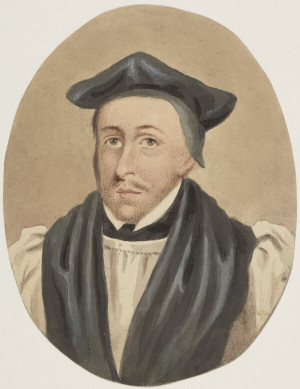
John Jewel (1522-1571) was a second-generation Anglican Reformer. He was a protege of Thomas Cranmer, and thus knew Cranmer personally. Later the great Anglican Divine Richard Hooker was a protege of Jewel’s. There is then something like a three-generation passing of the torch from Cranmer to Jewel to Hooker.
For a number of reasons, Jewel is unfortunately less well known than either Cranmer or Hooker. Cranmer is best known for his role in the creation of the Book of Common Prayer, which has provided the structure for Anglican worship for four hundred years. Richard Hooker is known for his writing of The Laws of Ecclesiastical Polity, which is probably the closest thing that Anglicans have to a systematic theology at the time of the Reformation. While his contribution is less, Jewel is nonetheless a significant figure, particularly for the development of Anglican ecclesiology – how Anglicans understand what it means to be a church, and, in that regard, how they address the question of the relationship between Anglicanism (or the Church of England) and the pre-Reformation western Catholic church.
In apologetic discussions, many Protestants and Roman Catholics agree in viewing the relationship between the medieval Catholic church and the post-Reformation Protestant churches as a simple break. This can be seen in such questions as “Did Henry VIII found the Church of England?” or “Where was your church before the Reformation?” or “Did the Church of England break with the Catholic church in order for Henry VIII to get a divorce?” Jewel’s approach to ecclesiology rejects this dichotomy. He refused to understand the Reformation as a simple break with the Roman Catholic church or to interpret the Reformation as a new beginning that leapt over sixteen hundred years of history to go straight back to Scripture, forgetting everything that had happened between the time of the death of the last apostle and Martin Luther’s 95 Theses.
At the heart of Jewel’s argument is the claim that Anglicanism was not the beginning of a new church; rather, the English Reformation was indeed a reformation, the reforming of the late medieval western Catholic church that Jewel claimed had in many ways departed from the historic church of the Patristic era and of the church of the New Testament Apostles before that.
John Jewel was born in 1522 at Buden, Devonshire. For the first few hundred years of Anglicanism, significant theological figures tended to receive their education from either Oxford or Cambridge. For example, Cranmer had studied at Cambridge. In 1535, Jewel entered Merton College, Oxford. In 1539, he transferred to Corpus Christi, Oxford, and received his Bachelor of Arts degree in 1540. In 1545, Jewel received his Master’s Degree. In 1548, Jewel was elected as Reader of Humanity and Rhetoric. In 1551, he received his license to preach at Sunningwell.
Up to this point, Jewel was following the career of someone who had grown up in Henry VIII’s Church of England, followed by Edward VI’s reformed Church of England. Thomas Cranmer’s first Prayer Book appeared in 1549, and the year following, Jewel received his license to preach. The second Prayer Book appeared in 1552. Edward VI died the next year in 1553, and Mary Tudor came to the throne. As a consequence of Mary’s return of England to Roman Catholicism, Jewel was deprived of his fellowship at Corpus Christi. A year later, in 1554, Jewel signed articles agreeing with Roman doctrine. If he had not done this, Jewel would likely have been one of the martyrs during the reign of Queen Mary, and he would have disappeared from history.
In 1555, Jewel fled to Frankfurt, then Strasbourg, and later Zurich, where there were a number of refugees who had fled England because of Mary’s persecution. Jewel brought with him a letter that he had received from Cranmer, in which Cranmer encouraged the Protestants on the continent to accept Jewel in spite of the his having signed the letters of agreement with Roman doctrine.
While in Frankfurt, Jewel became frustrated with disagreements among the English exiles, who had broken into two groups. Some wanted to remain faithful to the English Reformation, and particularly to the Book of Common Prayer. Others, finding themselves in the midst of Reformed Protestants, wanted to move in a more Reformed or Calvinist direction. This disagreement anticipated later divisions that would eventuate in the Anglican partisanship of high church versus low church, Puritans versus Prayer Book, and Evangelicals versus Anglo-Catholics.
Jewel entered into an argument with John Knox, who would later become the founder of the Church of Scotland (or the Presbyterian Church) in Scotland. Their disagreement anticipated the later controversy that erupted when the refugees would return to England. Those known as the Puritans were dissatisfied with the direction of the Church of England, complaining that the reform had not gone far enough. Their goal was to move the church in a more Protestant direction. Specifically, they thought that the Reformation in England should pattern itself along the Presbyterian type of Reformation found in John Calvin’s Geneva.
Jewel was among those who wanted to continue in the Reformation that had begun with figures like Thomas Cranmer during the reign of Edward VI. These Edwardian Reformers would become the leaders in what came to be called the “Elizabethan Settlement” following the death of Mary Tudor in 1558. When Elizabeth, Mary’s half-sister, came to the throne, she returned England to the Reformation begun under her brother Edward VI. This included a new 1559 Book of Common Prayer, largely a revision of the 1552 Prayer Book, but reintroducing some material from the 1549 Prayer Book. (See “Thomas Cranmer on the Sacraments and the Prayer Book“).
Jewel regularly preached at Paul’s Cross, an open air public pulpit in London. In 1559, Jewel preached his famous “Challenge Sermon,” which largely determined the rest of his career. The sermon addressed Roman Catholic clergy with the charge that many doctrines held by the Roman Catholic church could not be found in the church of the Fathers. The charge rested on a historical claim. Jewel challenged his opponents to demonstrate “[o]ut of any old Catholic doctor or father or out of any old general counsel or out of the Holy Scriptures of God or any one example of the primitive church whereby it may be clearly and plainly proved . . .” Jewel then listed a number of doctrines taught by the Roman Catholic church which he claimed could not be found in the Patristic church. Particularly, he focused on eucharistic doctrines such as transubstantiation, but also the papacy (the bishop of Rome as a universal bishop and head of the universal church) and worship and the Scriptures in language not familiar to the people.
This set the stage for a series of responses, replies to the responses,, and further challenges that would plague Jewel for the rest of his life as Roman Catholics began responding to Jewel’s challenge.
In 1560, Jewel was consecrated the Bishop of Salisbury. In 1562, he wrote his famous work, the Apologia Ecclesiae Anglicanae (translated in English as the Apology of the Church of England). This is one of the first uses of the term “Church of England” to refer to Anglicanism, but in Latin Ecclesiae Anglicanae is the way in which Jewel refers to that church so it is also perhaps the first use of the expression “Anglican” to refer to the church of the English Reformation. Jewel’s Apology is an expansion of the argument he had made in the “Challenge Sermon” – that the Church of England is actually Catholic because it is in continuity with the historic and patristic church, but equally important, that the late medieval Church of Rome was in discontinuity with the early church.
The most serious response to Jewel’s challenge came from the Roman Catholic Thomas Harding. Harding had initially accepted the Reformation under Edward VI, but when Mary became Queen, Harding returned to the Roman Catholic church, and remained a faithful Roman Catholic for the rest of his life. When Elizabeth became Queen, Harding was removed from his position as Canon at Salisbury Diocese, and fled to the continent where he lived in Belgium. Harding wrote an Answer to Mr. Jewel’s Challenge in 1564. In 1565, Jewel published a reply to Harding, and in 1566, Jewel wrote a Defense of the Apology.
Much of Jewel’s writings consist in back-and-forth disagreements between Harding and Jewel, with lengthy citations of the Fathers from both authors. (Jewel’s writings take up four volumes in the Parker Society edition of his works.) In this exchange, both combatants use vicious rhetoric typical of Reformation debates between Protestants and Catholics. While perhaps not an edifying discussion – the detailed repeated accusations and responses can prove to be tedious reading – one can learn much about their theology in this discussion. They also provide a Reformation-era discussion of interpretations of the church Fathers.
Jewel’s most significant contribution was that he was able to make the case that much of what was held to be doctrine by Roman Catholics in the Reformation era did not have historical precedent in the early church. So Jewel responds to Harding: “What mystic Catholic ears Mr. Harding hath that cannot abide the phrases and speeches of the ancient Fathers.”1
Finally in 1570, Jewel preached another sermon at Paul’s Cross, his “Sermon Against the Puritans.” This has not been published, but it is significant that Jewel was not simply frustrated with Tridentine Catholics. Jewel was equally at disagreement with those who thought that the Church of England had not gone far enough in the direction of the Reformation. Jewel was particularly troubled that the Puritans were unwilling to do something as indifferent as wearing a surplice. This echoed the frustration he had experienced on the continent with those who refused to use the Book of Common Prayer because they thought that it was too “Catholic.”
Jewel as Anglican Apologist
What is Jewel’s chief contribution to Anglicanism? Jewel was one of the two great apologists of early Anglicanism. Jewel wrote the foremost Anglican apology against the criticisms of Tridentine Roman Catholicism. In the following generation, Richard Hooker would write the classic Anglican apology against the criticism of the Puritans who were attacking Anglicanism from the opposite extreme. The Tridentine Roman Catholic apologists criticized Anglicanism because they claimed that it was no longer Catholic. The Puritans criticized Anglicanism because they claimed that it was still too much Catholic.
In William M. Southgate’s book John Jewel and the Problem of Doctrinal Authority, Southgate points out that the genius of Jewel’s apologetic lay in reversing the roles of the debate by stealing the high ground from the Roman position. The Roman Catholic claim that they were the true representatives of historic Christianity was popular with the English populace, who had grown up in this church and were sensitive to the criticism that the Church of England had left the church founded by Christ. Jewel’s counter claim was that it was actually the Roman position that was a departure from the historic tradition of the Catholic church.2
To the question “Is the Pope Catholic?,” Jewel would have responded (in essence) “not so much.” Jewel claimed that the Church of Rome had to prove that their doctrines and not those of the Reformers were the ones that were in continuity with the church’s ancient tradition. A key concern for Jewel was what John Henry Newman would later call the “development of doctrine.” The official Roman Catholic position at the time of the Reformation was that the church’s tradition was essentially unchanging. What the Roman Catholic church believed in the sixteenth century was identical in every respect with what it had believed in the first century. So Simon Peter was indeed the first pope of the church, and the apostles, that is, Jesus’ twelve closest disciples, as well as those who later wrote the New Testament, believed in transubstantiation.
Jewel’s advantage in the discussion that he was a good enough historian to know that this was not the case. After the Renaissance and the rise of Humanism, scholars began to read ancient texts for themselves. They discovered that it was not the case that later Roman Catholic doctrines could be found in the church Fathers. Modern Roman Catholic historians recognize this, and at least since the Second Vatican Council, have endorsed Newman’s “development of doctrine.”3 In essence, Newman’s theory of development is the recognition that Jewel was correct. However, Jewel’s opponents at the time could not make this concession. Southgate writes: “[Jewel’s] demand is based upon the premise that Rome had no right to be considered the defender of Catholic tradition. That in fact, the Church of England had the greater right.”4
Scripture and Tradition
The following discussion of Jewel’s argument has two stages. The first stage will be a summary of Jewel’s positive defense of the catholicity of the Church of England. The second stage will examine Jewel’s defense of the catholicity of Anglicanism by distinguishing between the Church of England and the Tridentine Catholic church, which Jewel insisted was not actually Catholic on certain issues.
Insofar as Jewel is a Reformation theologian, it is not surprising that he begins with Scripture. The Reformers all affirmed the primacy and sufficiency of Scripture, but Jewel defends the primacy of Scripture in a manner similar to the way that Thomas Cranmer had done before him. Jewel appeals to the early Patristic church to argue that the historic tradition of the church is to affirm the sufficiency and primacy of Scripture: “For at that time made the Catholic fathers and bishops no doubt but that our religion might be proved out of the holy Scriptures. Neither were they ever so hardy as to take any for a heretic, whose error they could not evidently and apparently reprove by the self-same Scriptures.”5
Jewel is indeed correct here. To read the early fathers, Irenaeus, Athanasius, or, later in the West, Augustine, or even in the medieval period, figures like Thomas Aquinas, is to discover that they appeal to Scripture as a final authority, not simply the tradition of the church.
Next Jewel makes an appeal to the antiquity of the church in a manner that is similar to what has been called the Vincentian Canon – laid down by Vincent of Lerins in 434 AD. That which is Catholic is that which has been believed everywhere, always, and by everyone. Roman Catholic apologists have sometimes used the Vincentian Canon as an apologetic device against the Protestant Reformation, claiming that the Reformation cannot be catholic because it is something new. To the contrary, Jewel uses the Vincentian canon to claim that the Anglican Church is actually Catholic. Jewel appeals first to antiquity:
We have not without just cause left these men, but rather have returned to the Apostles and old catholic fathers: and if we shall be found to do the same, not colourably, or craftily, but in good faith before GOD, truly, honestly, clearly, and plainly: and if they themselves which fly our doctrine, and would be called Catholics, shall manifestly see how all these titles of antiquity, whereof they boast so much, are quite shaken out of their hands, and that there is more pith in this our cause than they thought for: — we then hope and trust that none of them will be so negligent and careless of his own salvation, but he will at length study and bethink himself to whether part he were best to join him.6
Next Jewel appeals to universality, what has been believed everywhere by everyone. The Church of England affirms what all Christians affirm: “Or is that now condemned in us, which was then commended in them, or is the thing now by alteration only of one man’s affections become schismatic, which in them was counted Catholic?”7
The Rule of Faith
Having made the claim that Anglicans believe what all Christians have believed everywhere and always, Jewel turns to a positive summary of what Anglicans actually believe. Jewel begins with the Rule of Faith. My essay “What is Anglican Theology?” points out that the Rule of Faith is a second century summary of Christian faith that has a Trinitarian outline. It can be found in theologians like Irenaeus and Origen, and later it develops into what we know as the Creeds.
Jewel summarizes the faith of the Church of England with a Trinitarian outline, beginning with the doctrine of God:
We believe that there is one certain nature and divine power, which we call GOD: and that the same is divided into three equal persons; into the FATHER, into the SON, and into the HOLY GHOST: and that they all be of one power, of one majesty, of one eternity, of one GODHEAD, and of one substance.8
Jewel is clear that the Church of England affirms the doctrine of the Trinity, the doctrine that was affirmed at the Christological councils. Jewel then turns from the Trinity in itself to the person of Jesus Christ:
We believe that JESUS CHRIST, the only Son of the eternal FATHER, (as long before it was determined, before all beginnings,) when the fulness of time did come, did take of that blessed and pure Virgin, both flesh and all the nature of man, that he might declare to the world the secret and hid will of his Father; which will had been laid up from before all ages and generations: and that he might full finish in his human body the mystery of our redemption, and might fasten our sins to the cross, and also that handwriting which was made against us.9
Jewel begins with who Jesus is, the doctrine of the Incarnation. Jesus Christ is the Son of God, the second person of the Trinity, who exists from all eternity. Jewel then turns to the work of Christ – what it is that Jesus does:
We believe, that for our sakes he died, and was buried, descended into hell, the third day by the power of his Godhead returned to life and rose again; and that the fortieth day after his resurrection, whilst his disciples beheld and looked upon him, he ascended into heaven, to fulfil all things; and did place in majesty and glory the self-same body, wherewith he was born, wherein he lived on earth, wherein he was jested at, wherein he had suffered most painful torments and cruel kind of death, wherein he rose again, and wherein he ascended to the right hand of the FATHER, above all power, all force, all dominion, and above every name that is named, not only in this world, but also in the world to come: and that there he now sitteth, and shall sit, till all things be full perfected.10
Finally, Jewel turns to the third person of the Trinity, the Holy Spirit:
We believe that the Holy Ghost, who is the third person in the Holy Trinity, is very God: not made, not created, not begotten, but proceeding from both the Father and the Son, by a certain mean unknown unto men, and unspeakable; and that it is His property to mollify and soften the hardness of man’s heart when He is once received thereinto, either by the wholesome preaching of the Gospel, or by any other way: that he doth give men light, and guide them unto the knowledge of God; to all way of truth; to newness of the whole life; and to everlasting hope of salvation.11
If the language sounds familiar, it is because it is an expansion of the language of the creeds.
Jewel is clear. Anglicans believe in the doctrine of the Trinity. They believe that Jesus Christ is fully God and fully human, that Jesus became incarnate to die and rise again to redeem humanity from sin, that the Holy Spirit proceeds from the Father and the Son – the traditional Western understanding of the doctrine of the Filioque.
Finally, Jewel summarizes the doctrine of grace by referring to the indwelling of the Holy Spirit, that the Spirit dwells within us to modify and soften the hardness of our heart by the preaching of the gospel or by other means, and the Spirit does this to lead us into the way of the truth, newness of life, and the hope of salvation:
We believe that the Holy Ghost, who is the third person in the Holy Trinity, is very God: not made, not created, not begotten, but proceeding from both the Father and the Son, by a certain mean unknown unto men, and unspeakable; and that it is His property to mollify and soften the hardness of man’s heart when He is once received thereinto, either by the wholesome preaching of the Gospel, or by any other way: that he doth give men light, and guide them unto the knowledge of God; to all way of truth; to newness of the whole life; and to everlasting hope of salvation.12
Bishops, Priests, and Deacons
Next, Jewel turns to a doctrine that actually distinguishes Anglicans from other Protestants: the doctrine of orders. Unlike the majority of Protestants, Anglicans retained the threefold office of bishops, priests, and deacons. But again, Jewel does this in such a manner as to claim that it is Anglicans who are more in tune with the traditional understanding of the church than is the Reformation-era Roman Catholic church. Referring to the historic threefold office, Jewel writes, “furthermore, we believe that there be diverse or different degrees of ministers in the Church, whereof some be deacons, some priests, some bishops.”13
Jewel now turns to the fundamental doctrine that separates Anglicans from the Roman Catholic church, specifically the doctrine of the papacy. The Roman church insisted that one cannot be in communion with the Catholic church unless one acknowledges the supreme authority of the Bishop of Rome, and unless one is in communion with the Pope, who is the successor of Peter. Jewel responds that this is not actually the historic understanding of the church Fathers. Jewel writes:
As Cyprian sayeth, there is but one bishopric, and a piece thereof is perfectly and wholly holden of every particular bishop. And according to the judgment of the Nicene Council, we say that the Bishop of Rome hath no more jurisdiction over the Church of God than the rest of the patriarchs, either of Alexandria or of Antiochia have. And as for the Bishop of Rome, who now calleth all matters before himself alone, except he do his duty as he ought to do, except he minister the sacraments, except he instruct the people, except he warn them and teach them, we say that he ought not of right once to be called a bishop, or so much as an elder.14
Jewel then appeals to the actual character of what it is that a bishop does.
For a bishop, as saith Augustine, is a name of labour, and not of honour: because he will have that man understand himself to be no bishop, which will seek to have preeminence, and not to profit others. And that neither the Pope, nor any other worldly creature can no more be head of the whole Church, or a bishop over all, than he can be the bridegroom, the light, the salvation, and life of the Church. For the privileges and names belong only to Christ, and be properly and only fit for him alone. And that no Bishop of Rome did ever suffer himself to be called by such a proud name before Phocas the emperor’s time . . . about the six hundredth and thirteenth year after Christ was born. Also the Council of Carthage did circumspectly provide, that no bishop should be called the highest bishop or chief priest.15
Jewel mentions the Emperor Phocas, who referred to Pope Boniface III as the head of all churches in 607. (Jewel incorrectly has the date as 613.) Phocas was in conflict with the Patriarch of Constantinople, and as a political move he transferred the title of universal bishop of Constantinople to Rome, but the bishop of Rome had not previously claimed this title.
Sacraments
Jewel affirms the following concerning the sacraments of the Eucharist, baptism, and communion in both kinds. Concerning the Eucharist or Holy Communion, which was at this time a point of controversy between not only the Roman Catholic Church, but between different Reformation churches, Jewel affirms what might be designated a participatory doctrine of real presence:
And we do expressly pronounce that in the Lord’s Supper there is truly given unto the believing the body and blood of our Lord, the flesh of the Son of God, which quickeneth our souls, the meat that cometh from above, the food of immortality, of grace, truth, and life, and that the same Supper is the communion of the body and blood of Christ by the partaking whereof we be revived, strengthened, and fed into immortality, and whereby we are joined, united, and incorporate into Christ, that we may abide in him, and he in us.16
In the above quotation, Jewel affirms three things. First, that in the celebration of the Eucharist (Jewel uses the word eucharistia [2.12]), the risen Christ is really present, and we really do feed on him. Second, Jewel focuses on union with the risen Christ, and he says that this is the primary function or purpose of the Eucharist, “whereby we are joined, unioned, and incorporated into Christ, that we may abide in him, and he in us.” This is the language of the Prayer Book, and the consequence of this union is that there is a real sanctification, transformation, or theosis that takes place. Jewel writes, “by the partaking whereof we be revived, strengthened, and fed to immortality.”
Concerning baptism, Jewel claims first that it is a sacrament. Baptism is not merely (as it was for Zwingli) a symbol. In Jewel’s words: “we say that baptism is a sacrament of the remission of sins and of that washing which we have in the blood of Christ.” Second, Jewel affirms that no one should be prevented from being baptized if they profess Christ’s name, if they have faith: “That no person which will profess Christ’s name ought to be restrained or kept back there from.” Finally, Jewel affirms the baptism of infants on two grounds. First has to do with the Augustinian doctrine of original sin. Infants have been born into sin, and second, they are members of the household of faith insofar as they are the children of practicing Christians. In Jewel’s own words, “no one ought to be restrained or kept back therefrom, no, not the very babes of Christians, for as much as they be born in sin and do pertain unto the people of God.”17
Finally, Jewel addresses the question of whether communion should be received in both kinds, both bread and the wine. In the medieval Western church, the laity were allowed to receive only the bread, but not the wine, because of concern that the blood of Christ might be spilled. Jan Hus had protested against this practice and was condemned at the Council of Constance (1414-1418). However, Anglicans affirmed what the ancient church had affirmed, that the faithful should receive communion in both the bread and the wine. In Jewel’s own words: “Moreover, when the people cometh to the Holy Communion, the sacrament ought to be given them in both kinds, for so both Christ hath commanded, and the apostles in every place have ordained, and all the ancient fathers and Catholic bishops follow the same.”18
This is Jewel’s positive doctrine of the catholicity of the Church of England. What Jewel was arguing is that the Church of England was actually more Catholic than the Tridentine Church of Rome because they had retained such things as the primacy of Scripture, the faith of the ecumenical councils, communion in both kinds, and a proper understanding of the role of bishops, a role in which all bishops have an equal authority, and one bishop, particularly the bishop of Rome, does not have primacy over every other bishop. This, Jewel claims, was the position of the ancient church.
Jewel’s argument up to this point had been positive in the sense that in response to the negative criticism that the Church of England was not Catholic because they had separated from the true church, Jewel argued to the contrary that of the various claims that the Roman Catholic church had made concerning its uniqueness, the Church of England could claim catholicity. The Church of England affirmed the doctrines of the Creed. The Church of England affirmed the doctrines of the Ecumenical Councils. The Church of England had bishops. The Church of England affirmed that Christ was truly present in the sacraments. The Church of England affirmed that in baptism Christ truly meets us, and even infants should be baptized. The Church of England affirmed the historic distinction between bishops, priests, and deacons, and in contrast to the Roman primacy of the papacy, the Church of England affirmed the historic position that all bishops are equal, and that no single bishop had authority over all other bishops.
The Power of the Keys
The following material in Jewel’s argument is negative, not in the sense that he is presenting a negative argument, but in the sense that he reversed the attack of the Roman Catholic church. Jewel turns the Tridentine claim that the Church of England is not Cathoic on its head by claiming that concerning traditional doctrines and practices, the Church of England affirms the historic position of the church and the Roman church does not.
The first doctrine is that of the power of the keys. The power of the keys is the understanding that the church has the power to bind and loose, that is, the church has the power under certain circumstances to proclaim forgiveness of sins. The doctrine of the keys is based on two New Testament passages. The first occurs in Matthew’s Gospel (16:18), in which Jesus responds to Peter’s confession that Jesus is the Christ. The second passage occurs in John’s Gospel when Jesus appeared to his disciples after his resurrection and pronounced “If you forgive the sins of any, they are forgiven; if you retain the sins of any, they are retained” (John 20:23, RSV).
The position of the Roman Catholic church was that the keys had been given to Peter, and because the Pope is the successor of Peter, the Pope exclusively has the power of the keys to loosen and to bind. In the official insignia or seal of the Pope, the papal tiara or crown is in the center and in front of the crown are two crossed keys, which represent the keys that were given by Jesus to Peter.
In contrast to the Roman Catholic position, the Eastern Orthodox position has always been that the keys belong not to Peter alone, and certainly not to the Bishop of Rome alone, but to all the Apostles and to all the Bishops as successors of the Apostles.19
Protestant churches tend not to say much about the power of the keys. Mennonites historically have a practice of shunning, the position that when the church pronounces judgment on someone who refuses to repent from their sins, that person must be shunned by the community until they repent.
Jewel does indeed affirm that the church has the power of the keys and that ordained ministers do indeed have the power to pronounce forgiveness of sins. In every Anglican worship service, both the Daily Office and the Eucharist, after the public confession of sin, if there is a priest present, the priest pronounces forgiveness. Jewel writes:
Moreover, we say that Christ has given to his ministers power to bind, to loosen, to open, to shut. As the Office of Loosing consists in this point, that the minister should either offer by the preaching of the Gospel the merits of Christ in full pardon, to such as have lowly and contrite hearts, and to infinitely repent themselves, pronouncing unto the same sure and undoubted forgiveness of their sins, and hope of everlasting salvation, or else, the same minister when any have offended their brothers’ minds with a great offence, with a notable and open fault, whereby they have, as it were, banished to make themselves strangers from the common fellowship and from the Body of Christ, that after a perfect amendment of such persons, thus reconcile them, and bring them home again, and restore them to the company and unity of the faithful.20
Jewel is claiming that the power of the keys is the power of ordained clergy to pronounce the forgiveness that has already been given to sinners because they have heard the promise of the gospel concerning the forgiveness of sins, and have repented. If that is the case, then the minister has the authority to pronounce that forgiveness.
Married Clergy
The next issue of controversy concerns the marriage of clergy. The position of the Tridentine Catholic church was that ordained clergy must be celibate, and this continues to be the position of the Roman Catholic church even after Vatican II, although exceptions can be made for priests who are part of Eastern Rite churches that are in communion with Rome. The historic position of the Orthodox churches is that clergy may be married as long as they are married before they are ordained, but only celibate unmarried priests can become bishops.
Jewel responds to the position particularly of Rome to claim that this demand for clerical celibacy is not the position of the patristic church. He writes:
We say that matrimony is holy and honorable in all sorts and states of persons, in the patriarchs, in the prophets, in the apostles, in holy martyrs, in the ministers of the Church, and in bishops, and that it is an honest and lawful thing, as Chrysostom saith for a man living in matrimony, to take upon him, therewith, the dignity of a bishop.21
Against both Rome and (in respect to bishops) the Orthodox, Jewel appeals to one of the great church Fathers, John Chrysostom, to argue not only that clergy can be married, but that even bishops can be married.
Common Worship
Concerning the church’s practice of gathered worship, Jewel echoes the position of Thomas Cranmer that worship should be in the language of the people, in a language they understand, not one they do not understand, such as Latin. Jewel writes:
We make our prayers in that tongue which all our people, as meet is, may understand; to the end they (as St. Paul counselleth us) take common commodity by common prayer; even as all the holy fathers and catholic bishops, both in the Old and New Testament, did use to pray themselves, and taught the people to pray too.22
Jewel has two opponents in mind. Against the Roman Catholic position, Jewel complains (as did Thomas Cranmer in his “Preface” to the Book of Common Prayer) that medieval worship had become too complicated and needed to be simplified:
As touching the multitude of vain and superfluous ceremonies, we know that Augustine did previously complain of them in his own time, and therefore have we cut off a great number of them, because we know that men’s consciences were covered about them, and the Church of God overladen with them.23
However, Jewel is just as unhappy with those Puritans who claimed that the church should not do anything unless it is specifically required in Scripture, and that the historical liturgical worship of the church simply needed to be discarded. Against the Regulative Principle, Jewel writes:
Nevertheless, we keep still and esteem not only those ceremonies which we are sure were delivered us from the apostles, but from some others too besides, which we thought might be suffered without hurt to the Church of God, because that He had a desire that all things in the Holy Congregation might, as St. Paul commandeth, be done with comeliness and in good order.24
The Unity of the Church
Jewel responds to the accusation that the Church of England had left the true Catholic church, and thus sundered the unity of the church, by arguing instead that to reform the church is not the same thing as to leave the church, and that unity in itself is not necessarily a sign that the church is the true church. Jewel writes:
Of a truth, unity in concord doth best become religion, yet is not unity the sure and certain mark whereby to know the Church of God, for there was the greatest consent that might be amongst them that worshiped the golden calf, and among them which with one voice gently cried out against our Saviour Jesus Christ, crucify Him.25
That the church is one does not necessarily mean that the church is Christ’s church. The very existence of councils and bishops means that from time to time the church will need to be reformed. According to Jewel:
If there be no peril that harm may come to the Church, what need is there to retain to no purpose the names of bishops? For if there be no sheep that may stray, why they be called shepherds, if there be no city that may be betrayed, why they be called watchmen, if there be nothing that may run to ruin, why may they be called pillars? How might such reform take place?26
The late medieval movement of Conciliarism held that a church council should be superior to a pope, and that disagreements among Christians should be resolved by a church council. Jewel wrote about councils: “As for their religion to be of so long continuance as they would have men wean it, why do they not prove it so by the examples of the primitive church, and by the fathers and councils of old times?”27 Jewel claims (somewhat disengenously perhaps) a kind of conciliar authority for the way in which Anglicanism had been promoted by the English government.
Yet truly we do not despise councils, assemblies, and conferences of bishops and learned men. Neither have we done that we have done altogether, without bishops or without a council. The matter hath been treated in open parliament, with long consultation, and before a notable synod and convocation. But touching this council, which is now summoned by the Pope Pius, wherein men so lightly are condemned which have been neither called nor seen, it is easy to guess what we may look for or hope of it.28
If Jewel’s comparing the gathering of Parliament to a church council is certainly problematic, his point concerning the Council of Trent has a certain validity. An embassy of Lutherans (including Philip Melanchthon and Johannes Brenz) attempted to attend the Council of Trent in 1552, hoping to have their voices heard, but turned away when the Protestants were denied a voice. If one reads the canons and decrees of the Council, it seems that Trent was interested far more in claiming that the Protestants were mistaken and heretical than in listening to the actual concerns that were raised by the Reformation. In practically every issue raised by the Reformers, Trent simply affirmed the contrary position. If the Reformers affirmed the primacy and sufficiency of Scripture, Trent replied that Scripture and tradition were equal authorities. If the Reformers claimed that the apostle Paul taught that we are justified by faith alone, Trent said to the contrary that we are not justified by faith alone, but by faith and works. If the Reformers wanted worship in the language of the people, Trent insisted that worship should still be in Latin. If the Reformers thought that clergy should be allowed to marry, Trent insisted that clergy must be single and celibate. At the time of the Reformation, the Roman Catholic church seemed unable to hear the the Reformers’ concerns.
Ecumenism
One last criticism often raised against Protestants is that while there is one Catholic church, there are thousands of Protestants denominations, and this is proof that the Reformation was a failure since Protestants cannot even agree among themselves. In this regard, John Jewel was one of the first examples of ecumenism. While many Protestants even at the time did not agree with each other, and the Reformed and Lutherans were particularly at odds with one another about their understanding of the sacraments, Jewel held out an ecumenical hope that these disagreements could someday be resolved. He wrote:
And as for those persons, whom they upon spite call Zwinglians and Lutherans, in very deed they of both sides be Christians, good friends and brethren, they vary not betwixt themselves upon the principles and foundations of our religion, nor as touching God nor Christ nor the Holy Ghost nor the means of justification nor yet everlasting life, but upon one only question which is neither weighty nor great, neither mistrust we or make doubt at all, but that they will shortly be agreed, and if there be any of them which have other opinion than is meet, we doubt not, but ere it be long, they will put together all affections and names of parties, and that God will reveal it unto them, so that by better considering and searching out of the matter, as once it came to pass in the Council of Chalcedon, all causes and seeds of dissension shall be thoroughly plucked up by the root, and be buried and quite forgotten forever, which God grant.29
Unfortunately, Jewel got it about as far wrong here as could be. Four hundred years have passed since Jewel wrote, and, unfortunately, Christians still disagree with one another about such things as our theology of the sacraments, even within Anglicanism. There are divisions sometimes, it seems, within church bodies as fierce as those between denominations, yet Jewel reminds us that an ecumenical vision was inherent to Anglicanism from its beginning.
Finally, there is in Jewel a recognition that there is another body of Christians, the Orthodox, an appreciation genuinely rare at the time of the Reformation, even among Anglicans who had bishops. It has only been in the last two centuries that Anglicans have entered into conversation with the Orthodox. Jewel writes:
If we be schismatics because we have left them, by what name, then, shall they be called themselves, which have forsaken the Greeks, from whom they first received their faith, even the primitive church, forsaken Christ himself, and the apostles, even as if children, should forsake their parents? For though those Greeks, who at this day profess religion in Christ’s name, have many things corrupted amongst them, yet hold they still a great number of those things which they received from the apostles, they have neither private masses, nor mangled sacraments, nor purgatories, nor pardons, and as for the titles of high bishops, and those glorious names, they esteem them so, as whoever he were that would take upon him the same, and would be called either universal bishop, or the head of the universal church, they make no doubt they call such a one both a passing proud man, a man that worketh despite against all the other bishops his brethren, and a plain heretic.30
Conclusion
A previous essay bore the title “What is Anglican Theology?” and addressed the question of Anglican identity with the claim not only that Anglicanism has a distinctive identity but that Anglicanism can be identified as a reforming movement in the western Catholic church that is an heir not only of the historic catholic and orthodox Nicene/Chalcedonian faith but also of the Protestant Reformation. The two previous essays on Thomas Cranmer showed this twofold emphasis in Cranmer’s theology – the first focusing on Cranmer’s Reformation affirmation of the primacy and sufficiency of Scripture as well as justification by grace alone through faith alone. The second essay examined the catholic and evangelical dimensions of Cranmer’s sacramental theology as well as his liturgical contributions to the Book of Common Prayer. The claim is that Cranmer was a Reformation theologian, but Cranmer’s understanding of Scripture, his doctrine of grace, his sacramental theology, and the worship of the Prayer Book, are also in continuity with Catholic identity.
Where does John Jewel fit into this trajectory of Reformed Catholicism or catholic evangelicalism? In contrast to Cranmer and (more recently) Richard Hooker, little has been written concerning Jewel’s theology. One of the few books published in the last several decades dismissed Jewel as an erastian whose motives were entirely political,31 but this ignores that Jewel’s argument is entirely theological. Jewel argued not for the English but for the Catholic identity of the sixteenth century Church of England.
As seen above, there are five basic affirmations of Catholic identity in Jewel’s theology. First, in continuity with the Reformation, Jewel affirmed the primacy and sufficiency of Scripture, but interpreted Scripture in continuity with the patristic tradition of the church.
Second, Jewel claimed that Anglicanism upheld the trinitarian faith of the patristic church, as summarized through an outline that paralleled the patristic Rule of Faith which provided the hermeneutical key to the interpretation of Scripture and anticipated the historic creeds.
Third, although Jewel rejected transubstantiation as not in agreement with the historic understanding of the patristic church, he affirmed a sacramental theology in which sacraments unite the church to the risen Christ as instruments of a participatory theology of grace.
Fourth, Jewel defended the Anglican church order of bishops, priests, and deacons as in continuity with the historic catholic church, and the doctrine of the keys as the authority to pronounce absolution of confessed sin.
Finally, Jewel espoused an early form of ecumenism that anticipated later developments. Not only did Jewel hope for resolution of disagreements between Anglicans, Lutherans, and the Reformed, but he recognized the eastern Orthodox as in some ways closer to Anglicanism than the Tridentine Roman Catholic church.
Perhaps the most significant thing to say about John Jewel is that he was a genuinely rare figure at the time of the Reformation. While the Roman Catholic church looked primarily to its own identity at the end of the Middle Ages, claiming that they alone held the true Catholic faith, and many Protestants, in rejecting what they considered to be the errors of the Roman Catholic church, also rejected a great number of things that had been part of the church from its very beginnings (such as written liturgy and episcopacy), Jewel looked back to an earlier time. Jewel did not see the Reformation as a break with the Catholic church, but as an actual reformation, a reforming of the church that meant returning to the church in its earliest period, the church of the Fathers. Some of this was already present in Thomas Cranmer, and an affinity for the Fathers will become a regular theme in later Anglicanism. Anglicanism is not only a church of the Reformation, but a church that finds its roots in the church of the first several centuries, the church of the Ecumenical Creeds and Councils.
1 John Jewel, “A Defense of the Apology of the Church of England,” The Works of John Jewel (Cambridge: Cambridge University Press, for the Parker Society, 1848), vol. 3, 484.
2 William M. Southgate, John Jewel and the Problem of Doctrinal Authority (Cambridge, MA: Harvard University Press, 1962), 52.
3 See for example, Yves Congar, The Meaning of Tradition, A. N. Woodrow, trans. (San Francisco: Ignatius, 1964; 2004); Tradition and Traditions: An Historical and Theological Essay, Michael Naseby and Thomas Rainborough, trans. (New York: Macmillan, 1967), 2 vols.
4 Southgate, John Jewel, 52.
5 The text is from John Jewel, An Apology of the Church of England, Lady Ann Bacon, trans. (London, Paris, New York & Melbourne: Cassell & C., 1888); citations refer to the An Apology of the Church of England, Robin Harris and Andre Gazal, eds. (Davenant Institute, 2020); 1.10, 17.
6 Jewel, Apology, 1.6, 14.
7 Jewel, Apology, 3.1, 39.
8 Jewel, Apology, 2.1, 19.
9 Ibid.
10 Jewel, Apology, 2.1, 19-20.
11 Ibid, 20.
12 Jewel, Apology, 2.1, 20.
13 Jewel, Apology, 2.3, 21.
14 Jewel, Apology, 2.3, 22.
15 Ibid, 22-23.
16 Jewel, Apology, 2.6, 28.
17 Jewel, Apology, 2.11, 28.
18 Jewel, Apology, 2.12, 29-30.
19 John Meyendorff, Byzantine Theology: Historical Trends and Doctrinal Themes (New York: Fordham, 1974, 1979), 196.
20 Jewel, Apology, 2.6, 23-24.
21 Jewel, Apology, 2.8, 26.
22 Jewel, Apology, 2.18, 35.
23 Jewel, Apology, 2.17, 34.
24 Ibid.
25 Jewel, Apology, 3.6, 45.
26 Jewel, Apology, 4.12, 67-68.
27 Jewel, Apology, 5.2, 83.
28 Jewel, Apology, 6.2-3, 103.
29 Jewel, Apology, 3.6, 45.
30 Jewel, Apology, 5.14-15, 98.
31 Gary W. Jenkins, John Jewel and the English National Church : the Dilemmas of an Erastian Reformer (Burlington, VT: Ashgate, 2006).

[…] already mentioned in essays on Thomas Cranmer and John Jewel, the theology of the Eucharist was controversial between Protestants as much as between Protestants […]
Pingback by Non Sermoni Res — June 2, 2026 @ 9:16 am
[…] of “development” is in actuality a reappearance of an issue that had been raised earlier by John Jewel in his Apology of the Church of England. Jewel was a good enough historian to recognize correctly that there were beliefs and practices […]
Pingback by Non Sermoni Res — October 3, 2026 @ 5:20 pm