
 Before I begin I want to thank the graduating seniors for asking me to speak to them at what would normally be baccalaureate but because of the dedication of the Trophimus Center has been shifted to Wednesday chapel. Since I am retiring, this is a sermon to mark not only your own graduation from Trinity, but also in some sense mine. It has been a great honor to teach and to get to know hundreds of seminary students in these last eighteen years. It has been my great pleasure to get to know those of you who are graduating as well as those of you who will not graduate this year, but will be here awhile longer. I will miss you.
I also want to express my appreciation to my fellow faculty and to the staff. One of the wonderful things about teaching at Trinity has been the people who have dedicated themselves to what we do here. I especially want to express my appreciation to Don Collett, who arrived the same year I did, and to my fellow author Joel Scandrett for his collaboration on our book on the atonement. I just wish more people would buy it.
Two of the faculty, my dear friends the Rev. Drs. Martha Giltinan and Rod Whitacre, have now joined the celestial choir, where Rod no doubt plays ukelele, and Martha sings. By now I assume that they have resolved their disagreements about women’s ordination. Bishop Grant LeMarquand who was here when I arrived, and Dr. David Yeago, our first Lutheran theologian, have recently retired. Three of my dearest friends the Rev. Dr. Leander Harding, the Rev. Dr. Wes Hill, and the Rev. Tina Lockett are now serving the church elsewhere.
I also want to thank those who to me will always be the new faculty, Jack Gabig, David Ney, Brad Roderick, and Jacob Rodriguez. I cannot forget our Lutheran friends David Luy and Alex Pierce or our Presbyterian Rich Herbster. And of course, without our librarian Susanah Wilson, neither of my two books would have been written.
I have known four Dean Presidents and numerous Board Members, and there would be no seminary without them, so thank you to Dean Presidents and the Board. But the heart of seminary life is the faculty, the staff, and the students, and they are the ones I will remember with the greatest joy. Thomas Aquinas famously reinterpreted the virtue of charity as friendship, friendship with God and friendship with our fellow Christians. I am immensely grateful for the friends I have found at Trinity.
I am a layperson, which means that I am a sheep, not a shepherd. In what follows, I’d like to give some advice to those of you who as shepherds are about to be turned loose on the flock. The Anglican Divine George Herbert In The Country Parson defines your future role this way: “A Pastor is the Deputy of Christ for the reducing of Man to the Obedience of God.” Herbert goes on to say that, after Christ’s resurrection and ascension, “Christ being not to continue on earth, but after he had fulfilled the work of Reconciliation, to be received up into heaven, he constituted Deputies in his place, and these are Priests.” In typical Anglican fashion, Herbert gives us the titles of both “pastor” and “priest.” What is important for Herbert is not the title, whether “pastor” or “priest,” but what he means when he says that a pastor is a “deputy” of Christ.
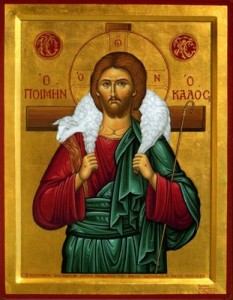
Another way of saying that a pastor is a “deputy of Christ” is to compare the pastor to an icon of Christ. I preached an earlier version of this sermon at an ordination when I first came to Trinity, which was published in The Living Church. That sermon later led to my publishing a book about ordination. In both cases, it was the publishers who chose to give the sermon and the book the title Icons of Christ.
I want to be very clear that when I suggest that the role of the pastor is to be an “icon of Christ,” I am using that term in a paradoxical manner. The biggest complaints I have received concerning both the Living Church sermon and the book have had to do with the expression “icons of Christ,” but for opposite reasons. Some interpreted the title literally and complained “A priest is not an icon of Christ.” Others recognized that I was using the term paradoxically, but denied that there is anything paradoxical at all about the title. A priest really is an icon of Christ, and specifically in one or more of the ways in which I had denied it.
There are two key passages in which the apostle Paul talks about what it means not only for clergy but for all Christians to resemble Christ – to be icons of Christ. The first is Philippians chapter two, in which Paul writes “Have this mind among yourselves, which is yours in Christ Jesus, who, though he was in the form of God, did not count equality with God a thing to be grasped, but emptied himself, by taking the form of a servant, being born in the likeness of men. And being found in human form, he humbled himself by becoming obedient to the point of death, even death on a cross.” So the first way in which all Christians resemble Christ is through what has been called cruciformity, humbling ourselves to follow the path of self-emptying in which the pre-existent Son of God put aside his divine glory to walk in the path of service whose destination was the cross.
The apostle Paul provides what I think is the definitive description of how the leaders of the church follow this pattern of cruciformity to resemble Jesus Christ in 2 Corinthians 4, “For what we proclaim is not ourselves, but Jesus Christ as Lord, with ourselves as your servants for Jesus’ sake. For God, who said, ‘Let light shine out of darkness,’ has shone in our hearts to give the light of the knowledge of the glory of God in the face of Jesus Christ. But we have this treasure in jars of clay, to show that the surpassing power belongs to God and not to us” (vs. 5-7).
So to speak of ordained clergy as icons of Christ is indeed paradoxical. The pastor is not Jesus Christ. The pastor is a jar of clay. The pastor represents Christ primarily in pointing away from him or herself, by pointing to Christ. But the priest also resembles Christ as one who shares in Christ’s suffering. Paul goes on to say, “We are afflicted in every way, but not crushed, perplexed, but not driven to despair, persecuted, but not forsaken, struck down, but not destroyed, always carrying in the body the death of Jesus, so that the life of Jesus may also be manifested in our bodies” (vs. 8-10).
So pastors or priests are icons of Christ not because they themselves are Jesus Christ, but because they point away from themselves and their own competence to the competence of the crucified and risen Christ. It is Jesus Christ who saves, not the priest.
The ordained minister first points away from himself and to Jesus Christ in the way they exercise authority. Post-modern culture just gets this wrong. For post-moderns, the pastor is not an icon of Christ, but a therapist, a social worker, or the Chief Operating Officer of the congregation. At the same time, when people are uncertain about the source of their authority, they become frightened, and they fall back on their own personal authority. There are plenty of clergy who have no problem imagining themselves to be icons of Christ, but the icon they prefer is that of Christ enthroned in glory, Christus Pantokrator.
In the couple of years just before I came to teach at Trinity and in the immediate years afterwards, I lived through the split in the Episcopal Church that led to depositions of clergy for abandonment of communion, and lawsuits over property, and depriving people of worship space they had built and paid for, for decades or even centuries. A generation ago, the problem of sexual and pastoral abuse of parishioners was a scandal particularly for the Roman Catholic church, but in recent years, it has become obvious that the problem of abuse exists in every denomination. If it is any comfort, misuse of clerical power is not new. If you want some very practical examples of both good and bad Anglican clerical leadership, I would suggest reading the novels of the nineteenth century author Anthony Trollope.
In contrast to this path of self-promotion, in the 1st Epistle of Peter, the apostle explains the proper type of pastoral leadership: “Shepherd the flock of God that is among you, exercising authority, not under compulsion, but willingly, as God would have you, not for shameful gain, but eagerly, not domineering over those in your charge, but being examples to the flock” (1 Peter 5:2-3).
In ministry, you will be called to exercise authority as did Jesus, who said “[W]hoever would be great among you must be your servant, and whoever would be first among you must be your slave, even as the Son of Man came not to be served but to serve, and to give his life as a ransom for many” (Matt. 20:26-28). As Jesus states in John’s Gospel, the role of the Shepherd is to lay down his life for the sheep. That kind of leadership is more difficult than being a social worker or a CEO. It demands more long suffering than does top-down authority. You cannot do it unless you love the people you are called to serve, and unless you are willing to suffer. As ordained clergy, the only authority you have is that which you share with the Good Shepherd who lays down his life for the sheep.
The second way in which the priest points to Christ is in the preaching of the Word and the administration of the sacraments. I think that this is actually the most important part of your job, what you will do on Sunday morning. This is an area where the Catholic and Reformation traditions love to part ways. Catholic preaching is notoriously bad because, it is presumed, the important thing is the sacraments. Conversely, there often seems to be a direct correlation between the high emphasis that Protestants place on preaching and the banality of Protestant worship. Those of you who are Anglicans cannot enjoy either excuse. You belong to the church of Thomas Cranmer’s liturgy and John Donne’s sermons. You have to do both, and do both well.
I am going to make some suggestions about preaching. First, the primary job of the preacher is to communicate the Word of God about Jesus Christ as contained in the Scriptures. Do not forget that the point of preaching is, once again, to point to Christ.
Your sermons should focus on Jesus Christ, the Good Shepherd and the High Priest, who Jesus is, and what Jesus did. Who is Jesus? He is the Son of God, the incarnate Word become flesh, the second person of the Trinity. What did Jesus do? He became human, he died for our sins, he rose from the dead, and he is coming again. That is the gospel. That is what you are to preach.
You also need to know the Scriptures, and you need to know the central themes of the Scriptures; your theology and spirituality need to be formed by the central content of the Scriptures, and that is what you should preach about. Your pet political causes are not the gospel. Moralistic exhortations about what people should or should not do, are not the gospel. And, although, as a theologian, it is painful for me to say, even your favorite theological commitments are not the gospel. The gospel is not a doctrine about imputation or infusion or predestination or free will, or even the proper way to divide law and gospel. And the gospel is certainly not the proper theory of apostolic succession or preaching about the correct number of sacraments. The gospel is that Jesus Christ died for our sins and rose from the dead, and is coming again. The good news is about Jesus Christ, and his person and work, and that is what you need to come back to in your preaching, over and over.
The administration of the sacraments and the celebration of the liturgy is the other really important thing you will do on Sunday morning. As sacramental Christians, Anglicans do not believe that Christian worship is either a matter of communicating cognitive intellectual information or of emotional manipulation. Sunday morning worship is neither the lecture hall nor a rock concert.
Sunday morning worship involves doing things, and performing certain rituals because the risen Christ communicates himself to us in more than words. Thomas Cranmer wrote that through the sacraments “we receive Christ himself . . . in baptism it is done in respect of regeneration, and in the holy communion in respect of nourishment and augmentation” (Writings and Disputations, Parker Society, vol. 1, 25).
Sharing in Christ’s body and blood through the eating of broken bread and the drinking of consecrated wine is the means by which the risen Christ shares his risen life with the church, so that, as the Prayer of Humble Access states, “we may continually dwell in him, and he in us, that our sinful bodies may be made clean by his Body, and our souls washed through his most precious Blood.”
I want to say just a bit about the liturgy. As a shepherd, your chief job in leading worship will be to help the congregation share in something objective and outside ourselves that has been given to the church. As Anglicans, we have something really precious in the liturgy. Prayer Book worship is rooted in a history that goes back almost two thousand years. The basic structure of worship in Word and Sacrament can be found in the writings of Justin Martyr in the second century. Traditional Anglican hymnals contain hymns from every era of the church’s history. The theology of many of those hymns is profound.
As you lead the congregation in worship, it will not be your responsibility to create something new or clever. C. S. Lewis talks about this in his book Letters to Malcolm: Chiefly on Prayer when he complains about liturgical novelty. It is distracting, Lewis complains, constantly to be asking oneself “What on earth is he up to now?” Lewis reminds the clergy: “I wish they’d remember that the charge to Peter was Feed my sheep; not Try experiments on my rats, or even, Teach my performing dogs new tricks.” (C.S. Lewis, Letters to Malcolm: Chiefly on Prayer (New York: Harcourt, Brace, Jovanovich, 1963, 1964), p. 5.) Again the purpose of the liturgy is to point to Jesus Christ. If it does not do that, the liturgy has failed in its purpose.
There is one last way in which the priest acts as an icon and shepherd of Christ. The priest is pastor and spiritual director. The words “pastor” and “pastoral” come from the Latin word that means “shepherd.” There is a uniquely pastoral dimension to Anglican ministry. The traditional exhortations given to the priest at ordination speak to this responsibility.
George Herbert again provides a wonderful example of ideal Anglican pastoral practice. He writes that “THE Country Parson upon the afternoons in the week-days takes occasion sometimes to visit in person, now one quarter of his parish, now another.” Herbert believes that it is important to visit people when they are about their daily life and business because, then, they will not be on what we might call their “best Sunday behavior.” When I was younger, it was not unusual at all for the pastor to simply show up at the door for a visit without warning. These days that might be a real surprise. Outside of an English country village, it would probably be difficult to have the kind of intimate acquaintance with your congregation that Herbert expected, but one of your responsibilities as a priest is to get to know your parishioners, to spend time with them, to pray with them, to baptize them, to marry them, to bury them.
At this point I’m just about ready to wrap things up. I’ve told you about what I think will be your main responsibilities as clergy, as icons of Christ, as servants who will preach the word, administer the sacraments, celebrate the liturgy, and who will care for Jesus’ flock. But I want to add one thing more, which I’ll summarize with the single word “Joy.”In 1 Corinithans, Paul writes, “So we do not lose heart. Though our outer nature is wasting away, our inner nature is being renewed day by day. For this slight momentary affliction is preparing for us an eternal weight of glory.” In Philippians, Paul tells us to “Rejoice in the Lord always; again, I say, rejoice.” Paul goes on to write, “Do not be anxious about anything, but in everything by prayer and supplication with thanksgiving let your requests be made known to God.”
As Christian leaders, you are preparing to take on an awesome responsibility. It is a daunting prospect to think about being an icon of Christ, of sharing in Christ’s sufferings, of bearing the burden of caring for a congregation. One might think that the best way to prepare for this prospect is to grit your teeth, furrow your brow, and get steely-eyed. And, again, if it were a job that you had to do, anything less would seem to be irresponsible.
But, once again, to be an icon of Christ means that this is not a job that you will have to do. This is a job only Jesus Christ can do, he has done it for two thousand years, and he will now do it through you. And this is good news. The message you have to proclaim is also good news. Jesus Christ has died and risen so that we can be forgiven. Christ has enabled us to to share in the divine life that is the triune Love between Father, Son, and Holy Spirit. And Christ has called you to be an ambassador of that Love. This is grounds for rejoicing. Jesus Christ has called you to lead his people in worship, to share with them his body and blood so that they may become his body. That is a “shout out loud” reason for joy.
As you prepare to become an icon of Christ, remember that you will not only share in Christ’s sufferings but also to rejoice in his resurrection. There are going to be times as pastors when you may well find yourself feeling overwhelmed by the duties of a Shepherd. That is the time to pray. As the apostle Paul writes, do not be anxious, but let your requests be known to God with thanksgiving. And then rejoice! You may be only a jar of clay, but you are a jar that carries Jesus, and you will carry him to your congregations. Rejoice, brothers and sisters! You have been called to be icons of Christ!