

I gave the following sermon in chapel the Wednesday following the Second Sunday of Easter, where the Gospel reading is always the story of Jesus’ appearing to the apostle Thomas in John’s Gospel. Trinity Seminary also annually celebrates a “high church” service, with incense, bells, and chanting. Since Trinity is an “evangelical” seminary, some students would not be familiar with this kind of worship, usually associated with Anglo-Catholicism. I confess that I have spent my entire adult life since becoming Episcopalian/Anglican worshiping in “high church” congregations. I would identify as “Evangelical Catholic” or “Catholic Evangelical” rather than Anglo-Catholic.
John 20:19-31
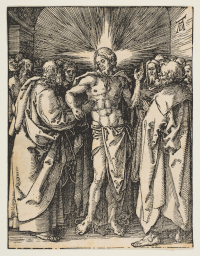
The second Sunday of Easter is known as “Low Sunday.” I find myself with a bit of liturgical whiplash this morning as we celebrate our “High Church” service with the readings from “Low Sunday.” I thought about asking the experts at Nashotah House if this was okay, but I imagine they’d just respond “What’s a low Sunday”? No one knows quite why the second Sunday of Easter is called “Low Sunday,” although it is speculated that “Low Sunday” contrasts with the “High Sunday” of Easter itself. It is not called “Low Sunday” because of the low attendance in church the Sunday after Easter, although perhaps it should be. The Sunday is also known as “Thomas Sunday” because of the Gospel reading for the Second Sunday of Easter, which is the selection we heard this morning, the story of Jesus’ resurrection appearance to Thomas the apostle.
Poor Thomas has received a bit of a bad rap because of this familiar story. He is known as “Doubting Thomas,” although no one uses names like “Denying Peter” or “Overly Ambitious James and John.” Despite his bad nickname, there are sermons that turn Thomas into a kind of apology for our own questionings. “Do you sometimes have doubts about whether this Christianity thing is true or not? That’s okay. Jesus’ disciple Thomas had doubts too.”
I once heard a sermon on Easter Sunday (not Low Sunday) where the Episcopal priest reassured those of us who were attending: “If you’re here this morning, and you’re not sure whether you really believe in the Easter stories, don’t worry. Modern biblical scholars assure us that we do not really have to believe that Jesus rose bodily from the dead.” So that was the good news of Easter. We don’t have to believe that Jesus rose from the dead after all. That was the last Sunday I attended that church.
I am going to focus on the Gospel story for my sermon this morning, but I want to claim that it is a misreading of the story to assume that the story is a story about Thomas’s doubt or even about Thomas at all. First, the name “Doubting Thomas” is misleading because the English translations are misleading. In the NIV translation, Jesus says to Thomas “Stop doubting and believe” (John 20:27). The NRSV reads “Do not doubt but believe.” However, there is no Greek word for “doubt” in the text. The actual contrast is not between doubt and believing, but between believing and not believing. The ESV translation actually gets this right. When Jesus appears to Thomas, he does not say to him “Do not doubt,” but “Do not disbelieve, but believe.”
In addition, Thomas’s position is not all that different from the other disciples. In each case, the movement of the appearances is from not believing to seeing to believing. When Jesus appears to Mary Magdalene, she does not recognize him at first, but thinks he is the gardener. It is only after he speaks to her that she recognizes him. She then goes to the disciples and announces “I have seen the Lord” (John 20:11-18).
On the first day of the week, that is Easter Sunday, the disciples are hiding out of fear. Jesus appears to them, and we are told “Then the disciples were glad when they saw the Lord” (John 20:20). The single almost exception to the pattern is the Beloved Disciple, who outraces Peter to the tomb and sees the empty tomb and the linen clothes but no Jesus, and we are told that “he saw and believed.” But immediately afterward, we read “as yet they did not understand the Scripture, that he must rise from the dead” (John 20:1-9).
Because Thomas was not with the other disciples on that Easter Sunday morning when Jesus appeared to them, the disciples say to Thomas, “We have seen the Lord.” Thomas then responds “Unless I see in his hands the mark of the nails, and place my finger into the mark of the nails, and place my hand into his side, I will never believe” (John 20:25). So it is a bit unfair to Thomas to mark him out as a special case because he demands to see before he can believe. Neither the other disciples nor Mary Magalene believed before they actually saw Jesus.
I would suggest that the passage is not actually about Thomas’s doubt, but first about Jesus, and second about faith or lack of faith in Jesus. In each case, the disciples of Jesus have had their previous faith shaken by Jesus’ crucifixion. Each story begins from a place of shattered faith. The risen Jesus appears to Mary Magdalene, to the disciples on Easter morning, and finally to Thomas. In each case, Jesus meets the disciples where they are, and gives them the visible signs that they need to recover their lost faith. Jesus appears to Mary and speaks her name. Jesus appears to the disciples in the upper room, and he shows them his hands and side.
Thomas is not someone who lacked faith in Jesus, but someone whose faith has been shattered by reality. In John 11, when Jesus announces that he is going to Jerusalem to visit the tomb of his friend Lazarus whom he heard has died, Thomas is the one who says to the other disciples “Let us also go, that we may die with him” (John 11:16). When the risen Jesus appears to Thomas, Jesus counters Thomas’s lack of faith by offering to him his pierced hands and side, much as he had done when he appeared to the other disciples a week earlier.
In each case, seeing comes first and leads to believing. But the conclusion of the passage provides the clue to the meaning of the entire series of appearances. Jesus says to Thomas, “Have you believed because you have seen me? Blessed are those who have not seen and yet have believed” (John 20:29). Finally, John makes clear that those who believe without seeing includes those of us who were not present with Mary in the garden or the disciples in the upper room or Thomas, and so, unlike them, we have not seen: “Now Jesus did many other signs in the presence of the disciples, which are not written in this book; but these are written so that you may believe that Jesus is the Christ, the Son of God, and that by believing you may have life in his name” (verses 30-31).
If Mary and the disciples and Thomas believed only because they first saw, how can we who live two thousand years later be expected to believe in that which we have not seen? This theme of the connection between faith and lack of faith, of seeing and not seeing is a key theme in John’s Gospel, and it provides a clue as to how to understand the entire Gospel. In the end, John’s Gospel is about how we who have not seen can believe. And the answer is not found as I heard in that sermon so long ago by assuring ourselves that none of these things really happened.
At the end of our Gospel passage, John refers to the “signs” that Jesus did. Signs are something visible that point to something else. What is it that the signs point to? First, the signs point to the God who is the Creator of the world, but because this God is the Creator and not one of the created things he has made, all of our searching among created things will not find him. John writes in chapter 1, verse 18, “No one has ever seen God.”
How can we have faith in an invisible God who cannot be seen? John’s solution to this very real conundrum is a paradox. The invisible Creator God who cannot be seen can nonetheless be seen because he has become visible by himself becoming a human being as the man Jesus Christ. The second half of verse 18 makes clear that the incarnate Son is the one who has made the invisible God known: “No one has ever seen God; the only God (or in some manuscripts the only Son) who is in the bosom of the Father, has made him known” (John 1:18).
John’s first chapter speaks of the Word who was with God and through whom God created all things. Because this Word came to live among us for a period of time in the first century, human beings have visible access to the invisible God. In verse 14, we read “And the Word became flesh and dwelt among us, and we have seen his glory, glory as of the only Son from the Father, full of grace and truth” (John 1:14).
The rest of the chapter is full of language of light and darkness, of seeing and not seeing, of believing and not believing. The Gospel identifies this Word with life, light, and with truth. John writes “In him was life, and the life was the light of men. The light shines in the darkness, and the darkness has not overcome it. . . . The true light, which gives light to everyone, was coming into the world. . . . [T]o all who did receive him, who believed in his name, he gave the right to become children of God” (John 1:4-5, 9, 12).
Language of light and seeing appear throughout the chapter. We are told that John the Baptist was not the light, but came to bear witness to the light (John 1:7). At the end of the chapter John states that because he saw the Spirit descend on Jesus “I have seen and have borne witness that this is the Son of God” (John 1:34). When two of John the Baptist’s disciples and later Simon Peter inquire about Jesus, the response is “Come and see” (John 1:39, 46). When Nathaniel identifies Jesus as the Son of God and the king of Israel, Jesus replies “Because I said to you, ‘I saw you under the fig tree,’ do you believe? You will see greater things than these” (John 1:50).
A couple of conversations that take place during John’s version of Jesus’ Last Supper discourse make clear that knowledge of the invisible God comes to us through knowledge of the visible Jesus. Jesus tells his disciples that he goes to prepare a way for them – to which the same Thomas from our Gospel reading asks: “Lord, we do not know where you are going. How can we know the way?” Jesus replies to Thomas: “I am the way, and the truth, and the life. No one comes to the Father except through me. If you had known me, you would have known my Father also. From now on you do know him and have seen him” (John 14:4-7).
Philip is not happy with this answer. He still wants to see the invisible Father: “Lord, show us the Father, and it is enough for us.” To which Jesus essentially responds, “Guys, you have not been paying attention!” Jesus corrects Philip. “Have I been with you so long, and you still do not know me, Philip? Whoever has seen me has seen the Father” (John 14: 8-9).
The high point of John’s Gospel comes at that moment in this morning’s Gospel reading when Thomas in his confession of Jesus as “Lord” reaches the conclusion that the Gospel has made from the beginning, that the visible Jesus is the invisible Creator God who has come among us. Thomas becomes the first of all the disciples to recognize the significance of Jesus’ identity when he proclaims of Jesus: “My Lord and my God” (John 20:28).
The theme of faith is a constant theme throughout John’s Gospel, but as in the story of Jesus’ appearance to Thomas, faith is always contrasted with lack of faith. We see this in John 3:16, the most famous passage in John’s Gospel. The passage begins “For God so loved the world, that he gave his only Son, that whoever believes in him should not perish but have eternal life. For God did not send his Son into the world to condemn the world, but in order that the world might be saved through him.” That’s the Good News of the Gospel with which we are so familiar, but the passage goes on: “Whoever believes in him is not condemned, but whoever does not believe is condemned already, because he has not believed in the name of the only Son of God” (John 3:18).
John’s Gospel is made up of a series of conflicts between faith and lack of faith. Throughout the Gospel, Jesus gives himself to various groups of people. Jesus performs what John calls “signs,” the purpose of which we saw at the conclusion of our Gospel reading this morning is to bring people to faith. These signs are seen by all those to whom Jesus is present, but some respond with faith and some respond with unbelief. In John 12:37, we read, “Though he had done so many signs before them, they still did not believe in him.”
Although all the signs point to Jesus, and Jesus points to the Father, many do not recognize the signs for what they are. How is this possible? It is possible because one can see the signs and miss the object to which they point. John’s Gospel includes several examples of people who see the signs but do not see the One to which the signs point. In each case, those who do not see are blinded by something else that it would seem they prefer to see, and this prevents them from the seeing that leads to believing.
Pontius Pilate, for example, is a cynic who sees through everything but actually sees nothing. When Jesus says to Pilate “For this purpose I was born and for this purpose I have come into the world—to bear witness to the truth. Everyone who is of the truth listens to my voice,” Pilate replies “What is truth?” (John 18:37-38).
Then there are the religious leaders whose primary concern is the maintenance of their own tradition, of their own power and keeping control of things lest they get out of hand. The leaders see the signs but they do not recognize the One to whom the signs point because they think they already know all they need to know about God. Jesus restores the sight of a blind man in order, as he says, that the works of God might be displayed in him. The theme of seeing and not seeing, of believing and not believing, appears throughout the story. Jesus summarizes the point of his giving sight to one who had never seen: “For judgment I have come into this world, so that the blind will see and those who see will become blind.” When the Pharisees ask “Are we blind too?,” Jesus replies “If you were blind, you would not be guilty of sin; but now that you claim you can see, your guilt remains” (John 9:39-41).
There are also the self-serving, those who see the signs, but do not commit in faith to the One to whom the signs point. John writes at the end of chapter two: “Now when he was in Jerusalem, at the Passover feast, many believed in his name when they saw the signs he was doing. But Jesus on his own part did not entrust himself to them, because he knew all people, and needed no one to bear witness about man, for he himself knew what was in man” (John 2:23-25).
The crowds follow Jesus for the miracles. After the miracle of the feeding of the five thousand, Jesus tells the crowds “You are looking for me, not because you saw the signs I performed but because you ate the loaves and had your fill” (John 6:26). When the crowd asks Jesus to give them bread from heaven, he replies “I am the bread of life. Whoever comes to me will never go hungry, and whoever believes in me will never be thirsty” (v. 35). After Jesus tells the crowd “Very truly I tell you, unless you eat the flesh of the Son of Man and drink his blood, you have no life in you” (v. 53), we are told “From this time many of his disciples turned back and no longer followed him” (v. 66).
We have seen in the Gospel reading this morning a pattern of movement from seeing to believing. At the end of the Gospel reading, we find a paradoxical statement: “Blessed are those who have not seen and yet have believed. Now Jesus did many other signs in the presence of the disciples, which are not written in this book; but these are written so that you may believe that Jesus is the Christ, the Son of God, and that by believing you may have life in his name” (John 20:29-31). If the pattern for these original disciples of Jesus is a pattern that moves from seeing to believing, the pattern for us is reversed, from believing to seeing. This would certainly seem to put us at a distinct advantage. How can John’s Gospel move us from not seeing to believing?
I would point to two distinct advantages that we have over those initial disciples. First, we have the whole story, including both the story of Jesus’ crucifixion and resurrection. In John’s Gospel, the invisible God is made visible in Jesus Christ in three ways, as life and as love, but also in the cross. The theme of life is evident in Jesus’ healings and miracles – the signs that appear throughout John’s Gospel. The theme of love is apparent in Jesus reaching out to those who would not be considered worthy of love – a paralyzed man who is made to walk at the pool of Bethseda (John 5:2-8), the healing of the son of a foreign Gentile centurion (4:46-54), the healing of the man to whom Jesus gives sight, a man whom people assume is blind either because of his own sins or because of the sins of his parents (ch. 9), a Samaritan woman who was not only a historic enemy of the Jewish people because she was a Samaritan, but also a moral disgrace because she had been married five times (4:1-45). In all of these cases, Jesus showed love to the unlovable. This love is also at the center of Jesus’ teachings. In his last supper discourse, Jesus tells his disciples “I call you no more servants but friends,” and gives them the new commandment to love one another (15:12-15,13:34-35).
Finally, there is the paradoxical manner in which the Gospel says that God’s glory is shown in the cross. In Jesus’ high priestly prayer, he prays “Father, the hour has come; glorify your Son that the Son may glorify you” (John 17:1).
None of these things make any sense to our normal ways of looking at things, and we have already seen that Pontius Pilate, the religious leaders, and the crowds who are interested in bread but not the Bread Giver simply fail to see the one to whom the signs point. For his disciples, Jesus’ crucifixion is not a sign of God’s glory but proof that they have come to the end of the road.
And yet it is Jesus’ resurrection that really does turn the defeat of death on a Roman cross to a sign of God’s glory. Jesus’ appearance to Thomas brings these themes of life, love and the cross together. The wounds in Jesus’ hands and sides point back to his death on the cross, but his resurrection points to Jesus as the life that overcomes death. Death and resurrection are tied together as the expression of God’s love. So bringing the whole story together shows that God is revealed in Jesus as life, light, and love.
Second, it is Jesus’ resurrection that provides the definitive clue to who Jesus is. Jesus is the One through whom the indivisible God has been made visible – the eternal Word of God become flesh. Before the resurrection, there was a kind of ambiguity to Jesus’ signs. The things that Jesus said and did could be puzzling or scandalous. Many deserted Jesus after the feeding of the five thousand. The disciples claimed at the last supper that they do not understand his sayings: “What is this that he says to us, ‘A little while and you will not see me, and again a little while, and you will see me?’ We do not know what he is talking about” (John 16:16-18).
Jesus makes clear that it is only after his resurrection that things will become clear. “I have said these things to you in figures of speech. The hour is coming when I will no longer speak to you in figures of speech but will tell you plainly about the Father” (John 16:25).
It is because of the resurrection that we who live after the disciples have no disadvantage over Jesus’ own disciples because we know the whole story and we know how the story turns out. This means that it is also the case that what distinguishes those who believe now from those who do not believe is not fundamentally different from what distinguished them then.
First, what distinguishes those who have faith from those who do not is a kind of paradoxical difference in moral disposition – recognizing the signs that point to Jesus as the light or rather refusing to come to the light. In John 10, Jesus identifies himself as the Good Shepherd who lays down his life for the sheep: “My sheep hear my voice, and I know them, and they follow me. I give them eternal life, and they will never perish, and no one will snatch them out of my hand” (John 10:27-28). When Jesus’ opponents ask him to say plainly whether he is the Christ, he responds, “I told you, and you do not believe. The works that I do in my Father’s name bear witness about me, but you do not believe because you are not among my sheep” (10:25-26).
We have already seen that Jesus told Pilate “Everyone who is of the truth hears my voice.” And Jesus accused those who did not recognize the point of his healing the blind man that they were self-blinded. Because they claimed “We see,” they were actually blind.
Whether we respond to Jesus with faith or not is then a kind of moral judgment on our response. Those who saw Jesus’ signs had all they needed to recognize in Jesus truth, life, light, and love, but those who did not recognize the signs were looking for something else rather than truth, light, and love. Pilate the cynic did not believe in truth. Jesus’ opponents among the religious leaders thought that they could see although they were actually blind. The crowds wanted Bread but did not recognize the One who was the Bread of Life.
Today as in the time of Jesus’ earthly ministry, faith comes through recognizing God’s presence as truth, light, and love in the character of Jesus. This means that coming to faith is not an intellectual exercise, but neither is it mere fideism. Faith is a gradual opening of the eyes so that we can see what is not immediately obvious but is there to be seen if our eyes are open. Faith in John’s Gospel is progressive, and the man born blind is an example. So is the story of the Samaritan woman. The faith of Mary Magdalene, the Beloved Disciple and Peter, and Thomas are also examples of the gradual progression of faith.
That faith is tied to a moral disposition is not saying that those who have faith in Jesus are morally superior to those who do not. There is rather a combination of what might be called co-naturality and humility. Faith in Jesus is a kind of falling in love. Like the Samaritan woman who had been married five times, those who come to faith in Jesus see in him a moral goodness that they recognize that they themselves lack. Faith in Jesus even includes those like Peter who denied him. Those like the paralyzed man at the pool of Bethsheda or the man born blind who place their faith in Jesus lack any kind of competitive success that they could use to impress him. Those who place their faith in Jesus are not those the world would consider great successes.
But in all these ways those who place their faith in Jesus contrast with the self-sufficient and the morally self-satisfied who are incapable of seeing the one to whom the signs point because in their self-sufficiency, they think that they do not need this man from Galilee.
The purpose of John’s concluding statement about “signs” is then that Thomas’s sign is a sign for those of us who have not actually seen Jesus physically. It is because Jesus was present to the generation of eyewitnesses who saw him – Mary Magdalene, Simon Peter, the other disciples and Thomas, and, finally, the Beloved Disciple whom we know as John who wrote the Gospel – that the signs can be signs for us as well. Although we cannot be immediate disciples of Jesus, nonetheless, we know of Jesus through their witness, and their witness helps us to see through the signs to the incarnate God who reveals in his flesh the God who cannot be seen. This seeing both enables and demands a transformation of vision so that we find ourselves singing in the words of John Newton’s hymn “Once I was lost but now am found, was blind but now I see.”