

Systematic Theology: Chapter Three (Appendix)
Perhaps the most heated point of controversy concerning the Bible in contemporary culture concerns whether we can trust the Bible. In previous generations, even those who never read the Bible commonly referred to it as the “Good Book.” In contemporary culture, more and more people view the Bible as an “evil book” because they view the God of the Bible as an oppressive threat – a bully who is fundamentally opposed to human flourishing. The crucial disagreement concerns the divide between a hermeneutic of continuity and a hermeneutic of discontinuity, and a divide between a hermeneutic of trust and a hermeneutic of suspicion.
The trustworthiness of Scripture has been challenged at all three levels of knowing and being. The Christian story and symbols have been challenged as either incoherent or as hostile to human flourishing. The historical witness of Scripture has been challenged as fundamentally unreliable, as not giving an accurate account of either the history of Israel or of the “historical Jesus.” At the level of ontology, it has been claimed either that the God of the Bible does not exist, or that if some kind of spiritual reality exists, it bears little or no resemblance to the God described in the Old and New Testament Scriptures.
The crucial issue of continuity over against discontinuity concerns whether God is in himself who he has revealed himself to be in the history of revelation. As noted in the previous paragraph, this is often posed in terms of either the historical reliability of the Scripture or their incompatibility with the findings of modern science, or the God whose story is told in the Bible is rejected as a morally repugnant character. I would suggest that two more pressing concerns lie behind the current challenges; first, the loss of transcendence and, second, distinct from, but connected with this, a moral challenge. Third, and related to both of the above is the more recent issue of the loss of faith among a younger generation of primarily “Exvangelicals” labeled “deconstruction.”
Loss of Transcendence
Key to the loss of transcendence in contemporary culture is what Charles Taylor in his book The Secular Age has designated as the “immanent frame,” a constructed social space that frames the lives of contemporary Western people within a natural (rather than supernatural) order. Taylor refers to this social space as a secular “social imaginary” that excludes transcendence. A “social imaginary” is different from an intellectual system in that it is the way that people unreflectively “imagine” or “feel” about their social surroundings. Social imaginaries are expressed more in terms of “stories,” images, and legends rather than in articulated intellectual beliefs. The secular “social imaginary” is thus similar to Thomas Kuhn’s notion of “paradigms,” but in contrast to the theoretical and reflective nature of paradigms, the secular “social imaginary” is rather a “take,” a way of construing the world as without transcendence that the contemporary person brings to experience rather than derives from it.54
Given the assumptions of an a priori secular social imaginary, interpretation of the Bible becomes problematic insofar as the subject matter of the biblical story is from beginning to end an account of the transcendent God who has created and redeemed the world, a God who speaks and acts. Joseph Butler had already recognized the problem in his apology against Deism over two centuries ago. Butler pointed out that “The Old Testament affords us the same historical evidence of the miracles of Moses and of the prophets, as of the common civil history of Moses and the kings of Israel; or, as of the affairs of the Jewish nation. And the Gospels and the Acts afford us the same historical evidence of the miracles of Christ and the Apostles, as of the common matters related in them.” Butler points out that the miraculous accounts are “related in plain unadorned narratives,” and appear to stand on the “same footing of historical evidence.”55
If one approaches the biblical texts with the a priori assumption that rescuing the people of Israel from slavery to form a covenant with them or raising Jesus of Nazareth from the dead is either not the kind of thing that God would do, or that there is no such God who would do these kinds of things, then one must assume that there is an inherent discontinuity between the plain sense of Scripture and the realities to which Scripture refers.
In reference to the Old Testament, biblical scholar Walther Eichrodt noted almost a century ago a tendency of biblical scholars to create a dichotomy between the “spurious factuality” of the biblical account of salvation-history and “historical truth.” On this account, “any genuine historical foundation for a confession of faith in Yahweh, the God of Israel, must be always out of the question.” To the contrary, Eichrodt insisted that central to biblical faith is “God’s sovereignty in the universe and in the history of mankind.” Accordingly, he insisted, “[t]here must be an absolute refusal to surrender a real historical foundation to the faith of Israel.” In the Old Testament, “we are dealing not with an ani-historical transformation of the course of history into a fairy tale or poem, but with an interpretation of real events inspired by contact with the mysterious Creatorhood of the God who controls history, and form continual experience of his saving action.”56
In response to questions raised during the early twentieth century about the historical trustworthiness of the New Testament by the application of historical critical method, Edwin Hoskyns and Edwin Davey wrote in their influential book The Riddle of the New Testament that there is no strand of New Testament teaching in which the life, death and resurrection of Jesus Christ are not interpreted within the context of the Old Testament, and in which Jesus is not portrayed as the Son of God and the Savior of the world who died on the cross for our sins and rose from the dead. Accordingly, the crucial divide between those who accept and those who reject the witness of the New Testament to the person and work of Jesus Christ is not primarily a historical question, but a theological one. Do we accept the universal witness of the New Testament that God has acted uniquely and definitively in the history of Jesus?57
Certainly, it is legitimate to raise questions about the reliability of the biblical narratives of the Old and New Testament as historical accounts, and this has been a major focus of biblical studies since the rise of modern historical method in the nineteenth century. However, in this regard, it is important to acknowledge that the most important issue to be addressed is again a theological and not a historical one. Either we agree with the central affirmation of the Old and New Testament that the transcendent God has created the world, created human beings with the goal of entering into fellowship with them, entered into a covenant with the nation of Israel, has become human as the incarnate Son of God in Jesus Christ, has become present to the church through the presence of the Holy Spirit and that this same God has an eschatological goal for his creation, or we have to assume that the Old and New Testament provide radically distorted accounts of their purported subject matter – the God who has acted and spoken in the history of redemption. That is, that God is not in himself who he is in his purported revelation.
The Moral Challenge
The second grounds for distrust of the Bible is a moral objection. Here again, Taylor points to a fundamental difference between those committed to a “closed” secular imaginary, and those open to transcendence – whether the transcendent is viewed as a threat or an obstacle to human flourishing or as an answer to our deepest need, and the fulfillment of our deepest suspicions. A popular New Atheist book bore the title, God is Not Great,58 but a more accurate description of the book’s critique would be that “God is not good.” Modern secularists raise such traditional concerns as the problem of evil, but perhaps more at the heart of objections is the concern that the God of the Bible is arbitrary – an authoritarian bully who demands unquestioning obedience, who imposes capricious demands, and punishes unjustly those who question such authoritarianism. Moreover, Christians themselves are perceived as moralistic authoritarians who attempt to impose their own beliefs and values on those who do not otherwise embrace them.
In terms of initial response, this moral objection to the content of the Bible seems primarily emotive rather than rational. If the biblical God exists, and that God is the Creator of the universe as the Bible describes God, then such a God would have to be fundamentally Good – even self-identical Goodness – which is the traditional Christian affirmation. A God who was not Good would be incapable of creating a world, but more important, simply could not be God.
Second, a plain sense reading of the biblical texts flies in the face of the “authoritarian” construal of the Biblical God. The Genesis creation narratives describe God as creating a world that is “good,” even “very good.” Human beings are created in God’s image, and given stewardship over creation. One of the most distinctive terms used to describe God throughout the Old Testament is hesed (חֶסֶד) translated most frequently as “loving kindness.”
Central to the Old Testament description of God is the covenant God makes with Israel at Mount Sinai and his giving of the law as a reflection of God’s good character. Fulfilling this law is not a condition to receive God’s favor, but rather a consequence of already having received that favor. God’s giving of the Ten Commandments begins with the prologue: “I am the LORD your God who brought you out of the land of Egypt, out of the house of slavery” (Ex. 20:2, NRSV). There is an essential moral dimension to the Old Testament notion of monotheism, and an association of God’s will and commands with that which is morally good. The notion of “sin” is certainly prominent in the Old Testament, but sin is not simply disobedience of an arbitrary divine will, but is always connected with unrighteousness, with a refusal to love God and neighbor.
For the Old Testament prophets, faith in God is correlated with moral righteousness, particularly justice, mercy, and compassion in Israel’s treatment of those on the fringes of society: the poor, widows and orphans, strangers (sojourners) in the community. The prophet Isaiah in particular condemns temple worship without corresponding justice. Isaiah expands the notion of idolatry to condemn not only the worship of false gods, but more importantly, an idolatry of the self. In worshiping idols, one is in essence worshiping the self, and this self-worship leads inevitably to a pride and love of power that in turn leads to exploitation of the poor by the wealthy. Isaiah (and later prophets) expand biblical eschatology in a universal direction to include not only God’s favor toward the nation of Israel, but to other nations as well. In the end of days, all people will worship the one God.59
The New Testament continues and develops these themes. Corresponding to the Old Testament hesed is the New Testament notion of agapē (ἀγάπη), translated “love” or “charity”: God is love, and those who love abide in God. God is light, and there is no darkness in him (1 John 4:16; 1:5). In the Sermon on the Mount, Jesus tells his hearers that God shows his favor both to the just and the unjust; Jesus famously commands going the extra mile, to not return evil with evil, to forgive without limit those who treat us injustly, and even to love one’s enemies (Matt. 5:28-46).
At the heart of the apostle Paul’s ethics is the notion of “cruciformity” – that in becoming human, the incarnate Jesus Christ became a servant to human beings to the point of death by crucifixion, and that to become a servant of Jesus Christ means to become a fellow servant to one’s fellow human beings (Phil. 2:1-11).60 Also central to New Testament theology is the notion of grace (χάρις, charis) which includes both forgiveness of sin and moral transformation. At the heart of the notion of grace is divine love. We love God and neighbor because God first loved us in Jesus Christ (Rom. 5:8; 1 John 4:19).
Why then the strong visceral reaction to the God of the Bible as somehow morally threatening? Turning again to the three levels of knowing and being, there is the significant modern epistemological shift to the priority of the knowing self designated earlier as “Cartesianism.” Within a secular culture dominated by the “immanent frame,” the Cartesian priority of the self becomes an example of the Feuerbachian critique of Christianity in reverse. An a priori commitment to autonomous individualism cannot help but regard any deity as threatening to the autonomy of the self.
In conjunction with this is an assumption noted already in Joseph Butler’s critique of Deism that modern people assume that they they know “ahead of time” how things should be. This presumption means that we already know the kinds of things that we would do if we were “in charge” of the universe, and thus the kinds of things that we think God should have done in creating a world rather than adopting the a posteriori path of “following after,” of both allowing ourselves to listen to but also to be transformed by the biblical story’s own account of how the Creator God has both created and redeemed a fallen world.61
The a priori presumption can also lead to a misreading of biblical texts as contemporary people assume that we know ahead of time the implications of biblical symbols rather than allowing the narrative contexts of Scripture to provide meaning to the symbols in what could be called “Christological subversion.” For example, if we read the New Testament references to God as “Father” with the presumed assumption that “Father” language endorses patriarchy, we will miss that when Jesus addresses as “Father” the God to whom he claims a unique and special relationship, this is actually a criticism and challenge of first-century honor culture and patriarchy.62
In contrast to the Cartesian presumption that knowledge consists of a transformation and subordination of external reality to the demands of the manipulative self in order to expand one’s personal “freedom” (understood as a voluntarist choice of whatever appeals to one’s desires) is Hilary of Poitier’s dictum: non sermoni res, sed rei sermo subjectus est (reality is not subject to the word, but the word is subject to reality). Knowledge consists of conformity of the knowing self to the known object rather than the Carteisan imposition of the individualist self on the world around us.
This has both an intellectual and a moral dimension. Knowing the truth demands doing the truth: the conformity of the self to reality rather than the conforming of reality to the self. There is in the Bible an alternative understanding of “truth” to both that of the modern world but also that of ancient culture. In the New Testament, the word alēthia (ἀλήθεια), translated in English as “truth,” corresponds to the Hebrew amen (אָמֵן). In the Old Testament, “truth” is not merely a matter of knowledge, but is associated with the Hebrew God: God is Truth. Truth becomes associated with the actions and character of the God who manifests his Truth in the world as a revelation of his mercy and his righteousness. The corresponding moral dimension is that the God who is “True” demands that his people should be like him: “Be holy as I am holy” (Ex. 19:6; 1 Pet. 1: 15-16). Human beings walk in the Way of Truth. Truth is not then merely a matter of “knowing the facts.” Truth is rightness of speech, motive, and action.63
The New Testament picks up on and transforms this notion of Truth in the light of the revelation of God in the life, death, and resurrection of Jesus Christ. The apostle Paul speaks of the “truth as it is in Jesus” (Eph. 4:21). Jesus’ opponents acknowledge of him, “Teacher, we know that you are true” (Mark 12:14, RSV). In John’s Gospel, Jesus states “I am the Way, the Truth, and the Life” (John 14:6). Jesus also says: “My teaching is not mine but his who sent me. Anyone who resolves to do the will of God will know whether the teaching is from God or whether I am speaking on my own. Those who speak on their own seek their own glory, but the one who seeks the glory of him who sent him is true, and there is nothing false in him” (John 7:16-18, NRSV).64
The Old Testament ties truth to a particular history as a quality of the God who has become known in his saving acts in history. In correspondence to God’s saving action, God’s truth is recognized by human beings not only in the sphere of knowledge, but in every area of life. Similarly, in the New Testament, truth is known in the life, death, and resurrection of Jesus, who is the Way, the Truth, and the Life. Jesus is the Truth because God has acted by raising Jesus from the dead. To know the truth means not only that one acknowledges certain “facts” as true, but that one confirms one’s spiritual and moral life to the “truth as it is in Jesus.”
This means that knowledge of truth presupposes divine revelation and divine grace, but also moral and spiritual transformation. Faith is not merely a correspondence between known “facts” and the mind. To return to Melanchthon’s distinction between gospel and law, the good news of the gospel not only precedes law, but grace includes spiritual and moral transformation as well as forgiveness of sin. To read the Scriptures properly is an exercise of faith that presumes and demands sanctification. We cannot know the truth if we do not do the truth. But at the same time, the “truth” is not an arbitrary heteronomous demand that crushes the human spirit. Rather, in the words that Jesus proclaimed, “You will know the truth and the truth will set you free” (John 8:32).
Deconstruction
This leads to the problem of “deconstruction,” the term for a recent movement among former mostly evangelical young people that refers to a process of re-examining and usually abandoning their Christian faith.65 The movement has been compared to a kind of “Great Awakening” in reverse, as thousands of young people who were raised in traditionally evangelical families have abandoned the faith in which they grew up. If the “New Atheism” was a rejection of Christian faith by outsiders, “deconstruction” is a criticism and rejection of Christian faith from within.
A common theme among those deconstructing Christian faith is a story of “spiritual abuse” in the church. The last generation made clear that sexual abuse is a serious problem in the church, first for Roman Catholics, but in recent decades, for Protestants as well. However, there are other kinds of abuse as well, and specifically a kind of spiritual abuse rooted in authoritarian church leadership that responds to what may be legitimate challenges with distrust and silencing rather than with honest engagement.
Insofar as the leadership of these churches identify their own beliefs and theological stances with the Bible, and fail to distinguish between their interpretations of the Bible and the voice of God, what young people hear is that to question abusive or authoritarian church leadership is in essence to question God. This creates a crisis of faith in which young people feel that they must choose between their own moral and intellectual integrity and membership in the church. If church leadership is perceived as abusive, young people also come to perceive the Christian God to whose authority the leadership appeals as an abusive God. In the end, those at the receiving end of spiritual abuse feel that they must make a choice between their own moral and intellectual integrity and not only the voice of the church, but their belief in the Christian God.
Correlated with this response to pastoral abuse is a process of “deconstructing” the Bible. As disillusioned young people reread the Bible, they find themselves noticing problematic texts. In particular, they distrust the God of the Old Testament as an abusive tyrant and a bully. While many still find Jesus attractive in some ways, the apostle Paul in particular is blamed for distorting Jesus’ message and Paul is dismissed as a rather nasty character who hated women and endorsed slavery. So the Bible itself is now read as an abusive text.
A primary irony of the deconstructing faith movement is that the very concerns about abuse of the less by the more powerful are the fruits not of secular but of Christian culture. The deconstructors are echoing not Friedrich Nietzche but St. Paul.66 Deconstruction is not new. The Exodus story in the Pentateuch is the foundation story of the Hebrew people – a rescue of an entire people from oppressive slavery. In the later prophetic literature, Ezekiel calls out religious leaders as poor shepherds who oppress rather than protect their flock, and promises that God will provide a shepherd like David who will properly care for the flock (Ezek. 34). From beginning to end of the book of Jeremiah, the prophet not only criticizes oppressive religious leadership, but himself becomes its victim (Jer. 7, 27-29, 38).
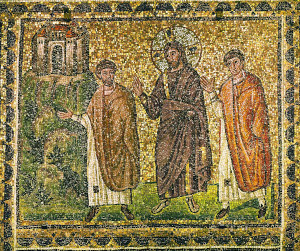
A deconstruction story is at the very heart of the New Testament, and Christianity began as a sort of deconstruction movement. The two disciples who encounter the risen Jesus on the road to Emmaus had their hopes dashed because the Jesus whom they thought was the one to redeem Israel had been put to death when the religious leaders of their own people made an alliance with the Romans, the resident enemies and oppressors of the Jewish people (Luke 24). Whatever else we can say about it, the crucifixion of Jesus is a prime example of clerical abuse.
If the story of Jesus had ended with his crucifixion, something like deconstruction would have been an understandable response for Jesus’ followers. However, deconstruction demands reconstruction if it is not to end up in pessimism or cynicism or despair. Despite Jesus’ repeated predictions, that Jesus rose from the dead was a complete surprise to his disciples, and Jesus’ resurrection undoes the despair that attaches itself to deconstruction. Resurrection is the other side of deconstruction, and so the two disciples of the Emmaus Road were not left in their despair.
Key to how the New Testament addresses deconstruction with reconstruction is that of Jesus’ personal identity. The life and identity of Jesus combined with his resurrection means that the spiritual abuse that leads to deconstruction does not have the final word. In her essay “The Greatest Drama Ever Staged, ” Dorothy L. Sayers points out that overfamiliarity with the Gospel story can lead us to miss the significance of its central claim: “[I]f the Church is right about him . . . . the man we hanged was God Almighty. So that is the outline of the official story – the tale of the time when God was the underdog and got beaten, when he submitted to the conditions he had laid down and became a man like the men he had made, and the men he had made broke him and killed him.”67 In other words, if Jesus of Nazareth really is who the Gospels say he is, the incarnation means that when God became one of us, he allowed himself to be the victim of the bullies. In the crucifixion of Jesus, God took his own medicine, as it were.
The connection between the resurrection of Jesus and the doctrine of the atonement addresses concerns about abuse of authority and power that so often is part of the story of deconstruction. In Karl Barth’s discussion of Jesus as the “Judge Judged in Our Place, ” Barth points out that on the cross of Jesus, Jesus was judged by the religious and political leaders of his day as a criminal and religious subversive, and was found guilty. In judging Jesus, those who crucified him declared him to be in the wrong and to be condemned by God. However, by raising Jesus from the dead, God reversed the guilty verdict by which Jesus had been crucified. In vindicating Jesus, his Father demonstrated that Jesus alone was the one who had the right to pronounce the divine verdict, and the irony is that Jesus’ verdict is the verdict of the Good Shepherd who seeks for the lost sheep, the verdict of “not guilty.”68
The life, death, and resurrection of Jesus reveal a pattern of cruciformity that lies at the heart of the Gospel.69 Jesus’ own ministry models a pattern of life that is expected of his followers as well. Throughout the Gospels, Jesus is the Lord who comes to serve. Jesus heals the sick, he casts out demons, he gathers around him a group of followers that includes fishermen and women. In his teaching, Jesus tells his followers to love their enemies, to emulate a Good Samaritan who became a neighbor to someone in need. When Jesus’ disciples quarrel about which one of them is the greatest, Jesus replies: “You know that among the Gentiles those whom they recognize as their rulers lord it over them, and their great ones are tyrants over them. But it is not so among you; but whoever wishes to become great among you must be your servant, and whoever wishes to be first among you must be slave of all. For the Son of Man came not to be served but to serve, and to give his life a ransom for many” (Mark 10:42-24, NRSV). The personal identity of the crucified and risen Jesus Christ is that of the servant Lord who is not only the Great Deconstructor, but also the Great Reconstuctor. In the incarnation of God in Jesus Christ, Jesus is the Lord who offers us hospitality.
The hospitality that characterized Jesus’ ministry is expected to be found in the church, a community that is supposed to follow Jesus. To the extent that the church fails to follow Jesus, and even abuses those who do try to follow Jesus, those who suffer abuse have a right to complain.
The New Testament itself can be brutally honest about the failures of the church, as we find in the apostle Paul’s letters to the Galatians and the Corinthians. However, the primary word about the church in the New Testament is positive, as seen in Paul’s letter to the Ephesians. The church is a new creation, a new Israel, the body of Christ, the bride of Christ. At the heart of the church’s mission is a sharing in the hospitality of Jesus, a place where Jesus’ followers welcome strangers, a place to listen before speaking, a place to serve before demanding service. Despite its many failures, the church is made up of people who attempt to follow Jesus,who show that by how they love one another and how they act as servants to one another. In the end, one must choose between deconstruction and reconstruction, between self-assertion and being servants to one another, between love and cynicism, between hope and despair, between either causing or fleeing pain or taking up one’s cross to follow Jesus.
What enables us to have hope for the church is, finally, the identity of Jesus Christ as the one who reveals the love of his Father, who emptied himself of his exalted position as the preexistent Lord to become a servant among us who models servitude for us. Jesus died for us and he rose for us, he sometimes meets us in our fellow Christians, and Jesus promises that the gates of hell will not prevail against his church. The church, for all of its present failures, is the Bride of Jesus Christ. The apostle Paul reminds us in Ephesians that Christ loved the church and gave himself up for her to make her holy, that he cleansed the church by washing her with water through the word, and the time will come when Jesus Christ the Bridegroom will present the church his Bride to himself, without stain or wrinkle or any other blemish, but holy and blameless (Eph. 5:25-27).
54 Charles Taylor, A Secular Age (Cambridge, MA: Harvard University Press, 2007); Thomas Kuhn, The Structure of Scientific Revolutions, 2nd. Edition (Chicago: University of Chicago Press, 1970 [1962[).
55 Joseph Butler, Analogy of Religion Natural and Revealed To the Constitution and Course of Nature, Part 2, Ch. 7
56 Eichrodt, OT Theology 1:513, 516.
57 Sir Edwin Hoskyns and Noel Davey, The Riddle of the New Testament (London: Faber & Faber, 1931). For more detailed discussion, see the chapter on Miracles and Providence.
58 Christopher Hitchens, God is Not Great: How Religion Ruins Everything (New York: Hatchette Book Group, [2007], 2009).
59 Kaufman, The Religion of Israel, 385-392.
60 Michael J. Gorman, Cruciformity: Paul’s Narrative Spirituality of the Cross (Grand Rapids: Eerdmans, 2001).
61 Butler points out that in the imaginary world which most people think God should create, the universe would likely be one in which, at the end of the day, everyone had a good time. Yet clearly such a universe does not exist, and imagining how to create a universe in which everyone would always be happy is beyond our capacities. Analogy of Religion, Introduction.
62 David A. DeSilva, Honor, Patronage, Kinship and Purity: Unlocking New Testament Culture (Downers Grove, IL: InterVarsity, 2000).
63 Hoskyns and Davey, Riddle of the New Testament, 38-40.
64 Ibid, 41-43.
65 Sara McCammon, The Exvangelicals: Loving, Living, and Leaving the White Evangelical Church (New York: St. Martin’s Press, 2024).
66 “Any condemnation of Christianity as patriarchal and oppressive derived from a framework of values that was itself utterly Christian.” Tom Holland, Dominion: How the Christian Revolution Remade the World (New York: Basic Books, 2019), 532.
67 Dorothy L. Sayers, “The Greatest Drama Ever Staged,” The Whimsical Christian (New York: Macmillan, 1978), 11-16.
68 Karl Barth, Church Dogmatics Volume IV The Doctrine of Reconciliaton Part One, Trans. G. W. Bromiley and T. F. Torrance (Edinburgh: T & T Clark, 1956, 211-312.
69 Gorman, Cruciformity.