

December 25, 2007

The One Who Is to Come: An Advent Sermon

Filed under: Sermons — William Witt @ 6:04 am

Third Advent 2007
Isaiah 35: 1-10
Psalm 146
Matthew 11: 2-11
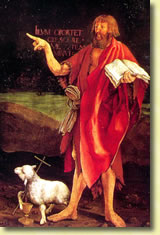
John the Baptist

The gospel passage that we read this morning has caused a great deal of trouble in the history of interpretation. Biblical interpreters from the earliest times to the present have not known quite how to deal with it. It is not that what the text says is hard to understand. That is fairly straightforward. John the Baptist is in prison and he sends some of his disciples to ask Jesus a question: “Are you the one who is to come, or shall we look for another?” The problem is that we already know who John the Baptist is. Phil Harrold did a great job last week of laying out the territory. John has one job. John is the one wearing the camel’s hair bathrobe in all those great Medieval paintings who is pointing to Jesus. That is what John does. He points to Jesus. Now it seems John has forgotten his job description.

The Church Fathers did not know quite what to do with this. John Chrysostom raises all the obvious questions: “He that knew Jesus before His miracles, he that had learned it of the Spirit, he that heard it of the Father, he who had proclaimed him before all; does he now send to learn of him, whether he is himself or not?” Chrysostom points out to John that his reputation is at stake: “If you did not know that Jesus was surely the one,” he asks rhetorically, “how could you have any credibility? If you are going to bear witness to others, you first need to have some credit yourself.” Chrysostom imaginatively grills John: “Didn’t you say that you were not worthy to untie his shoes? Didn’t you say that he sent you to baptize? Didn’t you see the Spirit descend, and hear the voice that said ‘This is my beloved Son?’ Didn’t you leap in the womb when you were a baby?” Chrysostom is having none of this “Are you the one who is to come or should we expect another?” business. (more…)


May 22, 2007

Christological Subversion: A Sermon

Filed under: Sermons — William Witt @ 9:16 am

7th Sunday of Easter, 2007
Ps. 68
Acts 16: 16-34
Rev. 22:12-14,16-17,20
John 17:20-26

This morning’s gospel reading is one of a series of readings from Jesus’ farewell discourse in John’s gospel we have had the last few Sundays that will conclude with the reading for Trinity Sunday. This morning’s reading is actually the conclusion of the discourse in John’s gospel, and has been referred to since the sixteenth century as Christ’s “High Priestly Prayer.” Unfortunately, as the lectionary editors sometimes do, they have rather arbitrarily cut the reading in a way that misses the main point of the chapter, so I’m going to preach as if the reading included the entire chapter. So much the worse for the lectionary editors.

In this chapter, John summarizes three central themes in his gospel, themes that run like a red thread from beginning to end. At the same time, John introduces an interpretive principle when he expounds these themes that I call Christological subversion. This interpretive principle is not unique to John. It appears in numerous places in the New Testament, but John uses it throughout his gospel, and we will largely misunderstand the New Testament if we don’t understand the principle.

(more…)

December 17, 2006

An Advent Sermon

Filed under: Sermons — William Witt @ 8:19 am
ship

Of the three theological virtues—faith, hope and charity—hope is the virtue that most characterizes Advent. Faith is the virtue we might associate in particular with Easter. Faith believes that victory is hidden in the cross that awaits the end of the path of Holy Week; faith believes that God has triumphed over death by bringing the crucified Christ to new life, the resurrection life of Jesus we share in through faith; Charity, or love, we associate easily with Christmas; Christmas is the time when we give gifts to others in honor of the Great Gift God has given to us by sending his Son as a child in a manger; Christmas is the feast of the incarnation, the time when God is literally most human.

Hope, on the other hand, is the neglected middle child of the virtues, neither the heroic virtue of faith that overcomes all doubts, nor the easily sentimentalized virtue of love about which songs are sung that make us feel all warm inside. In the words of John Lennon’s Beatles tune: “All you need is love. Love is all you really need.” So also, Advent is that season with which we often don’t quite know what to do. Advent is sort of latched onto Christmas by default. Advent is the season of Hope because it is the season of anticipation. During Advent, we anticipate the season of Christmas in which God comes among us as the infant in Mary’s arms. But let’s face it. Advent wreaths are nice; they can’t compare to Christmas trees. (more…)

« Newer Posts

Non Sermoni Res — William G. Witt is proudly powered by WordPress