
December 24, 2025

Can We Trust the Bible?

Filed under: Scripture,Theology — William Witt @ 9:43 pm

Systematic Theology: Chapter Three (Appendix)
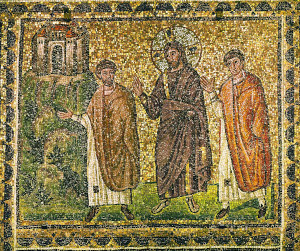
The Road to Emmaus

Perhaps the most heated point of controversy concerning the Bible in contemporary culture concerns whether we can trust the Bible. In previous generations, even those who never read the Bible commonly referred to it as the “Good Book.” In contemporary culture, more and more people view the Bible as an “evil book” because they view the God of the Bible as an oppressive threat – a bully who is fundamentally opposed to human flourishing. The crucial disagreement concerns the divide between a hermeneutic of continuity and a hermeneutic of discontinuity, and a divide between a hermeneutic of trust and a hermeneutic of suspicion.

The trustworthiness of Scripture has been challenged at all three levels of knowing and being. The Christian story and symbols have been challenged as either incoherent or as hostile to human flourishing. The historical witness of Scripture has been challenged as fundamentally unreliable, as not giving an accurate account of either the history of Israel or of the “historical Jesus.” At the level of ontology, it has been claimed either that the God of the Bible does not exist, or that if some kind of spiritual reality exists, it bears little or no resemblance to the God described in the Old and New Testament Scriptures.

The crucial issue of continuity over against discontinuity concerns whether God is in himself who he has revealed himself to be in the history of revelation. As noted in the previous paragraph, this is often posed in terms of either the historical reliability of the Scripture or their incompatibility with the findings of modern science, or the God whose story is told in the Bible is rejected as a morally repugnant character. I would suggest that two more pressing concerns lie behind the current challenges; first, the loss of transcendence and, second, distinct from, but connected with this, a moral challenge. Third, and related to both of the above is the more recent issue of the loss of faith among a younger generation of primarily “Exvangelicals” labeled “deconstruction.”

Loss of Transcendence

Key to the loss of transcendence in contemporary culture is what Charles Taylor in his book The Secular Age has designated as the “immanent frame,” a constructed social space that frames the lives of contemporary Western people within a natural (rather than supernatural) order. Taylor refers to this social space as a secular “social imaginary” that excludes transcendence. A “social imaginary” is different from an intellectual system in that it is the way that people unreflectively “imagine” or “feel” about their social surroundings. Social imaginaries are expressed more in terms of “stories,” images, and legends rather than in articulated intellectual beliefs. The secular “social imaginary” is thus similar to Thomas Kuhn’s notion of “paradigms,” but in contrast to the theoretical and reflective nature of paradigms, the secular “social imaginary” is rather a “take,” a way of construing the world as without transcendence that the contemporary person brings to experience rather than derives from it.54

Given the assumptions of an a priori secular social imaginary, interpretation of the Bible becomes problematic insofar as the subject matter of the biblical story is from beginning to end an account of the transcendent God who has created and redeemed the world, a God who speaks and acts. (more…)

Revelation and Scripture

Filed under: Scripture,Theology — William Witt @ 9:38 pm

Systematic Theology: Chapter Three

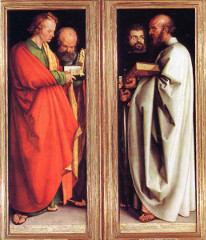
FourApostles

The two previous chapters dealt with the subject matter of theology (what theology is) and the task of theology (what theologians do). This chapter and the next deal with the sources of theology. Traditionally, these are Scripture (sola scriptura; Reformation Protestant), Scripture and tradition (Council of Trent; Roman Catholic), Scripture, tradition, and reason (Anglican; Richard Hooker), Scripture, tradition, reason, and experience (Methodism; the Wesleyan Quadrilateral; liberal Protestantism).

In terms of the three levels of knowing and being (ordo cognoscendi and ordo essendi), these sources of theology belong to the first level, the order of knowledge. Scripture, tradition, reason, and experience provide the sources and context within which Christians come to know what Christian faith is, and what it means to live as Christians. At the same time, it is important to distinguish between the first source – Scripture – and the other three sources in that historically Scripture has provided the primary source of the knowledge of Christian faith while reason, tradition, and experience are not in themselves independent sources of knowledge of Christian faith, but rather provide the ecclesial context in which Christians come to know and interpret Scripture.

Historically, tradition is not a separate and distinct source of knowledge of God, but the context in which Christian faith takes place. Patristic theologians like Irenaeus were expositors of Scripture, and the second century Rule of Faith is both a summary of the content of Scripture and a hermeneutical guide for interpreting Scripture. For theologians like Anglican Richard Hooker, reason was not a separate source for knowledge of God, but a hermeneutical tool to use in interpreting Scripture. For founder of Methodism John Wesley, experience did not provide additional knowledge about God, but was rather an ecclesial context in which the church appropriates the truth of Scripture.

At the same time, Reformation Protestants did not understood sola scriptura to mean that the church reads Scripture in an interpretive vacuum (nuda scriptura, “biblicism”). Protestants continued to recite the Creeds and to endorse the theological teaching of the ecumenical councils because they understood them to be summaries of and interpretive guides to the clear meaning of Scripture. Affirming sola scriptura did not prevent historic Protestants from endorsing confessional statements such as the Lutheran Augsburg Confession, the Reformed Westminster Confession, the Anglican Thirty-nine Articles or reading Scripture through interpretive guides such as the Lutheran Book of Concord or confessional catechisms.

In terms of the threefold level of knowing and being, Scripture has a unique role because of its place in the threefold structure. Although contemporary Christians read Scripture as the primary source of Christian knowledge and spiritual and moral formation (level 1), Scripture’s origins lie in the second level of the order of knowing and being – the level of history (level 2). The Bible is not a single “book,” but the collected writings of prophets and apostles who bear witness to the economy of salvation – the revelation of God as Father, Son, and Holy Spirit in the history of Israel, the incarnate Jesus Christ, and the New Testament church. As noted in the two previous chapters, this history of the economic Trinity (level 2) points beyond itself to the ontological reality of God’s nature in itself (the immanent Trinity, level 3). Our knowledge of God as Trinity thus follows from our knowledge of God in the history of salvation, and our contemporary appropriation of this knowledge in prayer, worship, and Christian ethics is dependent on this historical source of the Scriptures of the Old and New Testaments.

(more…)

December 13, 2025

The Discipline of Theology: What Theologians Do

Filed under: Methodology,Theology — William Witt @ 12:38 am

Systematic Theology: Chapter Two

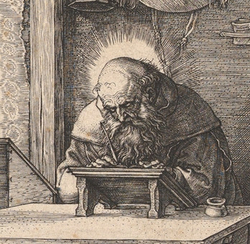
Durer Jerome in his Study

The previous chapter discussed the subject matter of theology: what theology is. This chapter deals with the discipline of theology: the work that theologians do. The study of theology has a number of names: “Christian doctrine” is the most general term. Doctrine can reflect the position of a particular theologian, church, or denominational group, or an account of one particular aspect of theology, for example, Thomas Aquinas’s or Karl Barth’s “doctrine of the Trinity” or the Reformed doctrine of Presbyterian polity or the Roman Catholic doctrine of the papacy.

“Dogmatics” refers to “authorized church teaching,” and is usually distinguished from doctrine by its universality and normativity. For example, while the universal church has never officially endorsed a specific interpretation of the atonement – there is no universally agreed doctrine of the atonement, but rather there are numerous theologians’ doctrines of the atonement – there is a universally acknowledged understanding of the doctrines of the Trinity and Christology, approved at the Councils of Nicea, Ephesus, and Chalcedon. We thus refer to the “dogmas” of the Trinity and Christology. Thus, all dogmas are doctrines, but not all doctrines are dogmas.

Finally, systematic theology is concerned generally with Christian claims about reality, especially the scope, unity and coherence of Christian teaching: “Systematic theology attempts a conceptual articulation of Christian claims about God and everything else in relation to God, characterized by comprehensiveness and coherence.”1 On the one hand, systematic theology is more comprehensive than “doctrine” because of the universality of its scope. On the other hand, systematic theology does not claim the definitiveness of dogma because it deals with every aspect of theology, not simply those central theological doctrines over which there is substantial agreement among the majority of Christians. Systematic theology is also the work of individual theologians, or reflects the theological commitments of specific ecclesial traditions.

Historical Development of Theology

John Webster points out that “Conceptual reconstruction of Christian teaching is a post-apostolic enterprise. . .” Early Christian writers did not distinguish between exegetical, doctrinal, moral, and pastoral theology.2 For example, Irenaeus’s Against Heresies is an apologetic work written against Gnostic heretics that also includes as part of the discussion throughout the five books fairly comprehensive discussion of Christian doctrines of the triune God, of creation, fall, and redemption. Augustine’s Confessions is a spiritual autobiography that also addresses numerous theological topics, for example, the doctrine of creation and the nature of evil. Much patristic theology is found in the form of sermons, whose primary purpose is the exposition of Scripture within the context of Christian worship.

The following factors led to the development of Christian theology:

(more…)

December 11, 2025

Introduction: What is Systematic Theology?

Filed under: Theology — William Witt @ 3:00 am

Systematic Theology: Chapter One

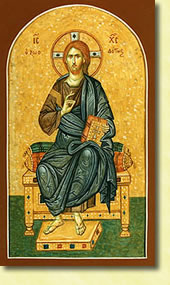
Christ Enthroned

Theology as Faith Seeking Understanding

The word “theology” is derived from the combination of two Greek words: θεός (theos) + λόγος (logos), meaning the “study of God.” In its broadest sense, systematic theology is that branch of Christian theology that has to do with systematic and organized reflection on the subject matter of Christian faith. Augustine of Hippo is known for the saying “Crede ut intelligas” (“Believe that you may understand”).1 Anselm of Canterbury modified this as “Credo ut intelligam” (“I believe in order to understand”), and Anselm’s motto fides quaerens intellectum (“faith seeking understanding”) is a helpful definition of theology.2 Thomas Aquinas identified Sacra Doctrina (Holy Teaching or Sacred Doctrine) as the “science of God” and of all other things insofar as they have reference to God. Sacra Doctrina is the “highest wisdom” because it deals with the Highest Cause insofar as God (meaning the triune God) has made himself known in revelation.3 John Calvin wrote in his Institutes of the Christian Religion that theology had to do with the knowledge of God and of ourselves that leads to immortality.4

More recently, Thomas Oden writes that the subject matter of theology is the “Living God,” YHWH, “known in the faith of the worshiping Christian community” which lives out of Jesus Christ’s resurrection, and of all things as they relate to God. God is a personal Subject, a You or Thou, not an it. Theology is the “investigation and clarification of the internal consistency of [the church’s confessional] assertions . . . and the way they relate to the problems of daily life.”5

Karl Barth adds that the task of theology is in the service of the church. Theology exists in “the realm between the Scriptures and their exposition and proclamation.” Theology “is based upon the fact that God has spoken to humanity and that humanity may hear God’s word through grace.” Theology reminds the church that its life and work are “under the authority of the gospel and the law, that God should be heard.”6

The language of the previous paragraphs helps to unravel the meaning of theology. First, faith: In Greek, the single word πιστεύω (pisteuō)) can be translated either “I believe” or “I have faith,” and the corresponding noun πίστις (pistis) can be translated as either “belief” or “faith.” This ambiguity explains the contradiction that is not really a contradiction between the apostle Paul in his letters to the Romans and the Galatians and the epistle of James concerning justification by faith. Paul states in Romans 3:28 “that a human being is justified by faith apart from the works of the law (δικαιοῦσθαι πίστει ἄνθρωπον χωρὶς ἔργων νόμου, dikaiousthai pistei anthrōpon chōris ergōn nomou),” while James writes that “a human being is justified by works and not by faith alone” (ἐξ ἔργων δικαιοῦται ἄνθρωπος καὶ οὐκ ἐκ πίστεως μόνον, ex ergōn dikaioutai anthrōpos kai ouk ek pisteōs monon, James 2:24).

That the contradiction is only verbal becomes clear in James 2:19 when James writes: “You believe (πιστεύεις, pisteueis) that God is one; you do well. Even the demons believe (πιστεύουσιν, pisteuousin)—and shudder.” As the English translation makes clear, James is understanding “faith” in the sense of an intellectual conviction: the demons believe that God exists. To the contrary, the apostle Paul uses the word “faith” in the sense of “trust,” not mere intellectual conviction. The demons may believe that there is a God, but they have not placed their complete trust and reliance on him in the manner in which Paul talks about justification by faith. In English, we mark the same distinction as one between “belief that” and “belief in.”

Latin distinguishes between fides qua and fides quae. Fides qua means “the faith which believes.” It refers to the subjective activity of “believing in” or “having faith.” This is the faith that justifies by trusting in Jesus Christ alone for salvation. Fides quae means “the faith which is believed.” This is the objective reality in which we place our faith. When the presiding minister says at the celebration of the Eucharist, “Let us confess our faith in the words of the Nicene Creed,” he or she is referring to faith in the sense of fides quae. The Apostles’ and Nicene Creeds are summaries of this subject matter of the Christian faith: “God the Father Almighty, Maker of heaven and earth,” “one Lord Jesus Christ, the only Son of God,” “the Holy Spirit, the Lord and giver of Life.” Father, Son, and Holy Spirit – these are the three triune persons who simply are the one God. This triune God is the objective reality in whom Christians place their faith, and the Creeds provide a short outline of who this God is, and what this God has done. Theology thus includes both fides qua and fides quae. “Faith seeking understanding” is the process by which those who have faith in the subjective sense (fides qua) come to understand and reflect about the object (or subject matter) of that faith (fides quae), that triune reality in which faith puts its trust.

What Faith Is Not

A description of theology as “faith seeking understanding,” helps to clear up some all too prevalent misunderstandings of the nature of both theology and faith. First, faith is not “fideism,” the common misconception that “faith” means implausible belief divorced from reason, that faith is mere credulity, or, in the words of the White Queen in Alice Through the Looking Glass, believing in “impossible things.”7

(more…)

Non Sermoni Res — William G. Witt is proudly powered by WordPress