
 Before I begin I want to thank the graduating seniors for asking me to speak to them at what would normally be baccalaureate but because of the dedication of the Trophimus Center has been shifted to Wednesday chapel. Since I am retiring, this is a sermon to mark not only your own graduation from Trinity, but also in some sense mine. It has been a great honor to teach and to get to know hundreds of seminary students in these last eighteen years. It has been my great pleasure to get to know those of you who are graduating as well as those of you who will not graduate this year, but will be here awhile longer. I will miss you.
I also want to express my appreciation to my fellow faculty and to the staff. One of the wonderful things about teaching at Trinity has been the people who have dedicated themselves to what we do here. I especially want to express my appreciation to Don Collett, who arrived the same year I did, and to my fellow author Joel Scandrett for his collaboration on our book on the atonement. I just wish more people would buy it.
Two of the faculty, my dear friends the Rev. Drs. Martha Giltinan and Rod Whitacre, have now joined the celestial choir, where Rod no doubt plays ukelele, and Martha sings. By now I assume that they have resolved their disagreements about women’s ordination. Bishop Grant LeMarquand who was here when I arrived, and Dr. David Yeago, our first Lutheran theologian, have recently retired. Three of my dearest friends the Rev. Dr. Leander Harding, the Rev. Dr. Wes Hill, and the Rev. Tina Lockett are now serving the church elsewhere.
I also want to thank those who to me will always be the new faculty, Jack Gabig, David Ney, Brad Roderick, and Jacob Rodriguez. I cannot forget our Lutheran friends David Luy and Alex Pierce or our Presbyterian Rich Herbster. And of course, without our librarian Susanah Wilson, neither of my two books would have been written.
I have known four Dean Presidents and numerous Board Members, and there would be no seminary without them, so thank you to Dean Presidents and the Board. But the heart of seminary life is the faculty, the staff, and the students, and they are the ones I will remember with the greatest joy. Thomas Aquinas famously reinterpreted the virtue of charity as friendship, friendship with God and friendship with our fellow Christians. I am immensely grateful for the friends I have found at Trinity.
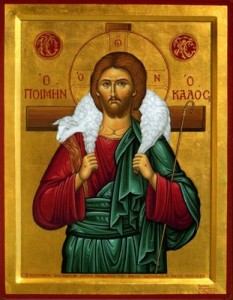
I am a layperson, which means that I am a sheep, not a shepherd. In what follows, I’d like to give some advice to those of you who as shepherds are about to be turned loose on the flock. The Anglican Divine George Herbert In The Country Parson defines your future role this way: “A Pastor is the Deputy of Christ for the reducing of Man to the Obedience of God.” Herbert goes on to say that, after Christ’s resurrection and ascension, “Christ being not to continue on earth, but after he had fulfilled the work of Reconciliation, to be received up into heaven, he constituted Deputies in his place, and these are Priests.” In typical Anglican fashion, Herbert gives us the titles of both “pastor” and “priest.” What is important for Herbert is not the title, whether “pastor” or “priest,” but what he means when he says that a pastor is a “deputy” of Christ.
Another way of saying that a pastor is a “deputy of Christ” is to compare the pastor to an icon of Christ. I preached an earlier version of this sermon at an ordination when I first came to Trinity, which was published in The Living Church. That sermon later led to my publishing a book about ordination. In both cases, it was the publishers who chose to give the sermon and the book the title Icons of Christ.