
July 6, 2025

Believing Thomas: A Sermon

Filed under: Sermons — William Witt @ 7:19 pm

I gave the following sermon in chapel the Wednesday following the Second Sunday of Easter, where the Gospel reading is always the story of Jesus’ appearing to the apostle Thomas in John’s Gospel. Trinity Seminary also annually celebrates a “high church” service, with incense, bells, and chanting. Since Trinity is an “evangelical” seminary, some students would not be familiar with this kind of worship, usually associated with Anglo-Catholicism. I confess that I have spent my entire adult life since becoming Episcopalian/Anglican worshiping in “high church” congregations. I would identify as “Evangelical Catholic” or “Catholic Evangelical” rather than Anglo-Catholic.

John 20:19-31
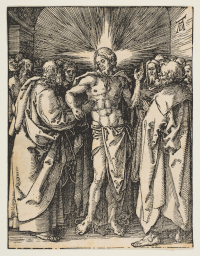
Durer Thomas

The second Sunday of Easter is known as “Low Sunday.” I find myself with a bit of liturgical whiplash this morning as we celebrate our “High Church” service with the readings from “Low Sunday.” I thought about asking the experts at Nashotah House if this was okay, but I imagine they’d just respond “What’s a low Sunday”? No one knows quite why the second Sunday of Easter is called “Low Sunday,” although it is speculated that “Low Sunday” contrasts with the “High Sunday” of Easter itself. It is not called “Low Sunday” because of the low attendance in church the Sunday after Easter, although perhaps it should be. The Sunday is also known as “Thomas Sunday” because of the Gospel reading for the Second Sunday of Easter, which is the selection we heard this morning, the story of Jesus’ resurrection appearance to Thomas the apostle.

Poor Thomas has received a bit of a bad rap because of this familiar story. He is known as “Doubting Thomas,” although no one uses names like “Denying Peter” or “Overly Ambitious James and John.” Despite his bad nickname, there are sermons that turn Thomas into a kind of apology for our own questionings. “Do you sometimes have doubts about whether this Christianity thing is true or not? That’s okay. Jesus’ disciple Thomas had doubts too.”

I once heard a sermon on Easter Sunday (not Low Sunday) where the Episcopal priest reassured those of us who were attending: “If you’re here this morning, and you’re not sure whether you really believe in the Easter stories, don’t worry. Modern biblical scholars assure us that we do not really have to believe that Jesus rose bodily from the dead.” So that was the good news of Easter. We don’t have to believe that Jesus rose from the dead after all. That was the last Sunday I attended that church.

I am going to focus on the Gospel story for my sermon this morning, but I want to claim that it is a misreading of the story to assume that the story is a story about Thomas’s doubt or even about Thomas at all. First, the name “Doubting Thomas” is misleading because the English translations are misleading. In the NIV translation, Jesus says to Thomas “Stop doubting and believe” (John 20:27). The NRSV reads “Do not doubt but believe.” However, there is no Greek word for “doubt” in the text. The actual contrast is not between doubt and believing, but between believing and not believing. The ESV translation actually gets this right. When Jesus appears to Thomas, he does not say to him “Do not doubt,” but “Do not disbelieve, but believe.”

In addition, Thomas’s position is not all that different from the other disciples. In each case, the movement of the appearances is from not believing to seeing to believing. When Jesus appears to Mary Magdalene, she does not recognize him at first, but thinks he is the gardener. It is only after he speaks to her that she recognizes him. She then goes to the disciples and announces “I have seen the Lord” (John 20:11-18).

(more…)

July 4, 2025

Sermon the Feast Day of George Herbert

Filed under: Anglicanism,Sermons,Spiritualty — William Witt @ 12:36 am

Preached on February 27, 2025

George Herbert

I

t is my normal policy when I preach to focus on the lectionary readings. I am going to make an exception today because this is the Feast Day for George Herbert, and I want to say a few things about Herbert. As a theologian, my favorite Anglican authors are from the period in which the Church of England began to settle into its identity following the English Reformation and the Elizabethan Settlement: Richard Hooker and his Laws of Ecclesastical Polity and the period of the Caroline Divines following Hooker: John Donne, Lancelot Andrewes, Thomas Traherne, and, of course, George Herbert. I have more than once used the period of Lent to read through some of John Donne’s sermons or Herbert’s poetry. As Lent begins, I might encourage you to spend some time doing the same.

Who was George Herbert? Herbert was an Anglican priest who was born in 1593 and died of tuberculosis in 1633 at the age of only thirty-nine. He is an example of how to live a meaningful Christian life in the midst of troubled times. Herbert spent his early years trying to pursue a career in politics, and he even served in Parliament for a time. However, with the death of King James, Herbert became disillusioned with politics, and he abandoned the world of public influence to serve in a small village church. Herbert spent the last three years of his life as the rector in the rural parish of St. Andrews, Bemerton, and it is these three years Herbert spent as a priest for which he is remembered four hundred years later. Izaak Walton summarized his life: “Thus he lived and thus he died like a saint, unspotted of the world, full of alms’ deeds, full of humility, and the examples of a virtuous life.”

If I were to summarize the chief characteristic of these Anglican writers known as the Caroline Divines, I would say that they brought together a combination of theology and spirituality. Herbert left us two writings: a guide for priests entitled The Country Parson, and a collection of poems titled The Temple. In a short sermon, I cannot do more than give you a brief introduction to the theology and spirituality of George Herbert, but I will mention what I will call four pillars of the spiritual life according to George Herbert.

The first two pillars are a combination of word and sacrament in contrast to a spirituality that centers only on Scripture – the Word without the sacrament – or only on worship – the sacrament without the Word. One of the characteristics of Anglican spirituality of this period was that it was a way of prayer and worship that was informed by two books – first, the English Bible that appeared as the Great Bible of Henry VIII 1539 and later the Authorized Version of King James translated under the leadership of Lancelot Andrewes published in 1611, and, second, the third Elizabethan edition of the Book of Common Prayer of 1559.

This two-book spirituality is found throughout Herbert’s prose and poetry. First, the Bible. Herbert writes in The Country Parson that the chief source of the pastor’s knowledge is the “book of books, the storehouse and magazine of life and comfort, the Holy Scriptures. There he sucks and lives” (The Country Parson, 4). The lights of Scripture shine not only individually, but form constellations of the one Christian story. In Herbert’s poem, “The Holy Scriptures,” he writes:

Oh that I knew how all thy lights combine,
And the configurations of their glory!
Seeing not only how each verse doth shine,
But all their constellations of the story (“The Holy Scriptures II”).

(more…)

Non Sermoni Res — William G. Witt is proudly powered by WordPress